
LGDM: Unmasking the Puppeteers of Tourism Social Networks
Detecting Suspicious Social Astroturfing Groups in Tourism Social Networks
This paper introduces the Latent Group Detective Model (LGDM), an unsupervised probabilistic framework based on Latent Dirichlet Allocation (LDA) designed to identify coordinated "astroturfing" groups in tourism social networks. By modeling the generative relationships between reviewers, products, and latent group assignments, the authors successfully distinguish organized fake review campaigns from genuine consumer feedback.
TL;DR
Online reviews are the lifeblood of modern tourism, but "Astroturfing"—organized deceptive campaigns—is poisoning the well. This paper proposes the Latent Group Detective Model (LGDM), an unsupervised approach that goes beyond spotting single "fake" reviews to uncover the hidden groups coordinating these campaigns. By using a generative probabilistic model, it identifies the latent clusters of reviewers lurking behind suspicious sentiment shifts.
Problem & Motivation
Most existing anti-spam tools look for "red flags" in individual reviews, such as weird phrasing or robotic repetition. However, Astroturfing is an organized crime of the digital age. Professionals or coordinated consumers are hired to promote or demote specific hotels/services, often mimicking human behavior so well that traditional filters fail.
The authors argue that the key isn't just what was written, but who is connected to whom in the latent space of the network. The challenge lies in the fact that these groups aren't explicitly linked; their connection is "latent," hidden in the patterns of their posting behavior.
Methodology: The Latent Group Detective Model
The core of the paper is the LGDM, a structural evolution of Latent Dirichlet Allocation (LDA). Instead of just finding "topics" in text, LGDM finds "groups" in the reviewer-product ecosystem.
Architectural Logic:
- Generative Process: The model assumes that every review is generated because a reviewer belongs to a specific group.
- Probabilistic Mapping: Reviewers are represented as random mixtures over latent group assignments.
- Filtering Mechanism: A threshold is applied to the group-distribution probability. If a reviewer’s probability of belonging to a group is too low, they are classified as "genuine," effectively isolating the highly-correlated "suspicious" core.
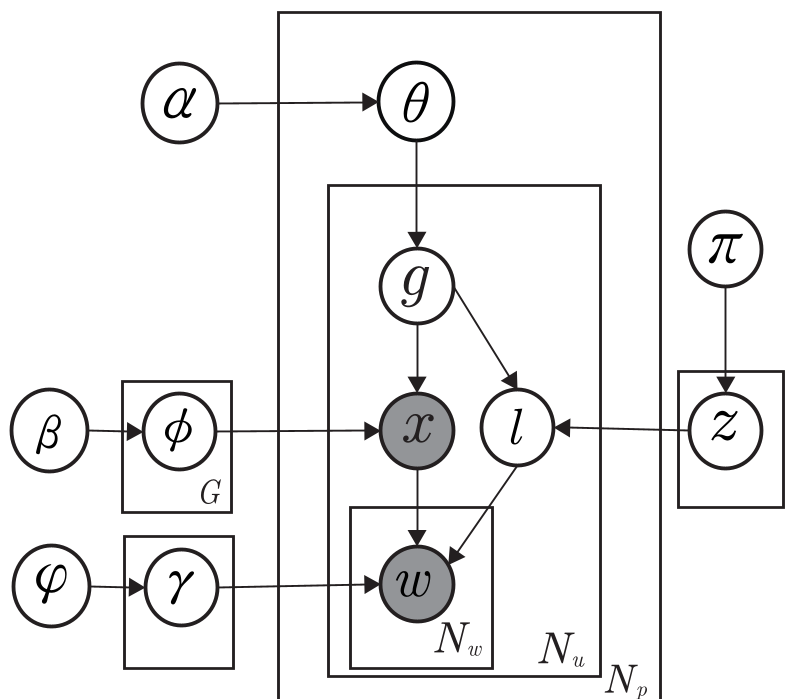 The graphical model above illustrates the dependencies between reviewers (x), latent groups (g), and the resulting words (w) in reviews.
Experiments & Results
The authors tested LGDM on a substantial corpus:
- Data: 60,000 reviews from 30 hotels, balanced between genuine and fake (labeled by Yelp's algorithm).
- Evaluation: Used Precision, Recall, and F1-score via 5-fold cross-validation.
The model demonstrates that as the number of latent groups () is adjusted, the F1-score reaches an optimal peak, suggesting that the model successfully captures the underlying organizational structure of the astroturfers.
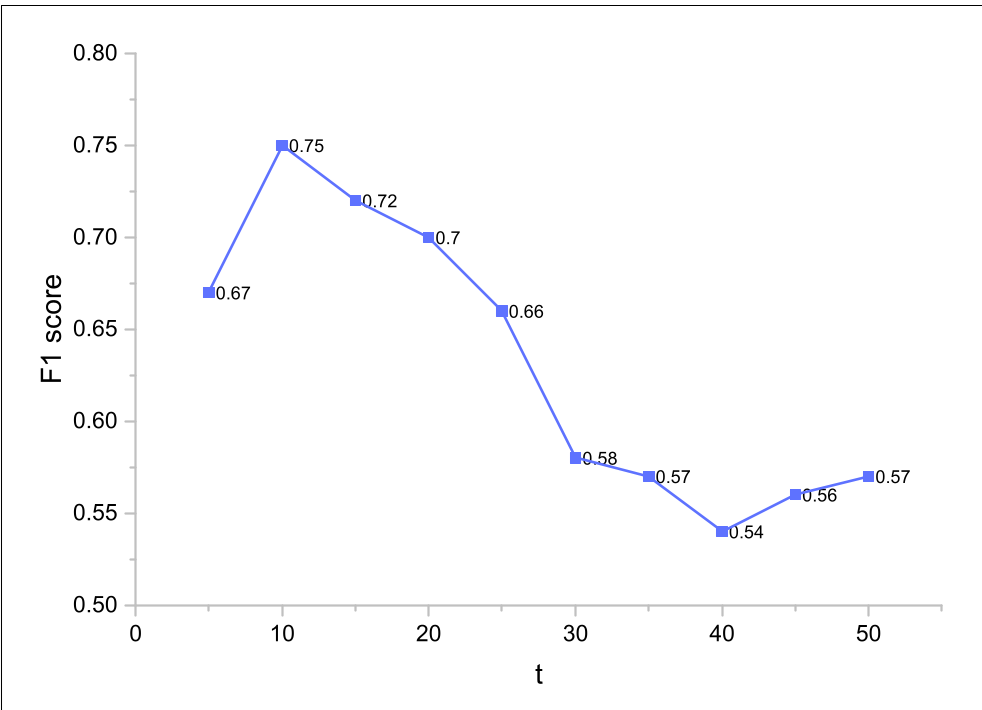 Fig 2. demonstrates the stability of the F1-score across different settings, validating the model's unsupervised effectiveness.
Critical Analysis & Conclusion
Takeaway
LGDM shifts the paradigm from Content-Based Filtering to Behavioral Group Discovery. For tourism platforms like TripAdvisor or Expedia, this means identifying "sleeper cells" of accounts that might look normal individually but act in lockstep as a group.
Limitations & Future Work
While LGDM is powerful, the authors honestly note its current limitations:
- Homogeneous Patterns: It doesn't yet fully integrate "Time Bursts" (many reviews appearing in a very short window).
- Data Silos: The current study focuses on one network. Cross-platform detection (e.g., matching a group acting on both Yelp and Booking.com) remains a "holy grail" for future research.
Ultimately, as astroturfing groups become more sophisticated—potentially using LLMs to generate highly varied text—probabilistic models that look at group coordination rather than just word choice will be our best line of defense.