
Beyond the "Friend" Button: Measuring Tie Strength in a Multidimensional Digital World
"How Well Do We Know Each Other?" Detecting Tie Strength in Multidimensional Social Networks
The paper proposes a novel multidimensional tie strength measure to distinguish between intimate "strong ties" and casual "weak ties" in online social networks. By integrating data from Facebook, Twitter, and Foursquare, the authors develop a metric that accounts for interaction intensity, structural overlap, and "social grooming" through geographic proximity.
TL;DR
In our current digital landscape, we are often overwhelmed by "weak ties"—online acquaintances that flood our feeds but offer little emotional depth. This paper introduces a multidimensional tie strength measure that successfully identifies intimate relationships by analyzing how users interact across different platforms (Facebook, Twitter, Foursquare) and how they perform "social grooming" through physical proximity.
Problem & Motivation: The Illusion of Global Connectivity
While social media promised a "global village," sociological research increasingly suggests that human "circles of intimacy" remain remarkably small, capped by cognitive limits like Dunbar's Number. Current platforms fail to distinguish your best friend from a high school acquaintance you haven't spoken to in a decade.
The authors identify two fatal flaws in previous attempts to measure tie strength:
- User Subjectivity: Communication frequency varies by individual; a "talkative" user might have high frequency with everyone, making it a poor proxy for intimacy.
- The Missing Physical Dimension: Strong ties require "social grooming," which often happens offline via geographical proximity—a factor largely ignored by virtual-only metrics.
Methodology: The Multidimensional Approach
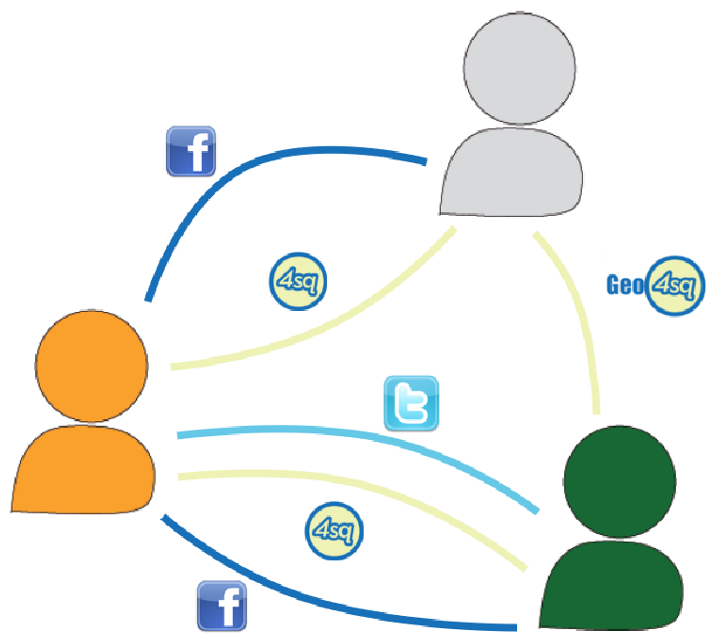
The researchers treat social connectivity as a multidimensional graph, where each dimension represents a medium (e.g., Foursquare for location, Twitter for information, Facebook for social life).
1. Contextual Strength ()
Instead of a simple symmetric Jaccard coefficient, they use a formula that rewards the "selectivity" of the relationship: This captures the overlap of social circles relative to the smaller (more selective) set of friends.
2. Social Grooming ()
They incorporate a "social grooming" component based on the geographical dispersion of users. The intuition is that users who reside in the same area have more opportunities for face-to-face interaction, which significantly reinforces bond strength.
Experiments & Results: Resilience and Robustness
To prove the metric works, the authors performed "network stress tests." According to Granovetter’s famous hypothesis, weak ties act as bridges between disparate communities.
- Weak Tie Removal: When links with low strength scores were removed, the global network collapsed rapidly into disconnected fragments.
- Strong Tie Removal: When links with high strength scores were removed, the network remained largely intact (70% reachability) because strong ties form dense, redundant local clusters.
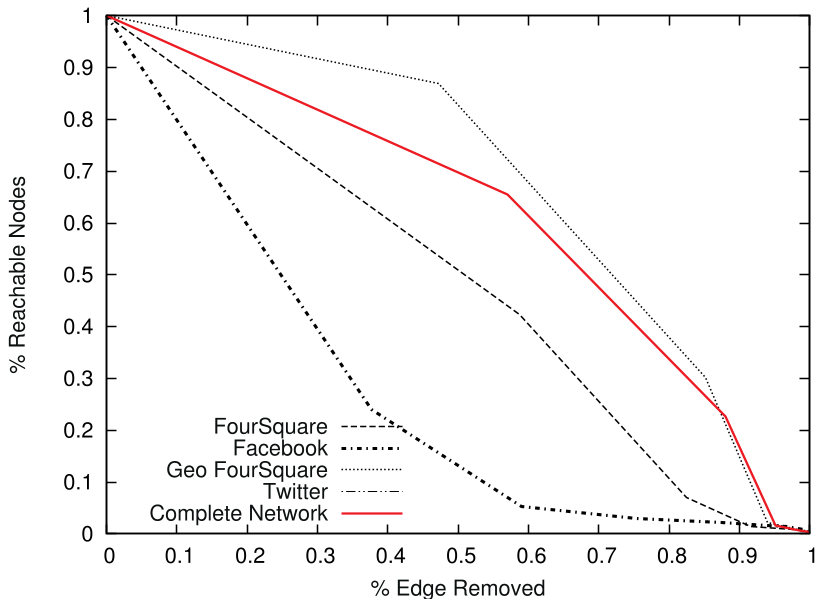
The study reveals that "super-strong" ties are those that persist across all four dimensions (Foursquare, Geo-Foursquare, Facebook, and Twitter). Only 48 such links existed in their dataset of thousands, highlighting the exclusivity of high-strength bonds.
Critical Analysis & Conclusion
The core contribution of this work is moving tie strength measurement from a single-channel analysis to a cross-platform synthesis.
Key Takeaways:
- Intimacy is Multi-Platform: If you are close with someone, you likely interact with them on multiple channels and in the physical world.
- Structure Matters: Strength is inversely correlated with Edge Betweenness. Bridges (weak ties) have high betweenness, whereas strong ties live inside dense communities.
Limitations: The dataset relies on Foursquare check-ins, which is a somewhat dated proxy for geographic proximity in the age of persistent background GPS tracking. Future work could benefit from more passive location data or encrypted metadata from messaging apps to better capture real-time social grooming.
In conclusion, knowing "how well we know each other" isn't about counting messages; it's about seeing where our social circles overlap and our physical paths cross across the entire spectrum of our digital lives.