
SocialAU: Unmasking True Influence via Multilayer Tensor Networks
17078_Detecting Topic Authoritative Social Media Users A Multilayer Network Approach.
This paper introduces SocialAU, a multilayer network approach for identifying topic-specific influential social media users. It models interactions using a 3rd-order tensor representing users, items, and keywords, and extends the PARAFAC decomposition by integrating HITS-based centrality measures to achieve SOTA-level discovery of authoritative influencers.
Executive Summary
TL;DR: Finding an influencer isn't just about counting followers—it's about finding the intersection of audience trust, topical activity, and subject matter expertise. This paper presents SocialAU, a framework that moves beyond 2D graph analysis into 3D tensor decomposition. By modeling social media as a three-layer network of Users, Items, and Keywords, it identifies "Authoritative Users" who don't just speak, but are heard and validated within specific niches.
Positioning: This work is an evolutionary SOTA. It takes the established multilinear algebra of TOPHITS and injects a "structural correction" that forces the model to respect the internal topology of the user community.
The "Popularity vs. Authority" Problem
Most social media metrics suffer from the "Million Follower Fallacy." A celebrity might have millions of followers (high in-degree) but zero influence on whether people buy a specific smartphone or watch a specific TV show.
Existing tools like PageRank or standard HITS often treat the network as a flat plane. They miss the Triadic Relationship:
- Who is talking? (User)
- What are they talking about? (Item)
- How are they describing it? (Keywords/Sentiment)
Methodology: The Power of Three Layers
The core innovation of SocialAU is representing social data as a 3rd-order tensor .
- User Layer (): Nodes are users; edges are mentions/retweets (explicit authority transfer).
- Item Layer (): Nodes are products/shows; edges represent similarity.
- Keyword Layer (): Nodes are descriptors; edges represent co-occurrence in a single post.
3D Connectivity
The interaction is captured as a triple . If User reviews 'The Walking Dead' using the word 'Bloody', a point is plotted in this 3D space.
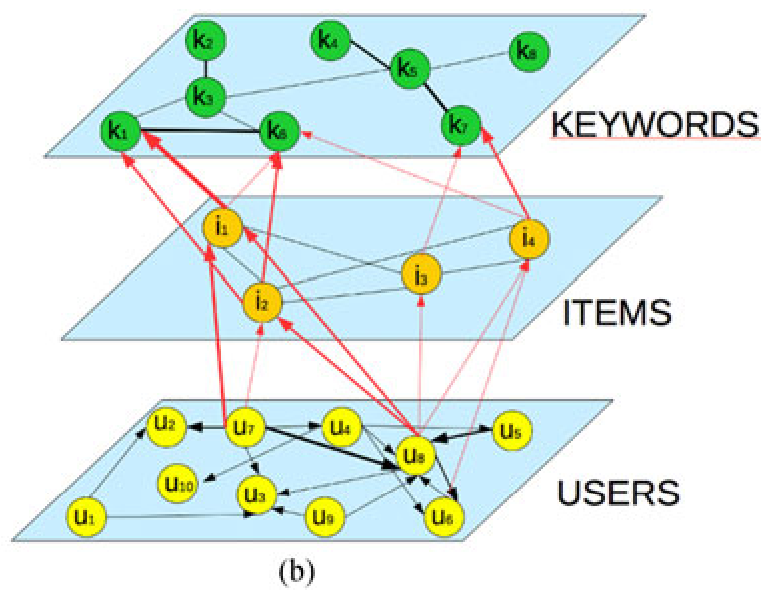 Fig 1: The SocialAU framework transforms unstructured posts (a) into a formal three-layer network (b).
The Algorithmic Twist
While the TOPHITS algorithm uses a standard PARAFAC decomposition to find the "dominant" slice of this tensor, SocialAU modifies the update step. It incorporates the hub/authority scores from the individual layers back into the tensor approximation. This ensures that a user's score is bolstered if they are already an authority in the user-to-user graph, not just a high-frequency poster.
Experimental Battleground: Twitter and Yelp
The authors tested the model against TOPHITS using a TV Series dataset (Twitter) and a Business Review dataset (Yelp).
Finding the "Right" Influencer
In the TV Show dataset, SocialAU identified official accounts (like @ncis_cbs) and lead actors (like Donnie Wahlberg) as top influencers. While TOPHITS often prioritized users who simply posted frequently, SocialAU correctly identified those who were frequently retweeted and mentioned—the true markers of authority.
Theoretical Validation on Yelp
Using "Trust Circles" as a ground-truth metric (representing expertise), SocialAU demonstrated a massive correlation advantage.
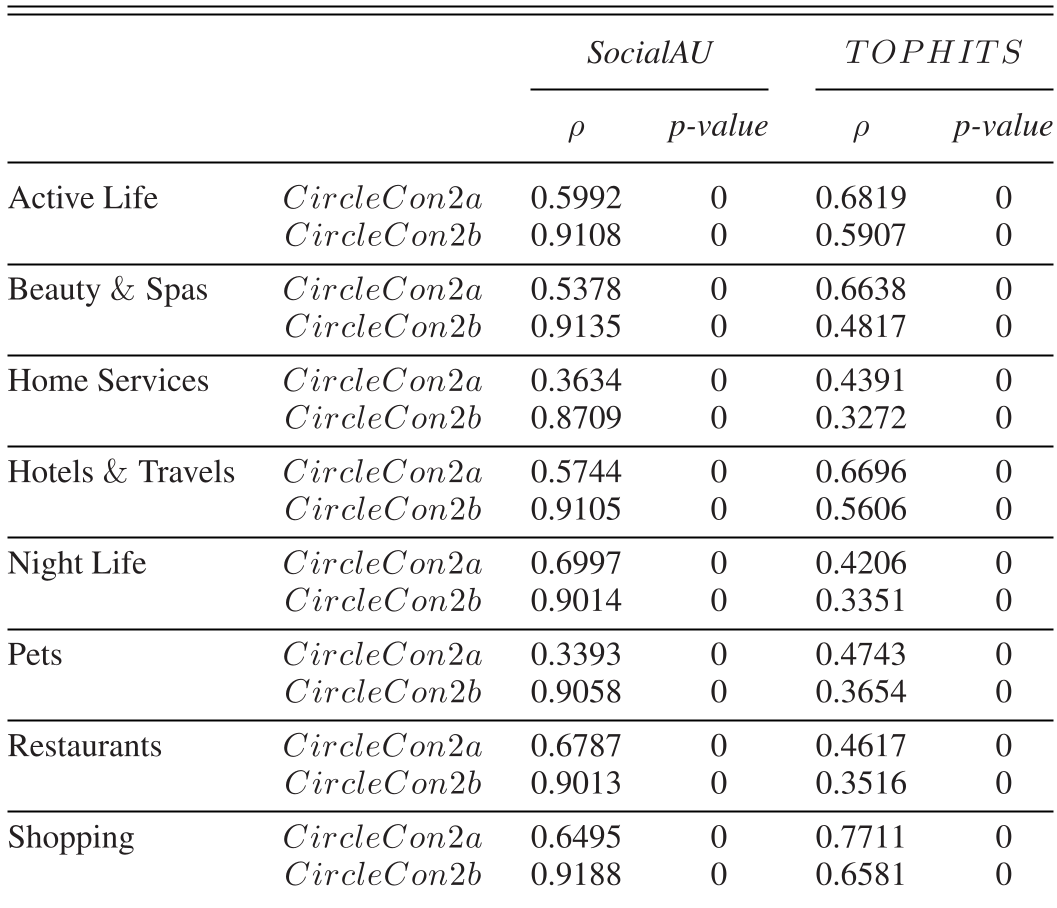 Table 1: Spearman's Correlation results showing SocialAU significantly outperforming TOPHITS in matching expertise-based trust (CircleCon2b).
Performance & Scalability
Despite the complexity of 3rd-order tensors, SocialAU is remarkably efficient. By utilizing sparse tensor toolboxes:
- It handles 1 trillion nodes (hypothetical space) with 1 million interactions in under 5 seconds.
- The computation time scales linearly with the number of interactions (triples), not the total number of users in the network.
Critical Analysis & Conclusion
Takeaway: SocialAU provides a specialized "lens" for marketing and recommendation systems. It filters out "noise" (users who post a lot but aren't respected) and highlights "authorities" (users whose opinions propagate).
Limitations:
- Cold Start: The model requires enough triples to build a meaningful tensor.
- Keyword Extraction: It relies heavily on the quality of keyword extraction; noisy or irrelevant keywords could distort the item-keyword alignment.
Future Outlook: The ability to integrate image analysis (extracting items from photos on Instagram/Flickr) into the "Item Layer" offers a clear path toward a truly multimodal influencer detection system.