
Turning Microblogs into Sensors: Deep Learning for Real-Time Traffic Detection
Detecting Traffic Information From Social Media Texts With Deep Learning Approaches
2018-11-08
Summary
Problem
Method
Results
Takeaways
Abstract
This paper presents a deep learning framework for detecting traffic-relevant information from Sina Weibo microblogs. It utilizes word embeddings trained via a Continuous Bag-of-Words (CBOW) model and introduces a hybrid LSTM-CNN architecture to achieve State-of-the-Art (SOTA) performance in short text classification for social transportation.
## TL;DR
Traffic management is evolving from physical loop detectors to "Social Transportation." This paper proposes a deep learning framework—utilizing **CNN, LSTM, and hybrid LSTM-CNN**—to sift through billions of Sina Weibo microblogs. By replacing traditional Bag-of-Words with **CBOW word embeddings**, the researchers achieved an F1-score of over **90%** in identifying traffic incidents, effectively turning the public into a ubiquitous sensor network.
## Problem & Motivation: The Gap in Social Sensing
Traditional Intelligent Transportation Systems (ITS) rely on physical infrastructure (CCTV, loop detectors), which are costly to maintain and limited in geographic scope. Social media, specifically platforms like Sina Weibo, offers a "free," real-time, and ubiquitous data source.
However, mining this data is notoriously difficult because:
1. **Informal Language**: Microblogs are short, noisy, and full of slang.
2. **Semantic Sparsity**: Traditional "one-hot" encodings (like those used in older SVM models) treat "congestion" and "jam" as completely unrelated tokens.
3. **Sequence Complexity**: Understanding the difference between "The traffic is moving" and "The traffic is not moving" requires capturing long-range dependencies.
## Methodology: Beyond Simple Keyword Matching
The authors moved away from manual feature engineering toward an end-to-end deep learning pipeline.
### 1. The Power of 3 Billion Microblogs (Word Embeddings)
Before classification, the researchers used a **CBOW (Continuous Bag-of-Words)** model to train word embeddings on a massive dataset of 3 billion microblogs. This ensures that the model understands that "车祸" (traffic accident) and "相撞" (car crash) occupy similar regions in the latent vector space.
### 2. Deep Learning Architectures
- **CNN (Convolutional Neural Network)**: Acts as an automated n-gram extractor. By sliding filters over the word vector matrix, it captures local phrases that signal traffic events.
- **LSTM (Long Short-Term Memory)**: Solves the vanishing gradient problem in standard RNNs, allowing the model to remember "context" from the beginning of a sentence to the end.
- **LSTM-CNN (The Hybrid)**: The core innovation. LSTMs first process the sequence to learn contextual dependencies, and the output is then fed into a CNN to extract higher-level abstracted features.
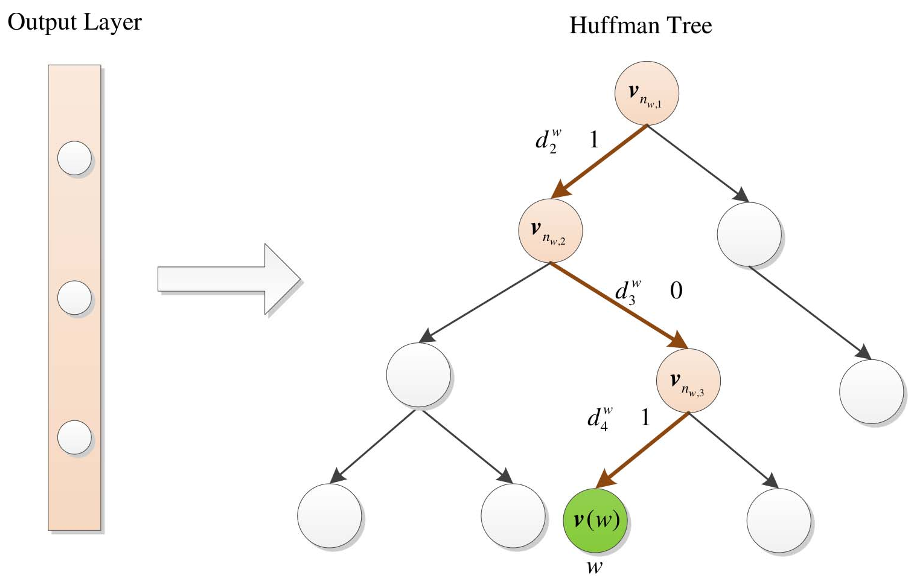
*Fig 1: The proposed system flowchart—from crawling and segmentation to deep learning classification.*
## Experiments & Results: SOTA Performance
The researchers compared their models against several baselines:
- **bow-SVM**: Bag-of-n-grams features (highly effective but high-dimensional).
- **vecseq-SVM**: SVM using word vectors.
- **MLP**: Multi-layer Perceptron.
### Key Findings:
- **Superiority of Hybrids**: The **LSTM-CNN** achieved the highest F1-scores, demonstrating that combining sequence memory with spatial feature extraction is optimal for short-text analysis.
- **Recall vs. Precision**: While a simple SVM had high precision, the **LSTM** model had the highest **recall**, which is more critical for traffic management (i.e., it is better to investigate a false alarm than to miss a major car accident).
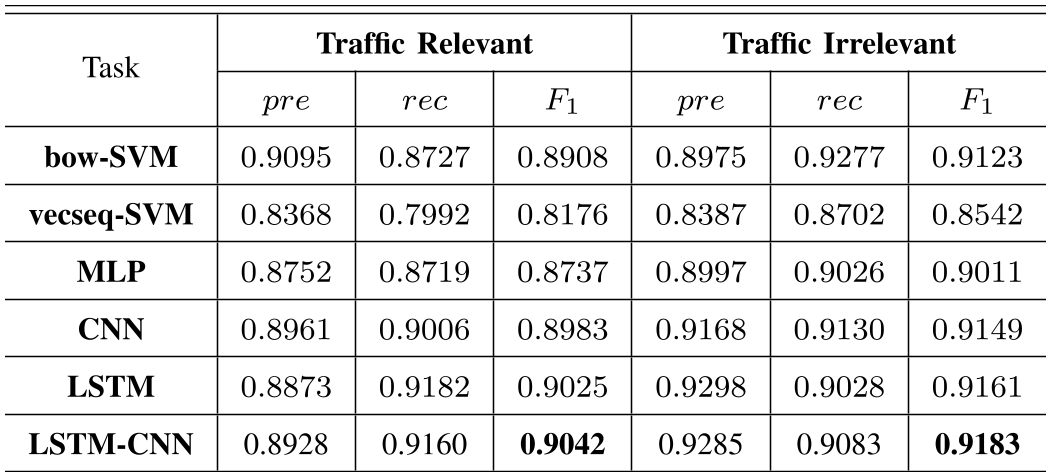
*Table 1: Performance comparison showing LSTM-CNN leading in F1-scores for traffic relevance.*
## Critical Analysis & Future Outlook
**Strengths**: The transition to deep learning removes the need for "expert-led" feature selection. The use of CBOW on a massive corpus provides a robust semantic foundation that smaller datasets cannot match.
**Limitations**:
- **Interpretability**: As a "black box" model, it is hard to explain *why* the model classified a specific post as traffic-relevant.
- **Complexity**: Training an LSTM-CNN on billions of tokens requires significantly more computational power than traditional linear models.
**Future Perspective**:
The industry is moving toward **Multi-Modal Data Fusion**. The next step for this research is to combine these textual "social signals" with real-time GPS data from floating cars to create a high-fidelity, real-time map of urban traffic health.
---
**Takeaway**: This work proves that with enough data and the right architecture, public social media sentiment can be processed with the precision of high-end physical sensors.