
Zeus Unmasked: Elevating Malware Detection via Strategic Feature Selection
Detecting the Zeus Banking Malware Using the Random Forest Binary Classification Algorithm and a Manual Feature Selection Process
This paper presents a robust detection framework for the Zeus banking malware using the Random Forest binary classification algorithm. By employing a manual feature selection process on network traffic, the authors achieved a 100% recall for Zeus traffic in testing, significantly outperforming automated feature selection benchmarks like CONIFA.
TL;DR
Banking malware is no longer just a nuisance; it is a multi-million dollar criminal industry. This paper explores a highly effective detection strategy for the notorious Zeus malware by combining the Random Forest algorithm with a meticulous Manual Feature Selection process. By shifting away from automated black-box feature selection, the authors achieved an unprecedented 100% recall for Zeus traffic in testing scenarios.
Problem & Motivation: The Persistence of Zeus
Despite being one of the "oldest" famous banking trojans, Zeus remains a dominant threat due to its leaked source code and adaptive C&C (Command & Control) architectures. Modern variants utilize Peer-to-Peer (P2P) communication and Domain Generation Algorithms (DGA), making them nearly invisible to static signature-based defenses.
The authors argue that previous Machine Learning (ML) attempts failed because:
- High False Positives: Some models reached a staggering 48% FP rate.
- Inefficient Automation: Automated feature selection often discards "expensive" but vital statistical markers that describe the bursty nature of botnet traffic compared to the more predictable flow of benign web browsing.
Methodology: The Power of Manual Insight
The core innovation here isn't just the algorithm (Random Forest), but the feature selection framework. While tools like Netmate-flowcalc can extract 44 statistical features, not all are created equal.
The authors utilized the Wrapper Method, manually iterating through subsets of features to measure their impact on accuracy.
The "Golden 13" Features
Through experimentation, the authors identified 13 specific features that differentiate Zeus from Windows 10 benign traffic. These include:
- Forward/Backward Packet Counts and Volumes: Zeus traffic patterns differ significantly in volume due to credential exfiltration.
- Packet Length Statistics (Min, Max, Mean, Std): Captures the unique "heartbeat" of the malware's C&C communication.
- Min Fiat (Forward Inter-Arrival Time): Exploits the timing differences between human-triggered browsing and automated bot polling.

Experiments & Results: Crushing the Baseline
The study compared the manual approach against known benchmarks like CONIFA and standard C4.5 frameworks.
Key Performance Metrics:
- Recall for Zeus: The model identified 160 out of 163 Zeus cases correctly locally, and achieved 100% Zeus recall in certain prioritized training configurations.
- Comparison: While previous automated frameworks struggled with F-scores between 0.56 and 0.67, the proposed manual selection method reached an F-score of 0.93.
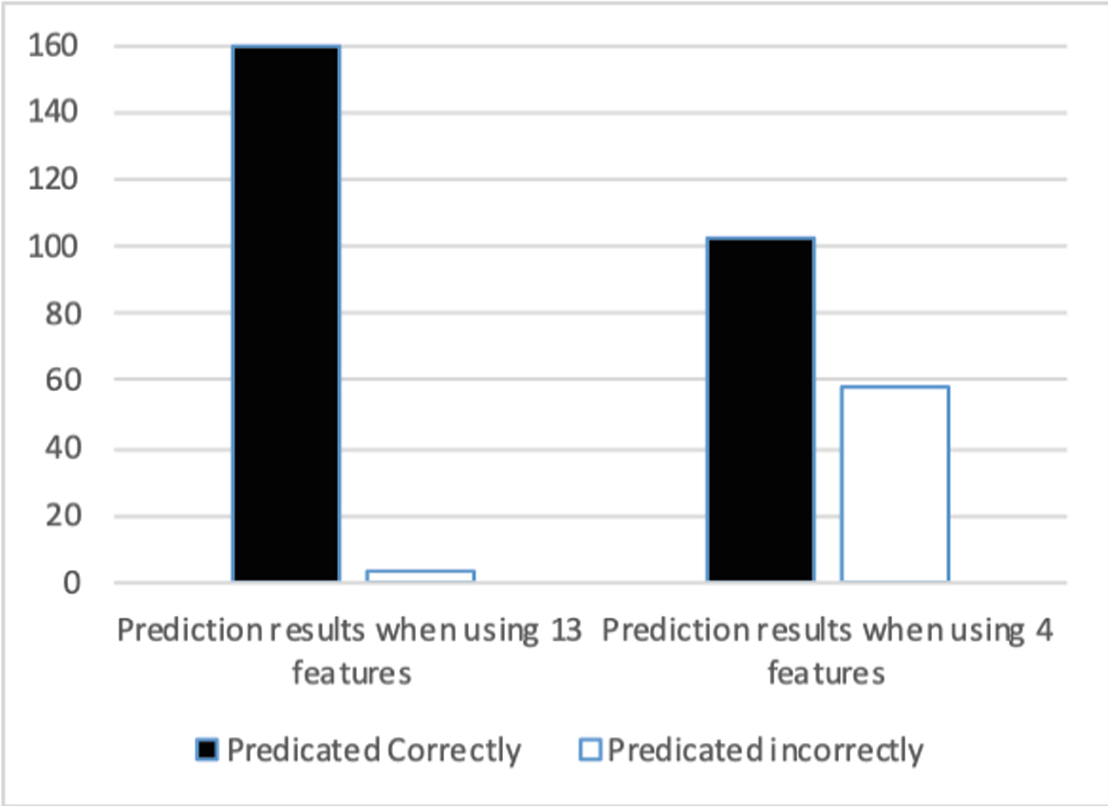 Figure: The chart illustrates the significant jump in detection accuracy when moving from automated frameworks to the author's manual feature selection methodology.
Ablation Insight
The researchers found that using only a minimal set of 4 features (duration, max_active, etc.) caused nearly half of Zeus samples to go undetected. This proves that malware detection is a "high-resolution" task—you need the full statistical context of the packet flow to separate the signal from the noise.
Critical Analysis & Conclusion
This work demonstrates that "Human-in-the-loop" feature selection still holds a significant advantage over fully automated systems in specialized cybersecurity domains. By understanding the operational characteristics of Zeus (like its P2P report channels), researchers can point the ML model exactly where to look.
Limitations:
- The dataset size (1048 samples) is relatively small for modern ML standards.
- Zeus was tested against "clean" Windows 10 traffic; real-world environments with other noisy applications might increase the False Positive rate (which was 37/152 in testing).
Future Outlook: The next frontier involves applying this manual selection logic to unsupervised learning to detect "Zero-day" banking malware that has no prior training labels.