
The DGA Dual Arms Race: Why Deep Learning is Winning (But Still Vulnerable)
7440_Detection of algorithmically generated domain names used by botnets a dual arms race.
This paper presents a systematic benchmarking of two primary Domain Generation Algorithm (DGA) detection paradigms: Feature-based Random Forests (FANCI) and Deep Learning-based LSTMs. The study introduces "deception_dga," a novel DGA designed to bypass detection by exploiting feature transparency, highlighting a critical "dual arms race" in cybersecurity.
TL;DR
In the escalating battle between botnet operators and security researchers, the "Dual Arms Race" is in full swing. This research benchmarks two titans of DGA detection: Deep Learning (LSTM) and Manual Feature Engineering (Random Forest). While LSTMs prove superior in raw accuracy (98.7%), the study exposes a chilling reality: by mimicking the statistical "fingerprint" of legitimate domains, a cleverly designed DGA can render traditional classifiers almost entirely useless.
Background: The Evolution of Botnet Communication
Modern malware doesn't hardcode IP addresses; it uses Domain Generation Algorithms (DGAs) to create thousands of "rendezvous points." For defenders, identifying these algorithmically generated names is the key to decapitating botnet Command & Control (C&C) structures. However, as defenders get smarter, so do the algorithms.
The Problem: Transparent Defenses
Traditional machine learning relies on "feature engineering"—deciding that factors like vowel ratio, character entropy, or domain length are "red flags." The authors argue this creates a "Dual Arms Race":
- The Feature Race: Developing deeper models to find better patterns.
- The Cat-and-Mouse Game: Adversaries using known feature sets to "blend in" with human-generated traffic.
Methodology: Man vs. Machine
The study pits two state-of-the-art approaches against a massive dataset of 26 real-world DGAs (including infamous names like Conficker, Gozi, and Locky):
- FANCI (Random Forest): Uses 41 manually crafted features (e.g., ratio of consecutive consonants, alphabet cardinality).
- Woodbridge LSTM (Deep Learning): A Recurrent Neural Network that treats the domain name as a sequence, learning its own internal representations without human intervention.
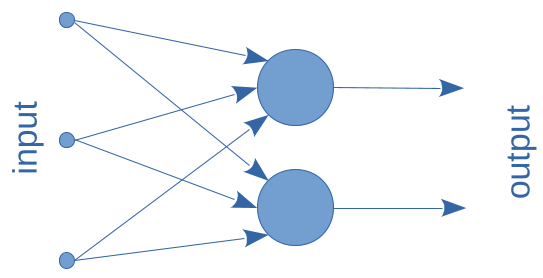 Figure: The comparison focuses on how LSTMs loop output back to understand sequence context vs. standard feed-forward approaches.
The Attack: "Deception_DGA"
To prove how fragile manual features are, the authors iteratively built deception_dga. By progressively adding statistical constraints, they systematically blinded the classifiers:
- v1 (Length): Matches the Alexa top-site length distribution.
- v2 (Vowel Ratio): Matches the frequency of vowels in benign sites.
- v4 (Bigram Probabilities): Uses "character probability given the previous character," essentially mimicking the linguistic flow of human-created names.
Performance & Critical Results
The results confirm a significant gap in consistency. The Random Forest classifier showed much higher variance and higher False Positive Rates across different DGA families.
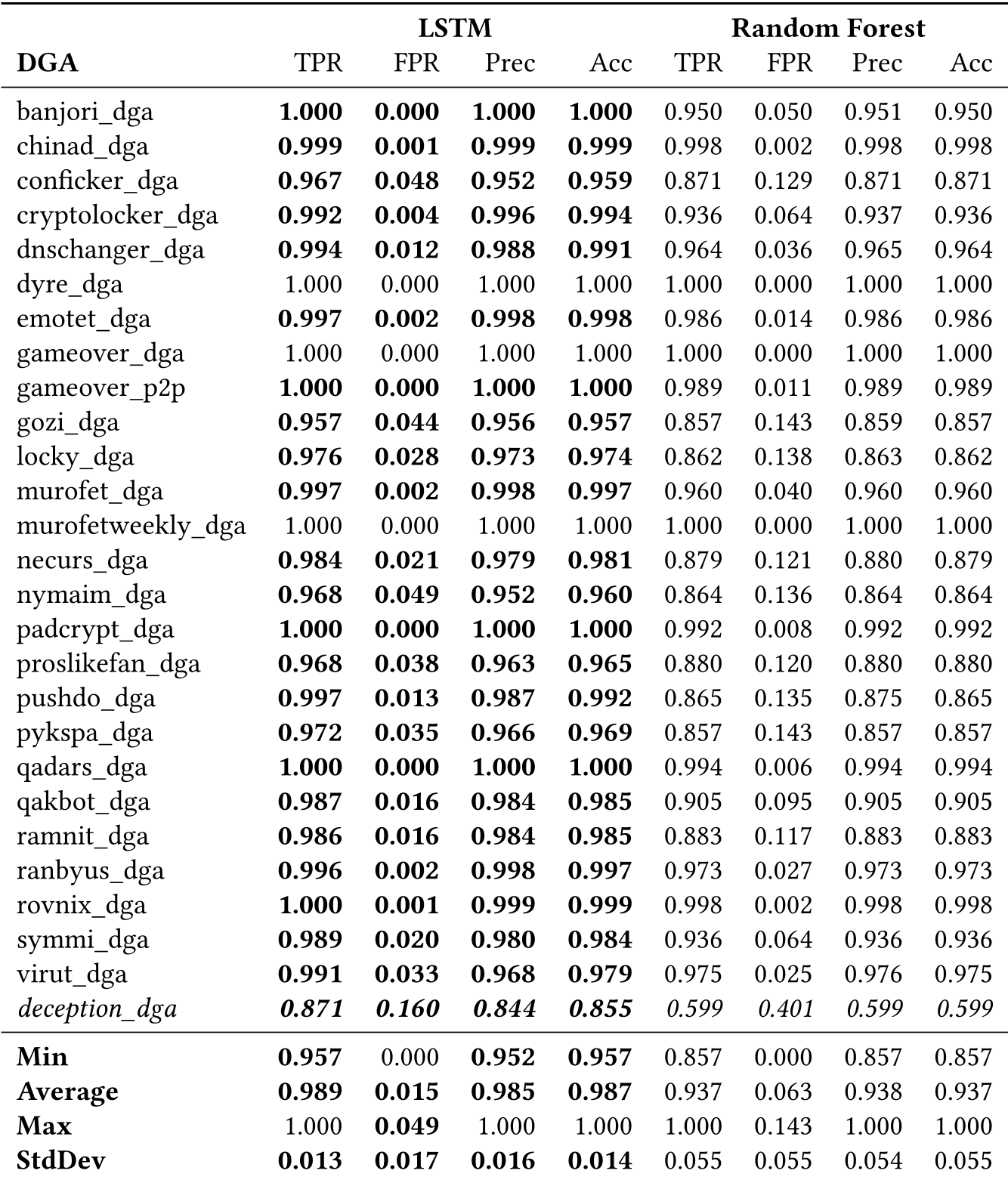 Table: Comparison of True Positive (TPR) and False Positive Rates (FPR). Note the drastic drop in the final row for "deception_dga".
When facing deception_dga, the Random Forest's accuracy plummeted to 59.9%—hardly better than a coin flip. Even the "black-box" LSTM was affected, dropping to 85.5% accuracy, proving that even deep models struggle when an adversary perfectly mimics the statistical properties of the training data.
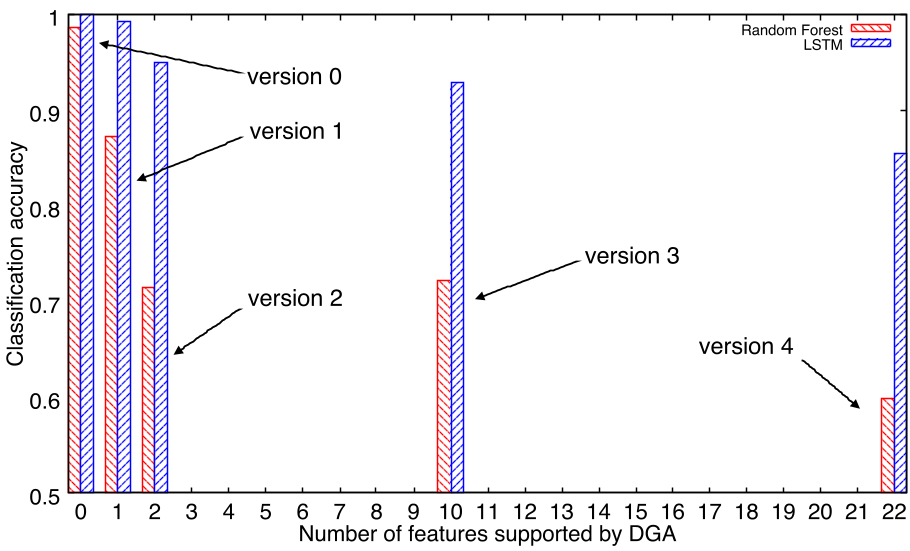 Figure: Accuracy drops as more features are emulated by the DGA.
Deep Insights: The Future of the Race
The success of deception_dga stems from its simplicity: it only required 535 lines of Python and no external libraries to generate 6,000 domains per second. This highlights a terrifying low barrier to entry for highly effective evasion techniques.
Takeaways for Practitioners:
- Manual Features are Fragile: Relying on fixed linguistic features (like entropy) is a liability in a targeted attack.
- Deep Learning is the Baseline: LSTMs provide better generalization and are harder to "reverse engineer," but they are not silver bullets.
- The Proactive Path: Defenders must move toward Generative Adversarial Networks (GANs)—using AI to build the "ultimate" DGA so they can train even better detectors before the malware hits the wild.
Conclusion
This paper serves as a wake-up call. DGA detection is not a solved problem; it is a dynamic equilibrium. As we move toward more opaque deep learning models, adversaries will continue to use statistical mirroring to hide in the noise of the open web.