
Hybrid Intelligence: Defeating Content Disguise in Social Media Moderation
Research on Detection Method of Unhealthy Message in Social Network
This paper presents a two-stage hybrid framework for detecting unhealthy messages (eroticism, gambling, drugs, and political sensitivity) in social networks. It combines a Naive Bayes classifier for initial categorization with a Support Vector Machine (SVM) model for fine-grained detection of disguised content.
TL;DR
To clean up digital spaces filled with eroticism, gambling, and sensitive content, researchers have moved beyond simple keyword filters. This paper introduces a dual-layered approach: using Naive Bayes for rapid categorization and Support Vector Machines (SVM) for high-precision detection. By extracting "camouflage features" (like split characters or Pinyin) and behavioral metadata, the system provides a robust shield against criminals attempting to bypass automated moderation.
Context & Motivation: The Failure of Keyword Lists
Most social platforms still rely on sensitive word lists. However, malicious actors are experts at evasion. They use symbols (e.g., "Free"), Pinyin ("fa-lun-gong"), or even split Chinese components ("车仑" instead of "轮") to slip past basic filters.
The challenge is two-fold:
- Short Text Sparsity: Tweets and Weibo posts lack the logical depth of long-form articles.
- Adversarial Noise: Intentional camouflaging renders traditional TF-IDF approaches insufficient.
Methodology: The Two-Stage Pipeline
The authors argue that a single classifier isn't enough. Instead, they propose a hierarchical approach:
Stage 1: Naive Bayes Macro-Classification
The system first categorizes incoming messages into five buckets: Eroticism, Gamble, Drug, Political, or Other. Using a multi-variable Bernoulli model, it calculates the probability of a message belonging to category . This acts as a high-speed filter to narrow down the problem space.
Stage 2: Feature Engineering & SVM Judgment
Once a message is flagged as potentially "Eroticism," for example, the system zooms in on specific red flags:
- Camouflage Recognition: Regular expressions strip special characters; Pinyin-to-word tables map phonetic substitutions back to sensitive terms.
- Behavioral Features: High URL ratios (), frequent mentions of other users (), and abnormal follower-to-following ratios () are heavy indicators of "garbage users" or bots.
- Message Similarity: Using Cosine Similarity to detect if a user is "blasting" similar messages across the network.

Performance Benchmarks
The study utilized a massive dataset from Datatang (over 8 million Weibo posts).
Naive Bayes Performance
The initial classification stage showed remarkably stable performance across all unhealthy categories:
- Eroticism: 83.80% F-Measure
- Political: 83.92% F-Measure
SVM vs. The Competition
In the final judgment phase (identifying if a categorized post is actually malicious), SVM proved to be the superior choice for high-dimensional social media data.
| Algorithm | Precision | Recall | F-Measure |
|---|---|---|---|
| SVM | 82.7% | 82.7% | 82.7% |
| C4.5 Tree | 78.5% | 78.5% | 78.5% |
| Naive Bayes | 72.3% | 72.3% | 72.2% |
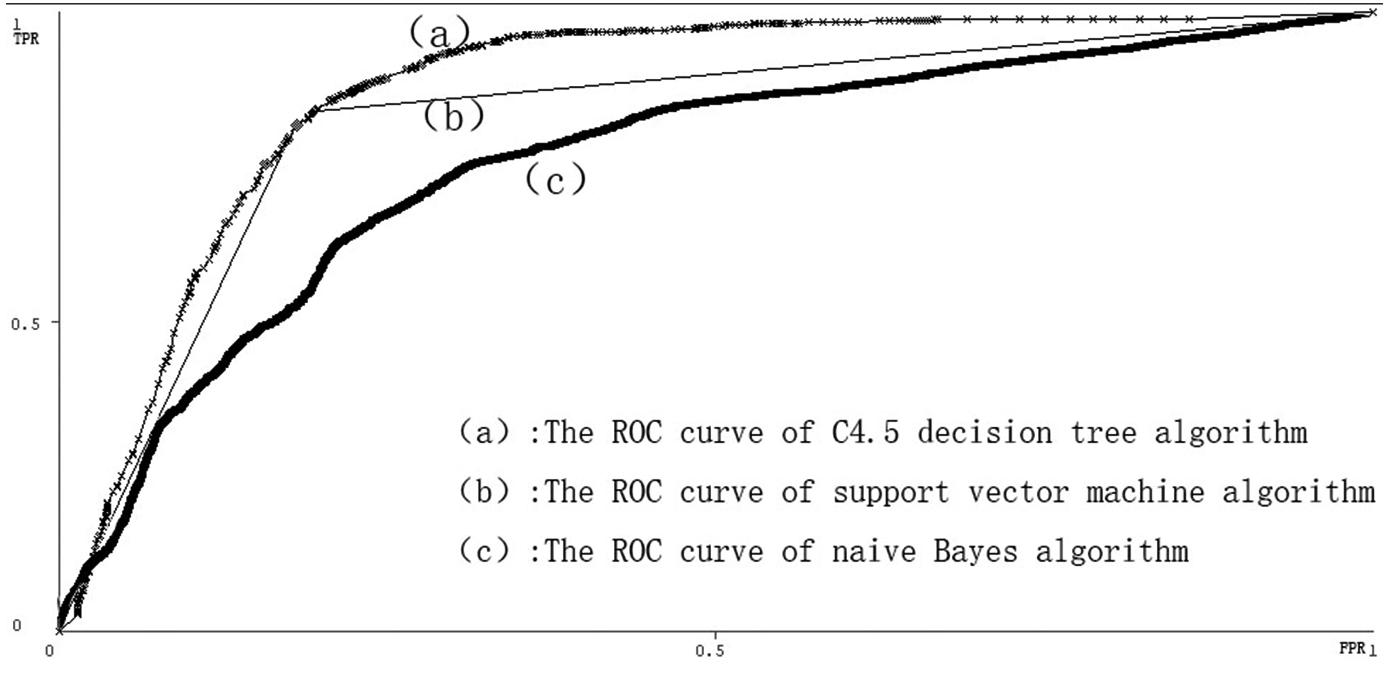 The ROC curve demonstrates that while C4.5 performs well in unbalanced scenarios, SVM remains the most robust overall classifier for this task.
Critical Insight: Why This Works
The "secret sauce" of this paper isn't just the algorithm—it is the feature engineering. By explicitly modeling how humans try to trick machines (splitting characters, using symbols), the authors provide the classifier with a specialized "vocabulary" for deception.
The inclusion of user metadata (like the ratio of followers) reflects a shift in moderation philosophy: Don't just look at what is said; look at who is saying it and how they are behaving.
Conclusion & Limitations
While highly effective for 2016-era social media, this method faces new challenges today. Modern "Meme-based" or image-embedded text requires sophisticated OCR and multi-modal models (like CLIP) that weren't the focus of this study. However, the core logic of hierarchical filtering (General Classification → Feature Recognition → Binary Decision) remains a blueprint for production-grade moderation systems.
Future Work: Integrating Recursive Neural Networks or Transformers could further improve the semantic understanding of "colloquialisms" that this paper handles through manual dictionary mapping.