
Decoding Social Roles: Identifying Spammers through Neighborhood Topology
Detection of Roles of Actors in Social Networks Using the Properties of Actors' Neighborhood Structure
This paper introduces a structural analysis method for classifying actors in social networks into "positive" or "negative" roles based on their local neighborhood topology. By comparing an actor's immediate relation patterns against predefined pattern graphs using degree, reciprocity, and transitivity, the method distinguishes between entities like regular users and spammers.
TL;DR
Understanding who is who in a massive social network is difficult when you can only see a small part of the web. This paper presents a method to classify actors as "positive" (regular) or "negative" (spammers) by analyzing the micro-structures of their immediate neighborhoods. By focusing on local properties like reciprocity and transitivity, the researchers achieved a 77% accuracy rate in detecting email spammers without ever looking at the content of the emails.
The Structural Intuition: Why Attributes Aren't Everything
In social science, we usually categorize people by their attributes—age, job title, or location. However, in technical systems like email or online communities, attributes are easily faked.
The authors argue that behavioral patterns—reflected in the structure of one's relations—are much harder to disguise. A spammer doesn't interact like a regular user; they are "sources" rather than "receivers," and their networks lack the "transitivity" (the "friend of a friend is my friend" logic) found in healthy human communities.
Methodology: The Geometry of a Social Network
The core of the approach is the comparison between an actor's local neighborhood and predefined Relation Pattern Graphs.
1. Key Metrics
The method leverages several structural properties:
- Outdegree/Indegree: Spammers typically have high outdegree but near-zero indegree.
- Reciprocity: Healthy communities have mutual connections. Spammers have one-way links.
- Transitivity/Clustering: Human networks are dense with triangles (triads). Spammers exist in sparse, star-like structures.
2. The Similarity Mechanism
The authors define a similarity function that measures how closely an actor's neighborhood matches a "Good" pattern or a "Bad" pattern. The final classification uses a normalized score :
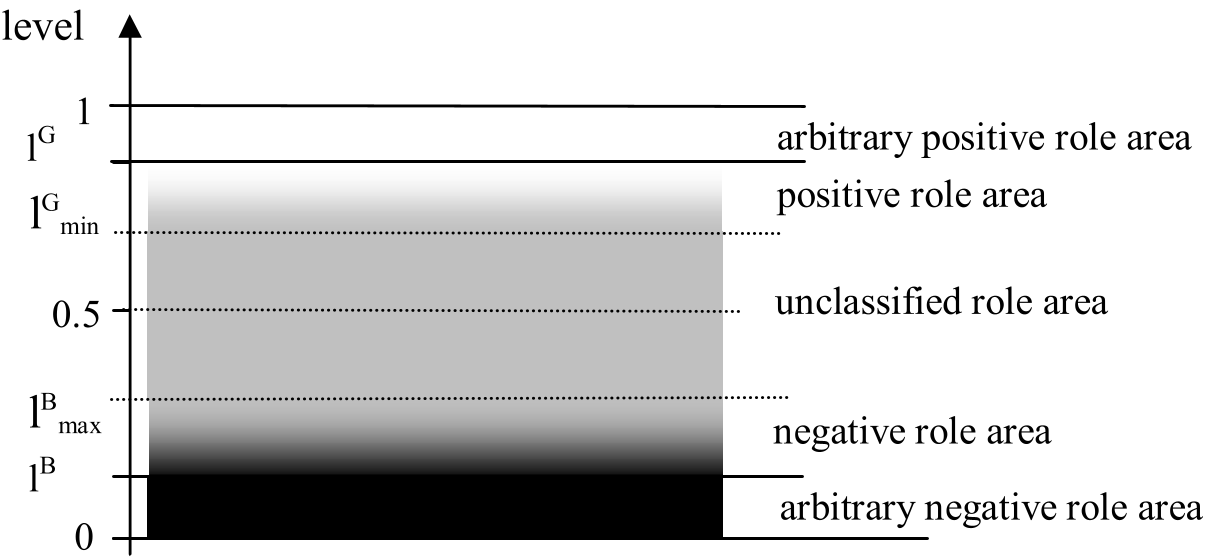
If the value leans toward 1, the actor is "positive"; if toward 0, they are "negative." If the results are ambiguous, the actor remains "unclassified."
Experimental Results: Catching the Spammers
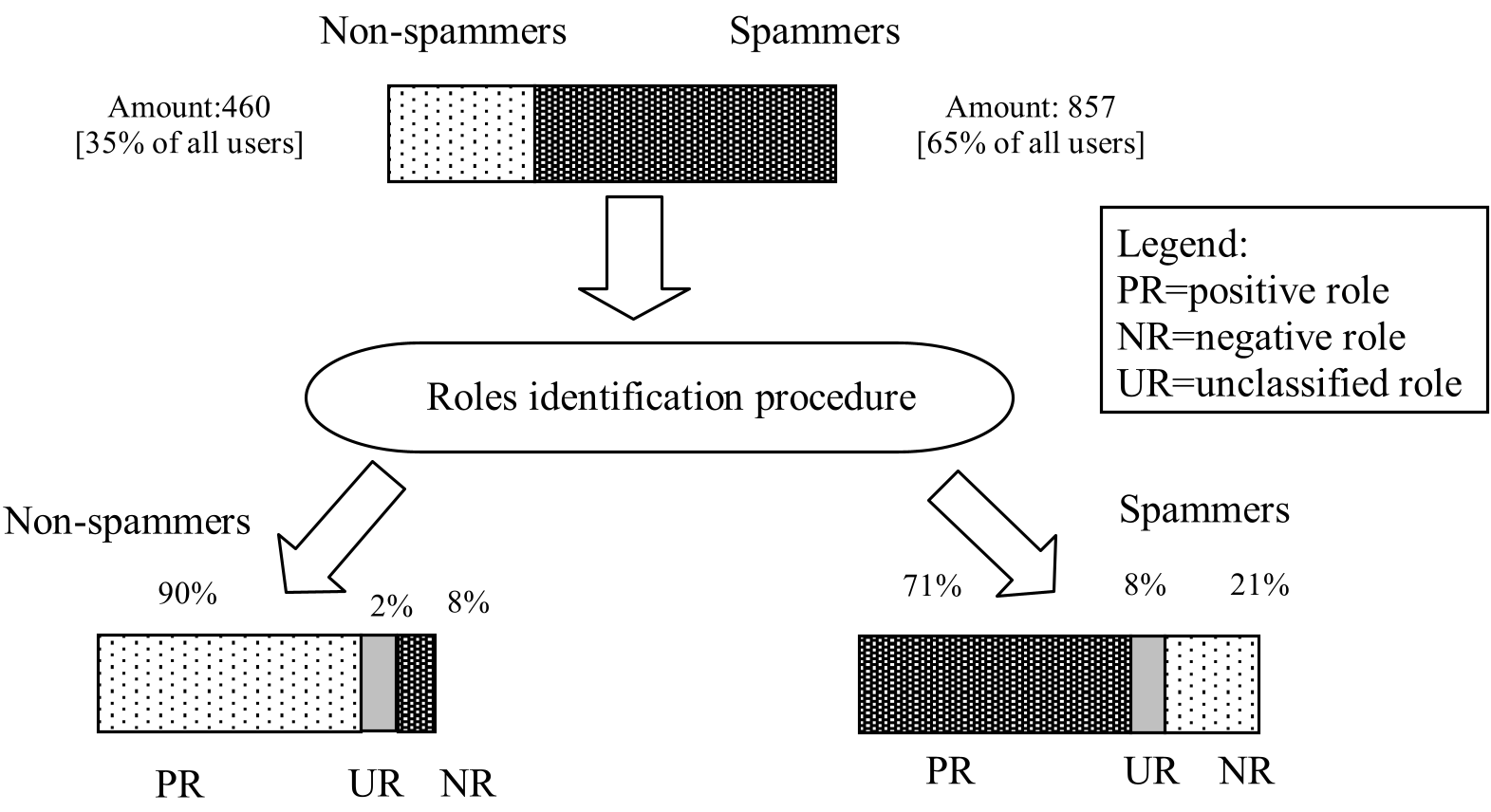
The researchers applied this to a community of internet email users at the Gdansk University of Technology.
Key Findings:
- High Precision for Regular Users: 90% of normal users were correctly identified, meaning the "false positive" rate (blocking real users) was low—a crucial requirement for any practical anti-spam tool.
- Effective Filtering: 71% of spammers were successfully flagged based purely on their connection patterns.
- Efficiency: Because the algorithm only looks at local neighbors, it is computationally light compared to Natural Language Processing (NLP) based filters.
Critical Insight: The "Limited Knowledge" Advantage
The most impressive aspect of this work is its realism. Most academic graph theories assume we have the "God view" of the entire network. In reality, we don't. By proving that local neighborhood analysis is "good enough" for classification, the authors provide a template for privacy-preserving or distributed social analysis where global data is unavailable.
Future Outlook
While 77% accuracy is a strong baseline, the authors admit that static pattern graphs are a limitation. Modern social networks change rapidly. The next evolution of this work likely involves Temporal Graph Analysis, where the order and timing of relations become as important as the connections themselves.
As a first-line defense, this structural approach remains a potent tool for identifying anomalies in any system—from cybersecurity to detecting "talented children" in social groups—without invading the privacy of the communication content.