
Unmasking the Influencers: A Deep Dive into Opinion Leader Detection in Social Networks
Detection of Opinion Leaders in Social Networks: A Survey
This survey paper provides a comprehensive overview of algorithms for detecting opinion leaders in social networks, categorizing approaches into Centrality-based and Influence Maximization techniques. It highlights the evolution from static graph metrics like PageRank to dynamic influence models such as the Linear Threshold (LT) and Independent Cascade (IC) models.
TL;DR
With the shift from passive information consumption to active user participation, identifying "Opinion Leaders" has become a cornerstone of digital marketing and social analysis. This survey paper systematically explores local and global graph centrality techniques and stochastic influence maximization models to find the users who truly move the needle in online communities.
Contextual Positioning
In the ecosystem of Social Network Analysis (SNA), this work serves as an architectural survey. It bridges the gap between classic graph theory (e.g., Freeman’s Centrality) and modern data mining challenges (e.g., Influence Maximization in large-scale DAGs). It positions opinion leader detection not just as a popularity contest, but as a strategic optimization problem.
Problem & Motivation: Popularity vs. Influence
The core issue in social media analysis is the "Influencer Paradox": a user with a million followers (high prestige) might not actually influence anyone's behavior. Prior work often conflated unidirectional information exchange with reciprocal interaction.
The authors argue that opinion leaders are sought out because they are perceived as credible, objective, and experienced. Detecting them requires looking beyond simple link counts and understanding the geodesic positions and stochastic spread patterns within the network.
Methodology: The Two Pillars of Detection
1. Centrality Techniques (Structural Insight)
Centrality measures identify leaders based on their location in the social graph.
- Degree Centrality: The simplest form, focusing on the number of immediate neighbors. It measures "local" influence.
- Closeness Centrality: Measures how "near" a node is to all other nodes. High closeness indicates an efficient propagator of information.
- Betweenness Centrality: Identifies "bridge" nodes that control the flow of information between different subnetworks.
- Eigenvector Centrality (and PageRank): A recursive measure where a node’s importance is derived from the importance of its neighbors.
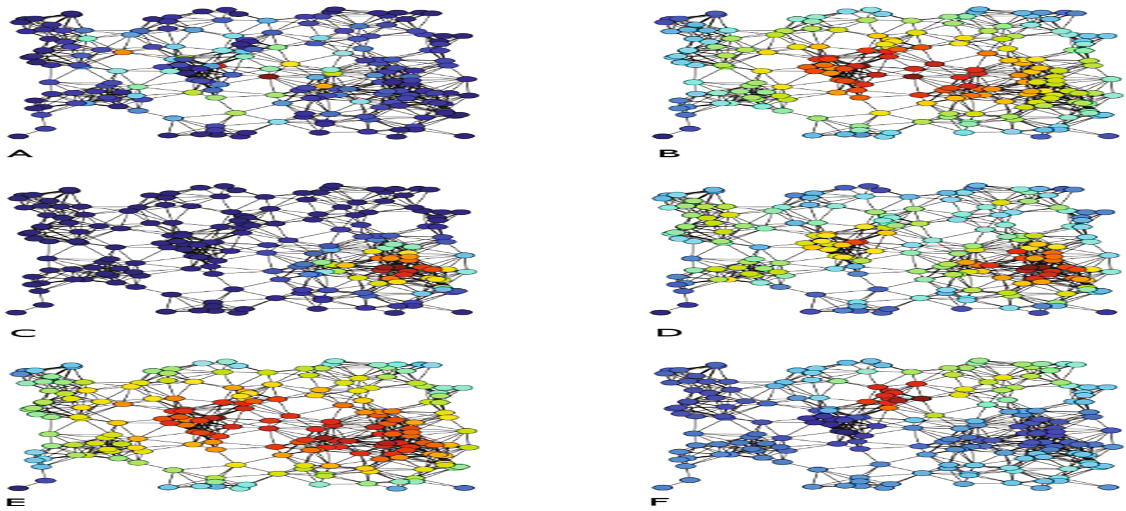 Figure 1: Visual comparison of different centrality types influencing graph structure.
2. Maximization Techniques (Behavioral Dynamics)
Influence Maximization treats the problem as finding a "seed set" that triggers the largest cascade.
- Linear Threshold (LT) Model: Users become influenced once a certain percentage of their neighbors adopt a behavior.
- Independent Cascade (IC) Model: Each active neighbor has a probabilistic chance to "infect" their friends independently.
The paper highlights that while the standard greedy algorithm for these models is effective, it is often not scalable. Recent heuristics like MIA (Maximum Influence Arborescence) offer a way to handle millions of nodes by approximating the propagation paths.
Experiments & Comparative Analysis
The authors provide a critical comparison of centrality measures, noting that while Eigenvector-based methods are powerful, they often struggle with oriented graphs (directed links) where nodes may only have one type of connection.
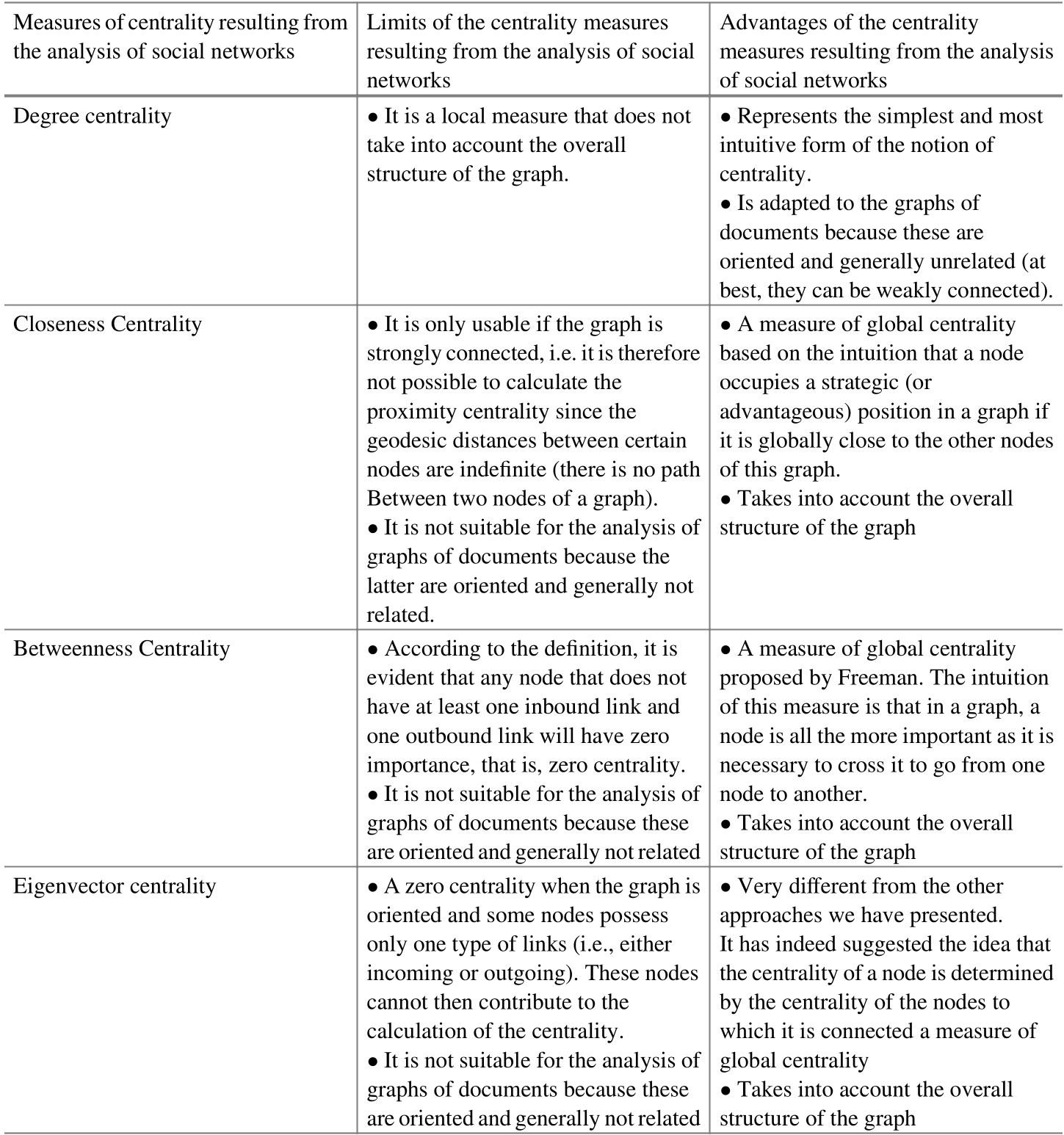 Table 1: Advantages and limits of various centrality measures for document and social graphs.
Key Insights from the Comparison:
- Local vs. Global: Degree centrality is fast but blind to the global structure. Closeness and Betweenness offer global perspectives but require the graph to be strongly connected to be meaningful.
- Document Graphs: Most classic measures are ill-suited for document-based graphs (like citations) because these networks are often weakly connected or strictly acyclic.
Critical Analysis & Conclusion
Takeaway
The detection of opinion leaders is evolving from static structural analysis to dynamic interaction modeling. Modern algorithms like TwitterRank or TunkRank are necessary because they account for topical similarity and the "retweet" probability rather than just "following" counts.
Limitations
A notable gap in the surveyed work is the focus on static structures. Most centrality measures do not account for the temporal decay of influence—a tweet from three years ago has less impact than one from three minutes ago.
Future Work
The authors intend to apply these findings to specific social platforms like Facebook groups, where the distinction between "Group Admins" and "Organic Opinion Leaders" provides a fertile ground for testing hybrid centrality-maximization approaches.