
Detecting the Puppeteers: A Behavioral Effort Approach to Political Manipulation
17990_Detection of Political Manipulation in Online Communities through Measures of Effort and Collaboration.
The paper introduces a novel framework to detect organized political manipulation in online discussion forums by measuring "effort" and "collaboration" metrics. Leveraging 64 distinct behavioral attributes and supervised learning (AdaBoost, SVM, Random Forest), the method achieves a SOTA classification accuracy of 97.2% on large-scale real-world datasets from South Korean portals Daum and Nate.
TL;DR
Political manipulators are masters of disguise, but they cannot hide their "sweat." This paper presents a breakthrough detection system that identifies online political trolls not by who they follow, but by how hard and how synchronously they work. Using 64 behavioral attributes, the system achieved a 97.2% success rate in catching manipulators during a major election cycle.
Background Positioning
In the landscape of "fake news" and "opinion spam" research, most tools look at social graphs (who is connected to whom) or NLP (what is being said). However, the author argues that these are easily faked. This work sits at the intersection of Security and Behavioral Measurement, moving the goalposts from analyzing content to analyzing the economics of effort.
Motivation: Why Social Links aren't Enough
Prior work often assumed that manipulators are social outcasts—meaning they have fewer friends or fewer replies. But in the modern era, "likes," "friends," and "retweets" are cheap commodities in underground markets.
The author identifies two critical flaws in existing SOTA:
- Forgiability: Social signals are low-cost to manufacture.
- Domain Mismatch: Product review detectors (like those for Amazon/Yelp) rely on star ratings, which don't exist in the hyper-active debate environment of political forums.
Methodology: The "Effort" Framework
The core insight is simple: To win a political argument online, you must be loud, consistent, and fast. This requires a level of effort and teamwork that organic users rarely exhibit.
1. Individual Effort
Manipulators often stay in a single thread for hours, posting lengthy manifestos to dominate the screen real estate.
- Metric Example: Consecutive posting windows (finding that 90% of organic opinions are separated by 23+ minutes, while manipulators post in bursts).
2. Collaborative Synergy
Manipulators work in packs. They synchronize "Recommendation Counts" (likes) to push their propaganda to the top of the "Most Read" lists.
- Architecture Detail: The study uses the Jaccard Coefficient (JC) to measure session overlaps. If two users are active in the same 2-hour window and share the same political inclination, they are flagged for high collaboration.
 Figure 1: The three tiers of attributes: Content, Individual Effort, and Collaborative Effort.
Experiments & Results: Catching the Pro-Level Trolls
The researchers tested their model against a dataset of 30 million users from South Korea's largest forums, Daum and Nate, focused on the 2012 presidential election.
- The Detection Rate: AdaBoost achieved an AUC of 99.5%.
- Robustness: Even when the authors excluded "easy to fake" features (like specific keywords), the accuracy stayed above 95%. This proves the "effort" signal is an Inductive Bias that manipulators cannot easily shed without losing their effectiveness.
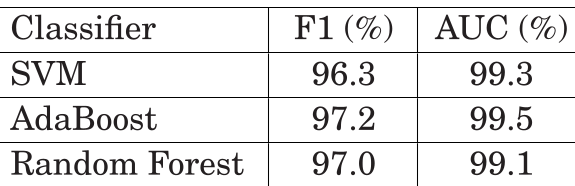 Figure 2: Comparison of different classifiers. AdaBoost takes the lead in both F1 and AUC.
The "Account Rotation" Discovery
While some manipulators were caught, 5% tried to evade detection by "rotating" accounts—writing 2 posts on Account A, switching to Account B, then C. The author tracked these by finding identical text (Jaccard Similarity) posted across different IDs within a 1-hour window. This behavior is a definitive sign of coordinated manipulation.
Critical Insight & Future Outlook
This paper serves as a wake-up call for platform administrators. The most valuable takeaway is that coordinated intent leaves a temporal footprint that is much harder to hide than a textual one.
Limitations: The study relies on a "predominant side" of campaign words to determine political inclination. In a world of deep sarcasm or multi-polar politics, this binary classification might need more nuanced Transformer-based embedding models.
Future Impact: Imagine a browser extension that places a "Warning: Likely Coordinated Campaign" badge next to suspicious posts. This work provides the mathematical foundation to make that a reality, potentially immunizing the public against digital viral misinformation.