
Predictive Sentiment Analysis: How Facebook Comments Reveal the Future of Public Opinion
Detection and Prediction of Users Attitude Based on Real-Time and Batch Sentiment Analysis of Facebook Comments
The paper proposes a hybrid sentiment analysis framework that combines real-time stream processing and batch data analysis to detect and predict user attitudes in Facebook comments. By utilizing NLTK for sentiment scoring and K-means/MB-means for unsupervised clustering of sentiment time-series, the method achieves a high prediction accuracy (Avg. MAE = 0.008) on political news topics.
TL;DR
This research moves beyond simple "thumbs up" counting by introducing a dual-stream method for Facebook comment analysis. By combining real-time event generation with batch cluster-based forecasting, the authors can predict how public attitude toward a news story will evolve with an impressive Mean Absolute Error (MAE) of 0.008.
The Blind Spot in Modern Social Analytics
Most sentiment analysis tools treat data as a static snapshot. They tell you what people think right now, but fail to answer how that opinion will shift in the next hour. Furthermore, academic focus has historically lingered on Twitter's short-form bursts, leaving the dense, context-rich environment of Facebook comments under-explored.
The authors identified a critical gap: public reaction to news isn't random. It follows specific timewise patterns. The challenge lies in detecting these patterns early enough to take proactive action—whether in political campaigning or brand management.
Methodology: Mining the Temporal Pulse
The proposed architecture is split into two specialized engines:
1. The Real-time Stream Engine
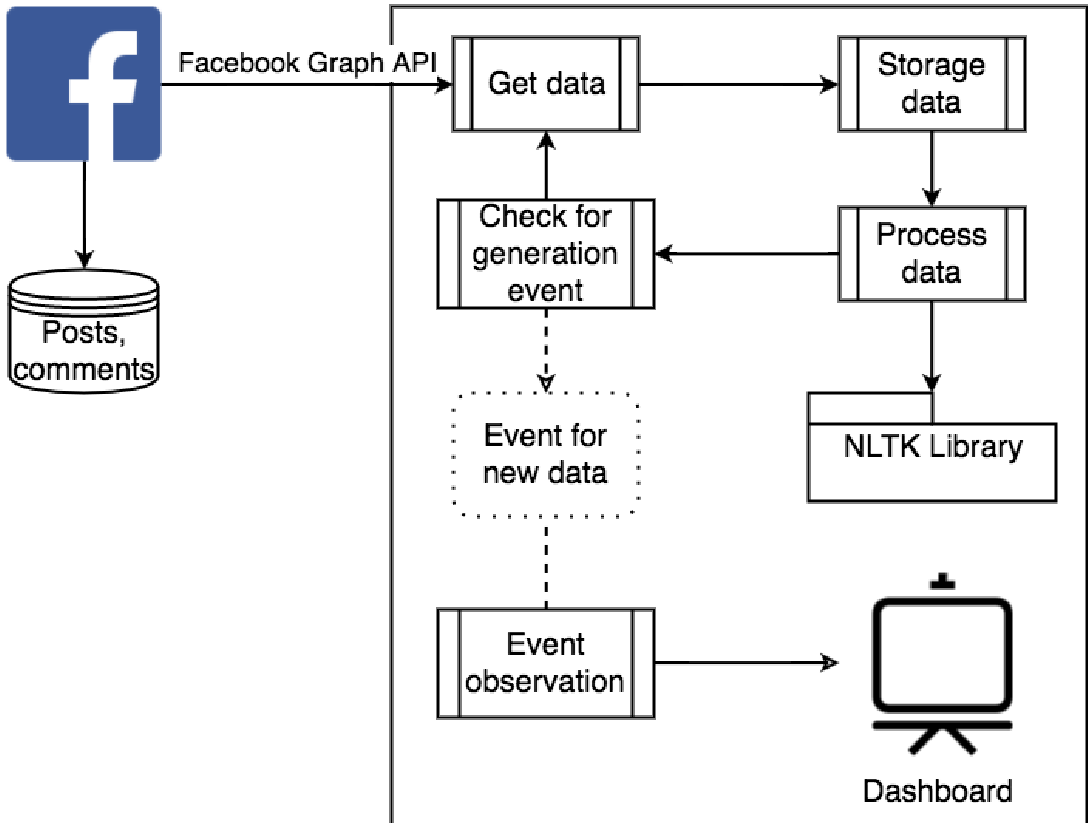
Using the Facebook Graph API and NLTK, the system retrieves data every 0.1 seconds. It functions as an "Early Warning System," generating events and updating dashboards immediately when sentiment shifts (e.g., a sudden spike in negative comments on a CNN post).
2. The Batch Forecasting Engine
Traditional forecasting often relies on complex regressions. Here, the authors use an Unsupervised Clustering Intuition:
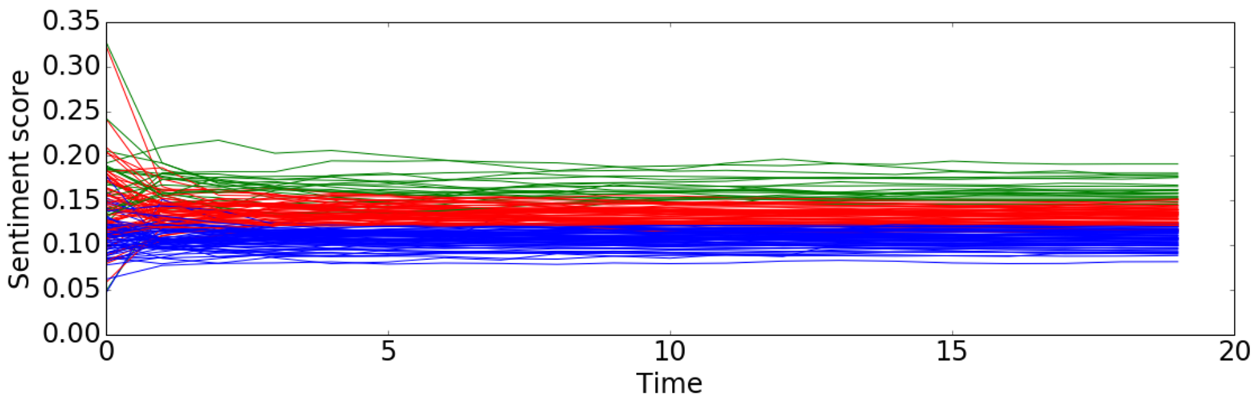
- Vectorization: Each post’s sentiment over 30,000 seconds is converted into a 20-dimensional feature vector.
- Clustering: Using K-means, they identified three "Natural Archetypes" of user behavior:
- Type 1 (The Fade): High initial interest that drops quickly and stabilizes.
- Type 2 (The Flatline): Steady, unwavering sentiment from start to finish.
- Type 3 (The Slow Burn): Starts low, peaks rapidly, then levels off.
Why This Works: The Two-Step Forecast
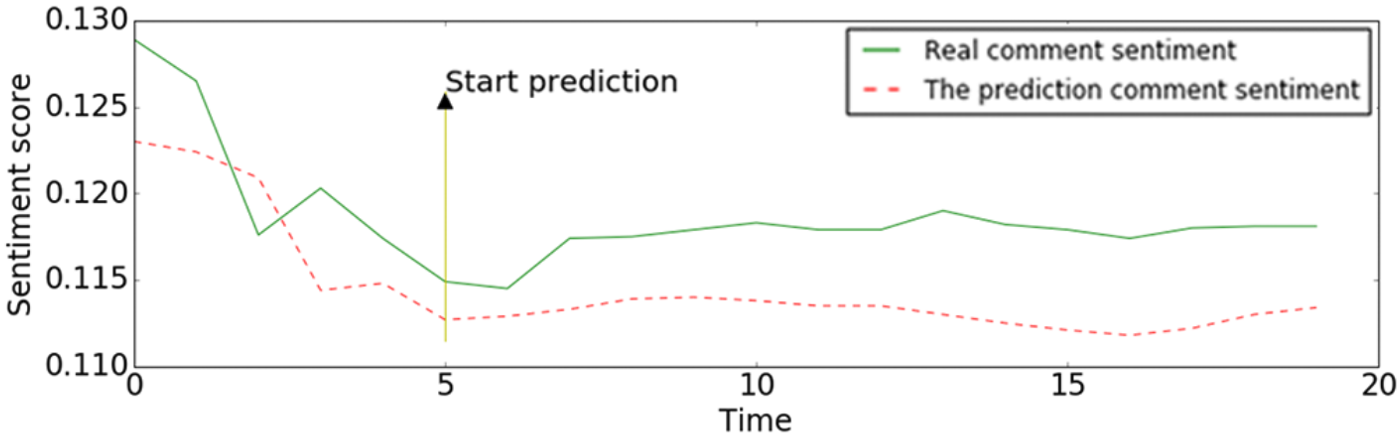
The "secret sauce" is how the model predicts the future. Instead of guessing values, it looks at the first 5 segments (the first ~1.25 hours) of a new post, finds the "nearest neighbor" cluster, and assumes the post will follow that cluster's established trajectory.
This Euclidean distance-based matching is computationally efficient and surprisingly robust, as shown in their evaluation using the 2016 U.S. Presidential Election as a case study.
Experimental Results
Tested against 200 posts and over 100,000 comments from BBC and CNN, the system proved its mettle.
- Accuracy: The predicted sentiment trend (Red Line) almost perfectly mirrors the actual data (Green Line).
- Precision: An average MAE of 0.008 indicates that the model is nearly spot-on in quantifying polarization levels.
Critical Analysis & Takeaways
This work provides a strong framework for Proactive Reputation Management. By recognizing whether a negative backlash is a "Standard Fade" or a "Slow Burn," organizations can decide whether to ignore it or launch an immediate PR intervention.
Limitations: The current model relies on NLTK's standard lexicon, which may struggle with sarcasm or regional slang (like the Vietnamese or Russian nuances the authors plan to study next). Furthermore, the reliance on a 30,000-second window might be too rigid for news cycles that last days rather than hours.
Future Outlook: Moving from K-means to more sophisticated Dynamic Time Warping (DTW) or Neural Process Models could further refine the prediction of non-linear sentiment spikes.