
Suicide Detection on Twitter: Enhancing Early Intervention via Multi-Classifier Fusion
Detection of Suicidal Twitter Posts
The paper introduces a multi-classifier fusion ensemble approach to detect suicidal ideation in Twitter posts. By combining Support Vector Machine (SVM), Naïve Bayes, and Decision Tree through majority voting, the authors achieve improved classification performance across binary, three-class, and seven-class suicide-related datasets.
TL;DR
Social media has become a primary outlet for individuals to express distress, yet identifying genuine suicidal ideation amidst the noise of the internet remains a "needle in a haystack" problem. This paper proposes a Multi-Classifier Fusion approach, combining traditional machine learning models (SVM, Decision Trees, Naïve Bayes) to categorize tweets into seven distinct categories. The study demonstrates that while individual models have specific biases, an ensemble strategy offers a more balanced and reliable detection mechanism.
The Challenge: Linguistic Nuance and Class Imbalance
In the realm of mental health surveillance, "False Negatives" are not just statistical errors—they represent missed opportunities for life-saving intervention. Previous work has faced two major hurdles:
- Semantic Ambiguity: Distinguishing between a "flippant" reference (e.g., "This exam is killing me") and "actual intent" requires sensitive feature extraction.
- The Minority Class Problem: Genuine suicidal posts are far less frequent than general reports or memorial posts, often causing models to over-optimize for the majority "Non-suicide" classes.
Methodology: The Ensemble Framework
The authors move beyond simple Bag-of-Words by implementing an N-gram strategy (up to 3-grams) to capture contextual phrases.
1. The Pipeline
The workflow follows a standard but rigorous NLP pipeline:
- Data Cleaning: Removing URLs, non-ASCII characters, and URLs.
- Feature Engineering: Comparing 1-gram vs. 1-3 gram representations.
- Fusion Strategy: Using a Majority Voting ensemble to synthesize predictions from disparate models.
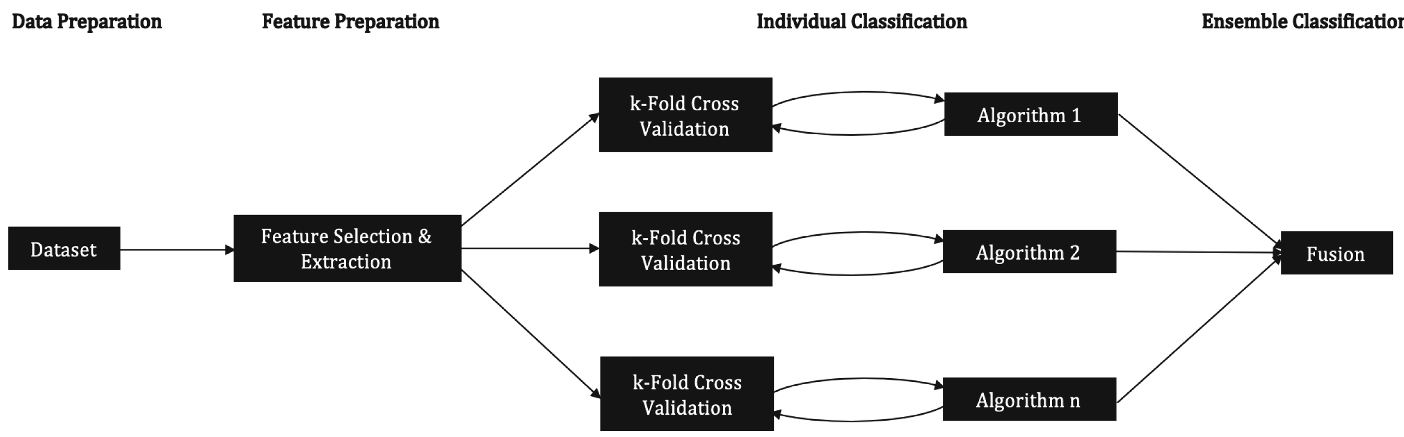 Figure 1: The Four-Stage Experimental Approach: Data Prep, Feature Prep, Individual Classification, and Ensemble Fusion.
2. The Data Split
The researchers categorized the data into three complexities:
- Binary: Suicide vs. Flippant.
- Three-class: Suicide, Flippant, and Non-suicide.
- Seven-class: Detailed breakdown including Campaign, Support, Memorial, and Reports.
Key Insights from Experiments
The results reveal a fascinating divergence in model behavior. Naïve Bayes (NB), while computationally efficient, performed poorly on its own, especially with flippant remarks. However, when integrated into the ensemble, it added a layer of diversity that improved the overall F-measure.
- SVM Supremacy: Support Vector Machines showed remarkable resilience in multi-class environments, achieving the highest F-measures for the "Suicide" class (approx. 0.80).
- N-Gram Impact: While 1-3 grams provided more features, 4-grams and 5-grams were found to be too sparse to be useful, highlighting a threshold for feature complexity in short-form text like Twitter.
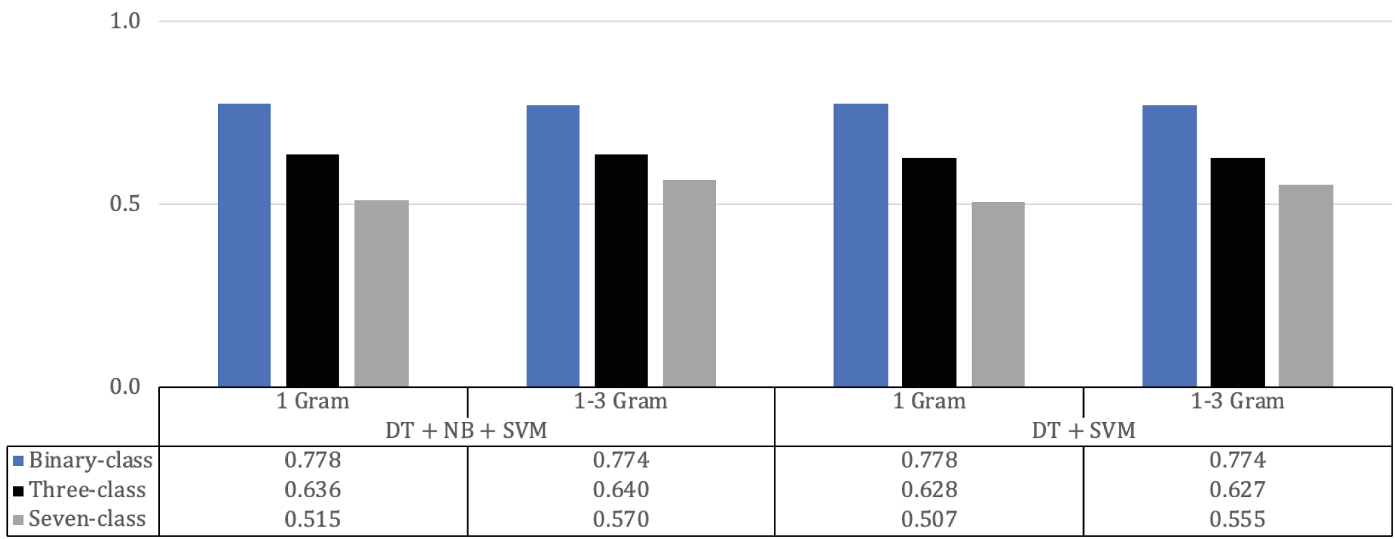 Figure 2: Performance comparison showing the Ensemble (Fusion) outperforming the baseline Random Forest across multiple datasets.
Critical Analysis: A Step Toward Proactive Safety
While the improvement from the ensemble was "marginal" compared to the best-performing individual classifier (SVM), the paper argues for the robustness of the fusion method. In a real-world deployment, relying on a single model can lead to catastrophic failure if the input distribution shifts slightly. An ensemble provides a "voted" consensus that is less prone to the idiosyncratic errors of a single algorithm.
Limitations & Future Work
The study relies on traditional ML. The next logical step, as noted by the authors, involves exploring different "fusing" weights rather than simple majority voting. Furthermore, the modern shift toward Transformer-based models (like BERT or RoBERTa) would likely offer even deeper semantic understanding of the distress signals hidden in social media text.
Conclusion
This research underscores the potential of using multi-classifier systems for high-stakes social monitoring. By refining how we categorize suicide-related communication, we move closer to an era where digital footprints can serve as an early warning system for mental health professionals.