
Beyond Retweets: Unmasking Genuine Social Influence via Granger-Causal Inference
Detection of Topical Influence in Social Networks via Granger-Causal Inference: A Twitter Case Study
The paper introduces a topical model of social influence using Granger-causal inference to distinguish between information diffusion and actual attitude change on Twitter. By representing interactions as multivariate time series of LDA-based topic distributions, it employs high-dimensional VAR models and Monte Carlo hypothesis testing to recover influence networks.
TL;DR
Is "going viral" a sign of influence or just mechanical noise? This paper argues that information cascades are poor proxies for social influence, which requires a measurable change in an individual's attitude. By applying Granger-causal inference to topical time series on Twitter, the authors find that most "influence" is actually the result of external confounders—like mass media—rather than interpersonal persuasion.
Background: The Epidemic Fallacy
In social network analysis, we often use epidemic models: a user is "infected" by a tweet and "spreads" it to others. However, the authors posit that a retweet is a change in behavior, not necessarily a change in thought. To truly detect influence, we must look at the Topical Distribution of a user's organic posts. If User A's past topics predict the new topics User B starts discussing (and B wasn't discussing them before), we have a candidate for genuine influence.
Methodology: High-Dimensional Causality
The authors move away from binary "sharing" events to a continuous, topical representation:
- Topical Decomposition: Using LDA, every user interval is mapped to a topic distribution. They specifically isolate additive change ()—the new topics a user adopts that they weren't discussing in the previous time step.
- Granger-Causal Framework: A variable Granger-causes if contains unique information that helps predict the future of .
- The Combat Against Confounders: To avoid "spurious influence" (two people talking about the same news event independently), the authors use:
- De-biased LASSO: To handle the high dimensionality of 150+ topics with limited time-series data.
- Temporal Permutation: Shuffling the influencer's timeline. If the "causal" effect remains, it was likely caused by an external event (confounder) affecting both users simultaneously.
 The core formula: Influence is measured by the magnitude of change (m) weighted by the similarity between the influencer's past and the influencee's topical adoption.
Experiments and Disillusioning Results
The study analyzed 30,000 Twitter users, focusing on "Mutual Interaction" (users who @-reply each other) as the most likely source of influence.
| Experiment Type | Positive Classification Rate (c+) | Final Influence Detected |
|---|---|---|
| Simple GC | ~32.7% | High (Includes Noise) |
| Thresholded (M+T) | ~51.5% | Moderate (Includes Confounders) |
| Full Testing (M+S) | 0.2% | Trace Amounts |
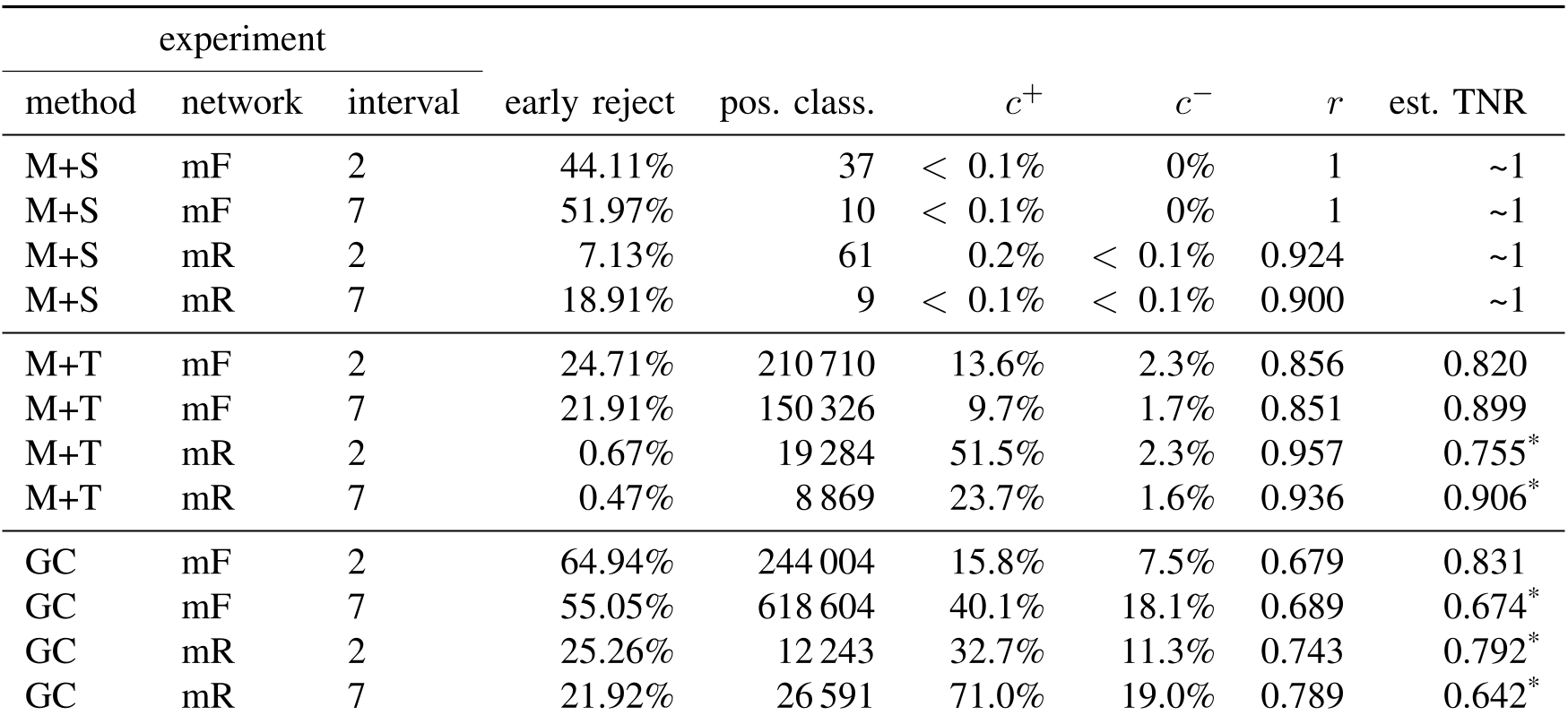 Table I: Notice how the positive classification (c+) drops drastically as the controls for confounders (significance testing) are tightened.
The results reveal a "Hierarchy of Refinement." While simple Granger tests suggest influence everywhere, rigorous statistical filtering shows that nearly all of it is "spurious." In fact, for a set of 50 randomly sampled "influenced" pairs, a human annotator found zero evidence of clear interpersonal attitude change.
Critical Insight: The Media Confounder
The paper’s most provocative conclusion is that Twitter is more of a news media platform than a social network. The "causal" signals detected are not peers talking to each other; they are thousands of individuals reacting simultaneously to the same external stimulus (e.g., breaking news, celebrity tweets, or mass media broadcasts).
Conclusion & Takeaways
- Influence is Rare: Social influence, defined as internal state change, is far less common than it appears on the surface.
- Confounders Rule the Screen: Most "diffusion" observed in social networks is driven by unobserved external factors.
- Methodological Rigor: This work provides a template for using high-dimensional VAR and surrogate data testing to debunk "spurious" SOTA results in social mining.
Future Outlook: For researchers, the next step is moving from dyadic (one-to-one) models to aggregate models—understanding how the "social climate" as a whole influences an individual, rather than hunting for a single "Influencer" who likely doesn't exist.