
The Stickiness Factor: What Really Keeps Users Loyal to Social Networking Sites?
Determinants of Customer Loyalty for Social Networking Sites
This paper presents a theoretical model to identify the determinants of customer loyalty in Social Networking Sites (SNSs). It integrates perceived value (utilitarian and hedonic), user satisfaction, and consumer knowledge (objective and subjective) into a conceptual framework to explain why users remain loyal to specific SNS platforms in a highly competitive market.
Executive Summary
In the hyper-competitive landscape of Social Networking Sites (SNSs), where platforms like Facebook and WeChat battle for every second of user attention, understanding "Loyalty" is no longer just a marketing goal—it is a survival requirement.
TL;DR: This paper explores the psychological and cognitive drivers of SNS loyalty. It moves beyond simple satisfaction to argue that loyalty is built on a trifecta of Perceived Value (Utility + Fun), User Satisfaction, and the often-overlooked factor of Consumer Knowledge about competitors. It offers a strategic roadmap for platform operators to increase "site stickiness" and reduce user defection.
Problem & Motivation: The Churn Crisis
As of the late 2000s and early 2010s, the SNS market witnessed a phenomenal surge in users, yet a paradox emerged: while total user numbers grew, individual site loyalty was fickle. Users might spend 5% of their time on one site and only 2% on another.
The authors identify a gap in the literature: previous loyalty models were built for traditional e-commerce (buying products). They did not account for the Social Capital building nature of SNSs. Why do users stay when switching costs (functionally) are zero? The researchers intuit that loyalty isn't just about being "happy" with a site; it's about the perceived value of the network and the user's awareness of what else is out there.
Methodology: The Drivers of Digital Commitment
The paper proposes a conceptual model that breaks down loyalty into manageable determinants.
1. The Value Dualism: Utilitarian vs. Hedonic
- Utilitarian Value: These are the "tools." Can I find my old classmates? Is it easy to upload photos? The functional benefit of communication.
- Hedonic Value: This is the "feel." Is the site fun? Do the interactive apps provide a sense of play and self-expression?
- The Insight: The authors suggest that Utilitarian value actually feeds into Hedonic value. A tool that works well makes the experience more enjoyable.
2. The Knowledge Paradox
One of the most sophisticated parts of this model is the inclusion of Consumer Knowledge.
- Objective Knowledge: Knowing exactly what features a competitor has.
- Subjective Knowledge: A user's perception of how much they know about the market.
- The Logic: The more a user thinks they know about alternative sites, the less loyal they are to their current one. Knowledge decreases perceived risk, making "platform hopping" more likely.
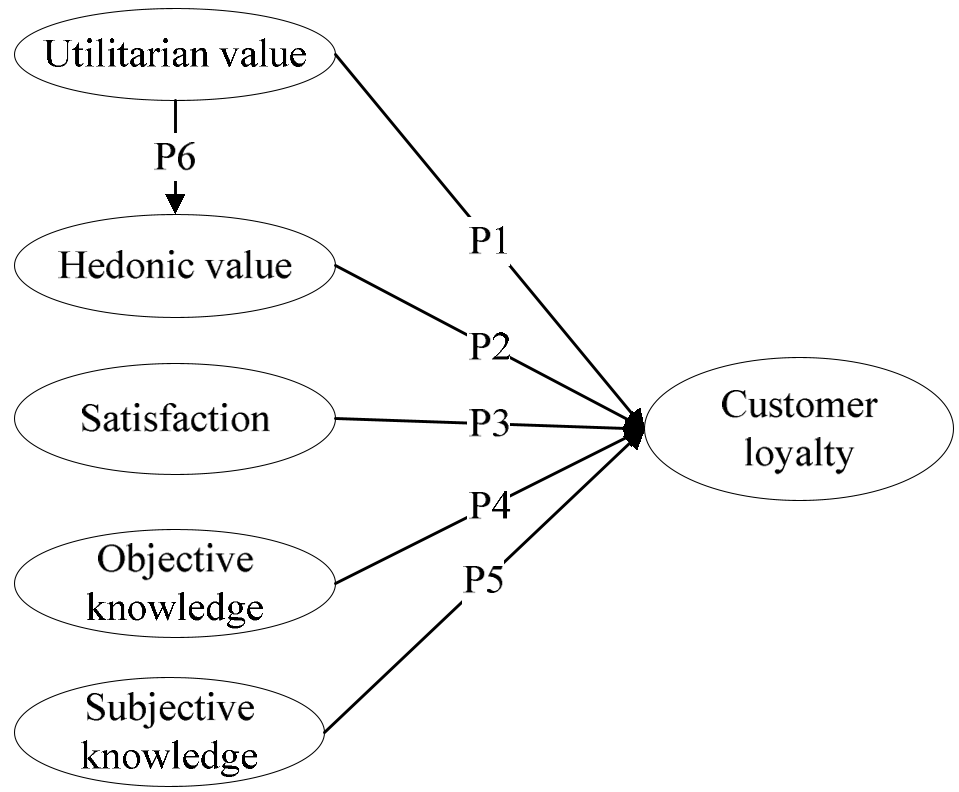
3. Proposed Research Model
Deep Dive into the Propositions
The authors put forward six critical propositions (P1-P6):
- P1 & P2: Both utility and fun drive loyalty.
- P3: Satisfaction is a baseline necessity, but specifically for e-services, when satisfaction passes a "critical level," loyalty increases exponentially.
- P4 & P5: Knowledge of alternatives is a "loyalty killer." It empowers users to evaluate and defect.
- P6: Good functionality (Utilitarian) serves as a foundation for emotional enjoyment (Hedonic).
Experiments & Results: Theoretical Validation
While this paper is primarily conceptual/theoretical, it synthesizes existing data and literature to validate its claims:
- SOTA Comparison: Unlike prior models that focus solely on "Satisfaction -> Loyalty," this model adds Value and Knowledge as critical filters.
- Quantifying the Market: The paper cites data showing that in the US and China, the disparity in "time spent" between top-tier and second-tier SNSs is massive (e.g., 5% vs 2%), validating that loyalty is the primary differentiator between market leaders and laggards.
Critical Analysis & Conclusion
Takeaway
For product managers and developers, the lesson is clear: Functionality is the floor, but Hedonism is the ceiling. To keep users, you must provide the tools they need (Utility) in a way that feels like play (Hedonic), all while being aware that your most "expert" users are the most likely to leave first.
Limitations & Future Outlook
The model, while robust, was proposed in the early era of SNS. In the current "Algo-driven" era, we might need to add "Algorithmic Personalization" as a third type of value. Future research should look at "Switchers" vs. "Stayers" to see if the knowledge paradox holds true in the age of platform saturation.
Overall, this work provides a foundational "Social Capital" lens for looking at why we stay where we post.