
Driving Digital Engagement: Why Firm-Level SNS Adoption Is More Than Just "Having a Profile"
Understanding the determinants of social network sites adoption at firm level: A mixed methodology approach
This study investigates the determinants of Social Network Sites (SNS) adoption at the firm level using a mixed methodology approach. It identifies Top Management involvement, strategic alignment, and competitive pressure as the primary drivers, ultimately explaining 65% of the variation in SNS adoption across firms.
TL;DR
Social Network Sites (SNS) are no longer optional for modern enterprises, yet many firms fail to extract value from them. This study proves that a firm's success in adopting SNS isn't about the technology itself, but about Top Management's belief, the alignment with business goals, and the brutal reality of competitive pressure.
Problem & Motivation: The Knowledge Gap in a Connected World
While billions of individuals use Facebook or LinkedIn, organizations often struggle with "Social Media Inertia." Existing literature has heavily focused on why individuals join social networks, leaving a void in our understanding of the firm-level decision-making process.
The authors argue that SNS represents a unique class of Information Technology (IT) that requires a specific mindset shift. Firms recognize the necessity of being active on social media but confess an inability to understand how to do it safely and effectively.
Methodology: A Rigorous Mixed-Mode Approach
To bridge the qualitative-quantitative divide, the research followed two critical stages:
- The Delphi Study: 25 experts distilled 27 variables down to the 10 most critical factors.
- The Empirical Validation: A survey of 247 firms was analyzed using PLS-SEM (Partial Least Squares Structural Equation Modeling) to confirm which factors actually moved the needle.
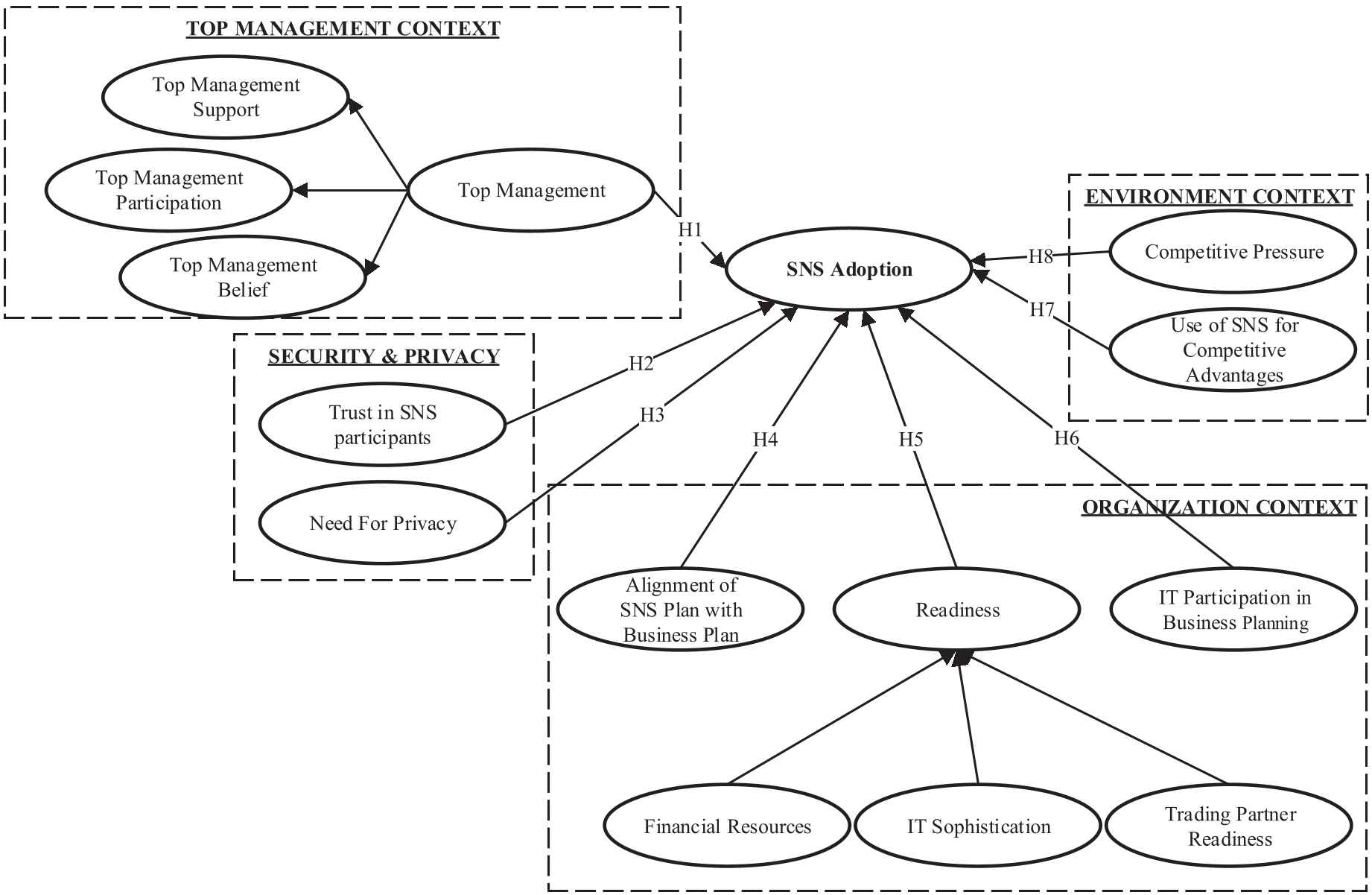
Core Insights: What Actually Drives Adoption?
1. The "Top-Down" Mandate
The single most influential factor is Top Management (H1). If executives view SNS as strategically important and are willing to allocate resources and take risks, adoption is almost guaranteed to succeed. It isn't enough for the marketing department to want a Twitter account; the "C-suite" must believe in the transformative power of the platform.
2. Competitive Pressure (The "FOMO" Effect)
The study confirms that Competitive Pressure (H8) is a massive driver. In high-instability markets, firms adopt SNS simply because their rivals have already done so. This "Institutional Isomorphism" forces laggards to digitize to maintain perceived legitimacy.
3. The Security Paradox
In a surprising twist, Security and Privacy (H2, H3) were not significant predictors of adoption. The data suggests that firms are so eager to capture ROI and market share that they treat privacy risks as a "necessary trade-off." They would rather be exposed and active than safe and invisible.
Experimental Results
The final structural model path analysis demonstrates the clear dominance of Top Management and Environment factors over organizational "readiness."
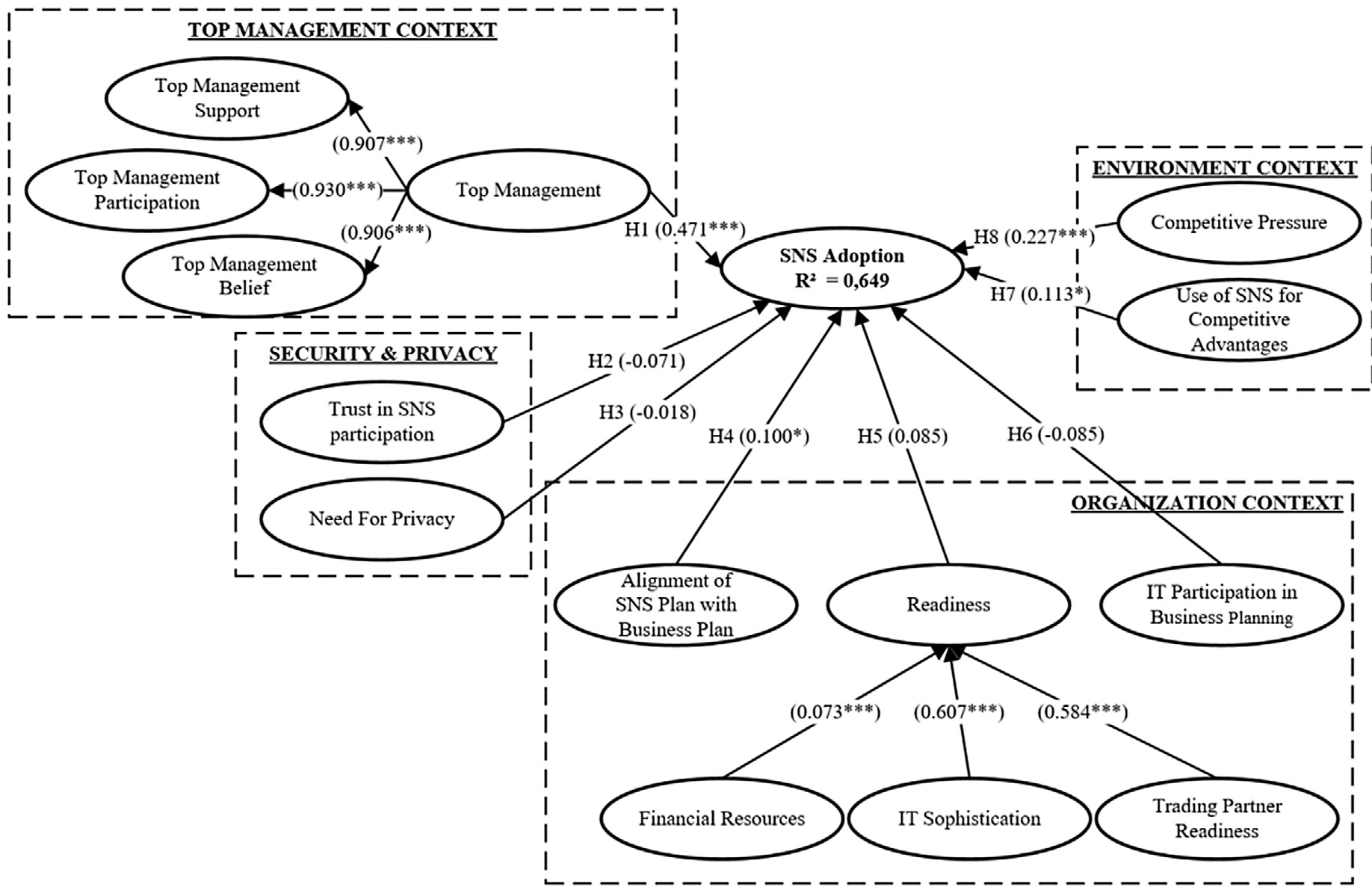
Key statistical scores:
- Total Variance Explained (): 65.5%
- Top Management Impact: (Highly Significant)
- Competitive Pressure: (Significant)
Critical Analysis & Conclusion
Takeaway
SNS adoption is a strategic choice, not a technical one. Success is predicated on Alignment—ensuring the "Social Plan" reflects the "Business Plan."
Limitations & Future Outlook
While the study provides a robust framework, it focuses on Portuguese firms. Cultural attitudes toward privacy may vary globally. Furthermore, as we move into the era of Web 3.0 and AI-moderated social structures, the "Top Management" of the future will need to balance human engagement with automated algorithms.
Future research should investigate the routinization phase—what happens after a firm adopts SNS? How does it become a core competency rather than a digital checkbox?