
The Architecture of Trust: How We Decode Credibility from Social Graphs
Determining credibility from social network structure
The paper investigates how users determine the credibility of information in social media using only network structure. Through human-subject experiments with a simulated platform ("FaceFriend"), the authors identified that social network properties like consensus and degree centrality are the primary heuristics for trust when biographical context is absent.
TL;DR
When you see a tweet or a post from a stranger, how do you decide to believe it? While most research looks at "blue checks" or profile bios, this study proves that humans are intuitive graph theorists. By simulating social interactions, researchers found that we rely heavily on Consensus (multiple people saying the same thing) and Degree Centrality (popularity) to navigate the "truthiness" of digital information.
Background: Beyond the Profile Picture
In the hyper-connected world of social media, we frequently interact with "alters"—people outside our immediate circle. During humanitarian crises or breaking news events, we don't have time to verify a source's resume. Instead, we look at their position in the network. This paper moves away from socio-linguistics and explicit reputation badges to ask: Can the geometry of a network alone signal truth?
Methodology: The "FaceFriend" Experiment
The researchers developed a mock social platform called "FaceFriend." Participants were presented with conversation threads and a corresponding social network graph.
- Isolation of Variables: The study stripped away names, profile photos, and "likes."
- Structural Properties: They manipulated factors such as Geodesic Distance (how many hops away is the source?) and Consensus (do two unrelated parts of the graph agree?).
- Metric: Subjects ranked commenters by how likely they were to be telling the truth.
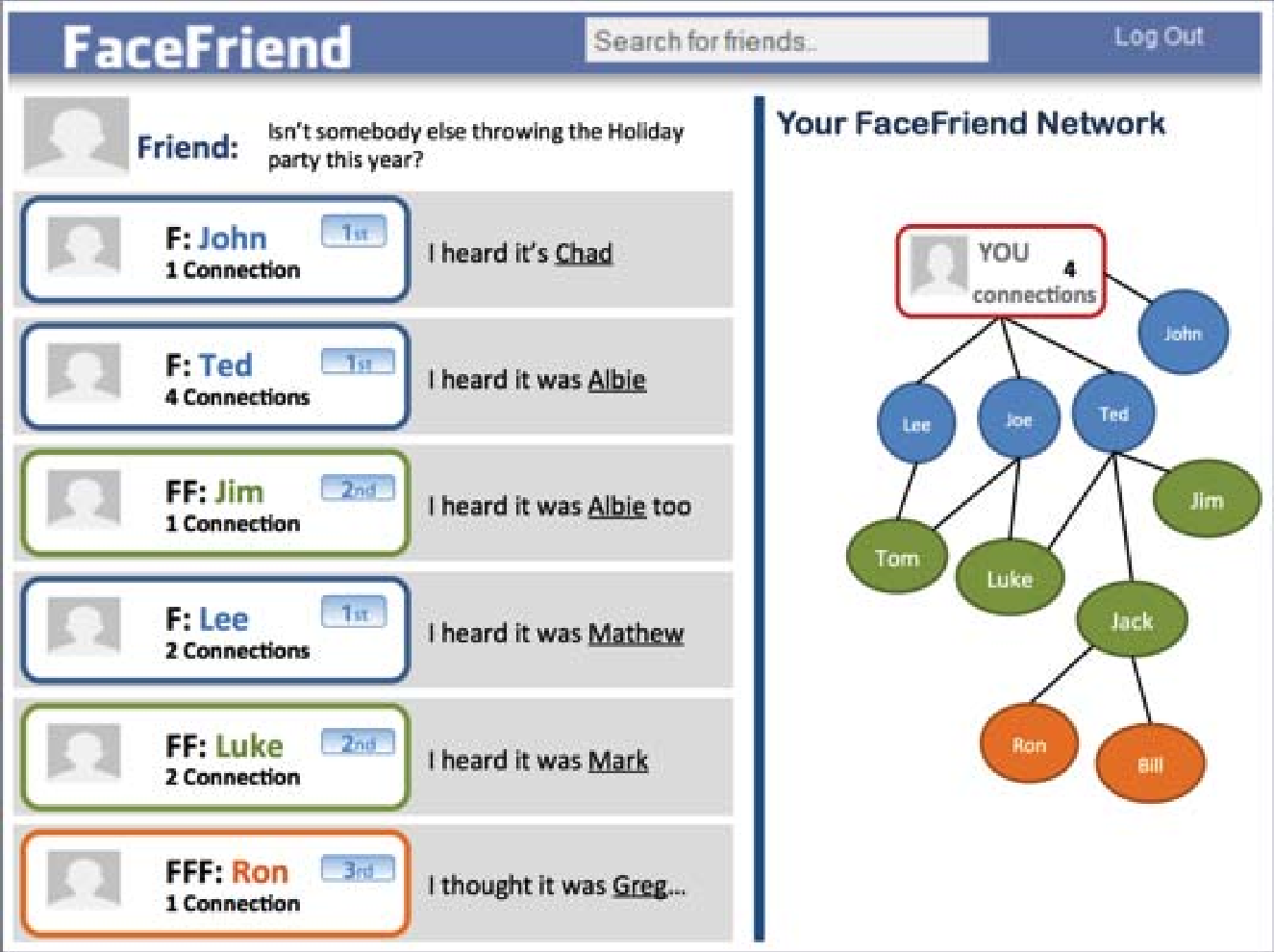 Figure 1: The experimental setup showing the conversation thread alongside the undirected social network graph.
Core Insights: What Makes a Source Credible?
The results revealed a clear hierarchy of structural trust signals:
- Corroboration is King (Consensus): If two different people in the network agree on a fact, subjects overwhelmingly rated that information as more credible, even if they didn't "know" the sources.
- The "Popularity" Bias (Degree Centrality): High degree centrality—having many connections—translated directly to perceived authority. One participant noted, "Pat has the highest number of connections, so she must be right."
- Proximity Matters (Geodesic Distance): We are hard-wired to trust "Level 1" friends more than "friends of friends." Distance functions as a decay factor for trust.
Visualizing the Data: The PCA Analysis
By applying Principal Components Analysis (PCA) to the node features, the authors visualized how different network properties cluster to form a "credibility space."
Note: The study utilized PCA to show that the first component (dominated by degree and consensus) accounts for the majority of how humans rank credibility.
Experimental Performance Comparison
The Friedman test confirmed that these preferences weren't random. Looking at the Mean Ranks below, a lower number signifies higher credibility:
| Property | Trial 2 Mean Rank | Trial 3 Mean Rank |
|---|---|---|
| Consensus | 1.67 | 1.39 |
| Degree Centrality | 2.55 (combined) | 2.79 |
| Overlap | 3.47 | N/A |
| Contrast (Low metrics) | 4.14 | N/A |
Critical Analysis & Conclusion
This work highlights a fascinating cognitive shortcut: Structural Schemata. Humans use "compression heuristics" to manage the overwhelming complexity of social networks. We don't remember every connection; we remember the "shape" of the network and use it as a proxy for reliability.
Limitations: The study was conducted in a controlled environment with Georgia Tech students. In the real world, "coordinated inauthentic behavior" (bots) can easily spoof high degree centrality and consensus, meaning our natural structural heuristics may actually make us more vulnerable to sophisticated misinformation campaigns.
Future Outlook: For developers building decentralized social protocols (like Lens or Farcaster), these findings are a goldmine. They suggest that credibility shouldn't just be an "upvote" count, but a dynamic score derived from the user's structural position and the independence of their corroborators.