
Designing the Middle Ground: A Stackelberg Approach to Social Network Privacy
Determining a Discrete Set of Site-Constrained Privacy Options for Users in Social Networks Through Stackelberg Games
This paper introduces a game-theoretic framework based on Stackelberg games to determine an optimal discrete set of privacy options for Social Network (SN) sites. It models the site as the leader and users as followers to balance content sharing maximization with user satisfaction, validated through a mock-SN user study.
TL;DR
Social network sites want you to share everything; users want to feel safe without needing a PhD in settings management. This paper bridge this gap using Stackelberg Games. By modeling the site as a strategic leader and users as followers influenced by both their internal "comfort zone" and "peer pressure," the researchers developed an algorithm to find a discrete set of privacy options that keeps everyone happy—and the data flowing.
Background: The Default Trap
Most users never change their privacy settings. Why? Because the choice is often binary (Public vs. Private) or too complex (custom lists). This paper recognizes that the Social Network (SN) site is a business. Its payoff depends on User Involvement (sharing) and User Satisfaction. If the site forces everyone to be public, users leave; if it’s too private, the site dies. The goal is to find the "sweet spot" of discrete options (e.g., Friends, Friends of Friends, Public) that optimizes this trade-off.
Methodology: The Math of Social Influence
The researchers define a two-level game.
1. The User's Dilemma
Each user acts to minimize a dissatisfaction function . This function is a weighted sum of two forces:
- Personal Comfort (): Staying close to an ideal sharing level .
- Peer Pressure (): Not straying too far from what their neighbors in the social graph are doing.
2. The Site's Strategy
The site (the Leader) chooses a set of discrete levels . It wants to maximize its payoff, involving the amount of content shared and overall user "happiness" (weighted by ).
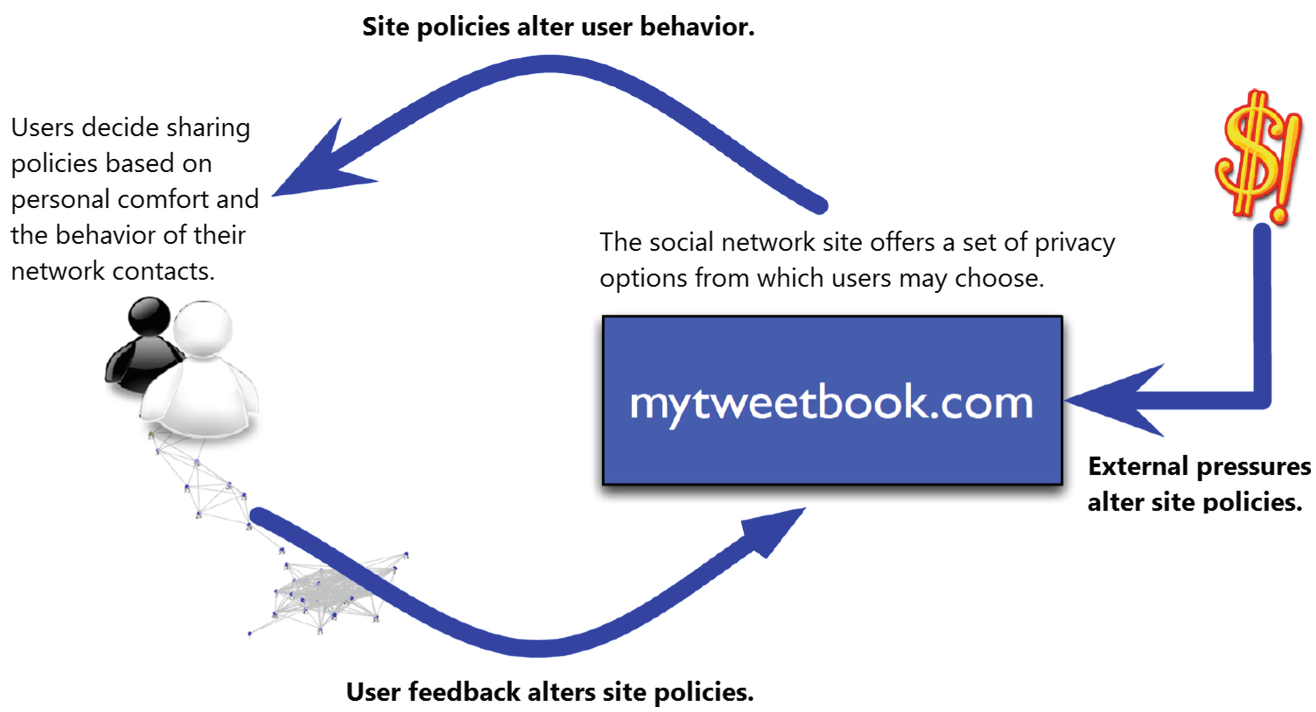
3. The Approximation Algorithm
Since solving bi-level combinatorial optimization is NP-hard, the authors propose a Site Algorithm. It starts with a base privacy level and iteratively adds new, higher sharing options (), simulating user response via Fictitious Play. If the site's payoff increases, the new option is kept.
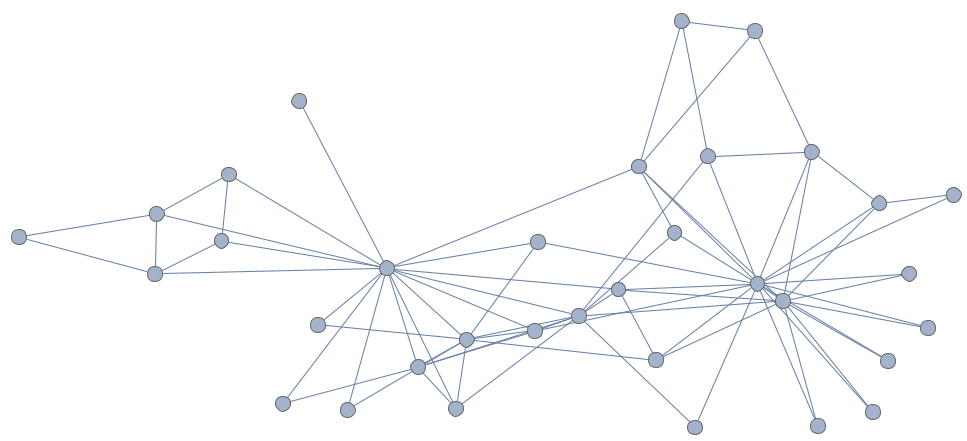
Experiments: Do Humans Actually Follow the Model?
To validate the theory, the authors conducted a study with 60 participants using a mock social network.
Key Insights:
- Peer Pressure is Asymmetric: Users were far more likely to become more private if their friends did so ("skew-down") than they were to become more public if their friends loosened up.
- Iterative Stability: Crucially, the researchers found that building the set of options "one-by-one" (the approximation method) resulted in the same user choices as offering them all at once. This proves the algorithm is a reliable proxy for real-world behavior.
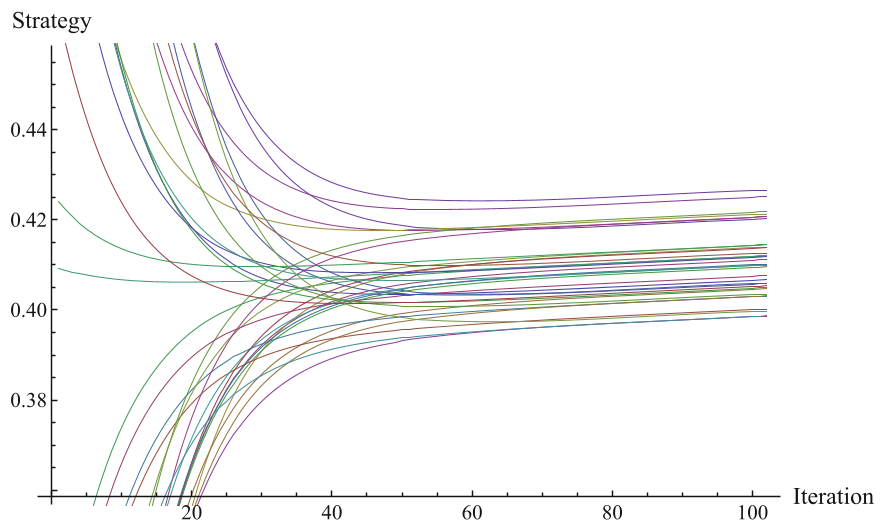 Visualizing how users' strategies converge to an equilibrium based on peer influence and personal comfort on the famous "Karate Club" social graph.
Critical Analysis & Conclusion
Takeaway
The study successfully moves privacy from a purely "legal/compliance" discussion to an "optimization" discussion. By treating privacy options as a discrete set of points in a game, SN sites can mathematically predict how a change in policy (like making "Cover Photos" public) will ripple through the network.
Limitations
- Captive Audience: The model assumes users stay on the platform. In reality, a bad privacy shift causes "churn" (users leaving for X or Mastodon).
- Symmetric Weights: The proof for Nash Equilibrium rely on symmetric influence (), which rarely happens in real life (celebrities influence fans more than vice-versa).
Future Outlook
This framework could be extended to Multi-modal Privacy. For example, a user might be comfortable sharing their "Gender" publicly but "Location" only with close friends. Future iterations of this model could help platforms automatically suggest "Privacy Tiers" tailored to specific communities or content types.