
Decoding Political Intent: Why External Language Models Edge Out Active Learning in Tweet Classification
Determining the Function of Political Tweets
This paper investigates the automatic classification of political tweet functions using the fastText machine learning framework. To overcome the high cost of manual annotation for social media discourse analysis, the authors evaluate techniques including weakly supervised learning, active learning, and pre-trained language models on a Dutch dataset.
TL;DR
Determining the "function" of a tweet (e.g., is it a campaign promotion or a critique?) is a notoriously subjective task. Researchers from the University of Groningen found that while simple machine learning (fastText) struggles with this task, the most effective way to boost performance isn't necessarily more clever sampling (Active Learning) or self-labeling, but rather the injection of massive "background knowledge" via language models trained on millions of unannotated tweets.
The Challenge: The Subtle Art of Political Discourse
In the realm of political science, understanding how politicians talk is as important as what they talk about. However, labeling tens of thousands of tweets manually is commercially and academically expensive. More importantly, political language is fluid, full of jargon, and highly contextual.
The authors identify a significant ceiling: humans only agree on these labels about 71% of the time (Kappa score of 0.66). This inherent ambiguity makes it a "hard" NLP problem where traditional supervised learning often hits a plateau.
Methodology: Searching for the Performance Booster
The researchers used a dataset of 55,029 Dutch tweets from the 2012 elections, categorized into 12 functional topics. They utilized fastText, a library known for its efficiency and use of subword information, as their baseline.
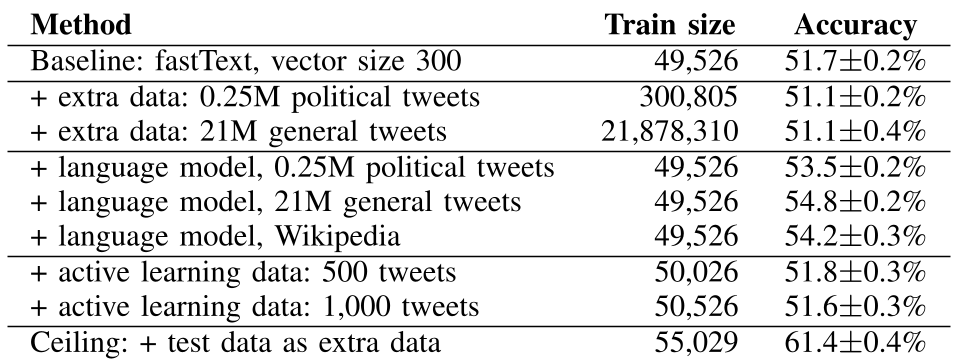
To push past the baseline accuracy of 51.7%, they tested three distinct strategies:
- Weakly Supervised Learning: Using the model to label 250k new tweets and then retraining on that "artificial" data.
- Active Learning: Selecting the 1,000 "hardest" tweets for manual annotation to maximize the information gain per label.
- External Language Models: Leveraging Skipgram word vectors pre-trained on a massive 21-million-tweet general corpus.
Key Insights: Why "More Data" Isn't Always the Answer
The experimental results yielded several counter-intuitive findings that challenge common machine learning heuristics:
1. The Failure of Weak Supervision and Active Learning
Standard wisdom suggests that more data—even if noisy—helps. However, adding 21 million self-labeled tweets actually decreased accuracy slightly (to 51.1%). This suggests that for highly subjective tasks, the model's own errors are compounded during self-training, leading to "model collapse" or reinforcement of its own biases. Similarly, 1,000 extra manually labeled tweets via active learning were insufficient to move the needle.
2. The Power of "Background" Semantic Knowledge
The only method that provided a statistically significant boost was the use of external word vectors. By training Skipgram models on 21 million general Dutch tweets, the model learned the "thesaurus" of the language. Even if a specific word wasn't in the small training set, the model knew it was semantically similar to a known word (e.g., "rally" being close to "campaign event").
3. General vs. Domain-Specific Data
Interestingly, vectors trained on general tweets (21M) outperformed those trained on political tweets (0.25M) and Wikipedia. This suggests that for social media tasks, the "noise" and informal structure of general Twitter data are more valuable than the formal structure of Wikipedia.
Critical Analysis & Conclusion
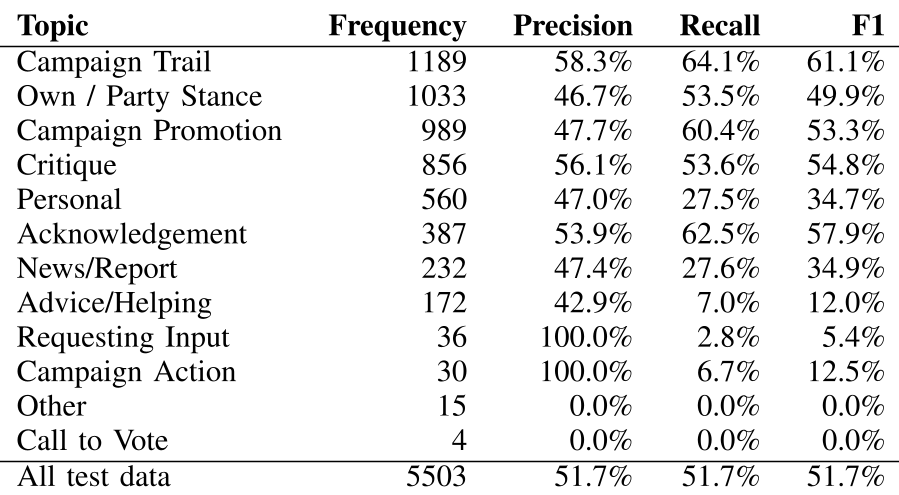
While the 54.8% accuracy achieved is a notable improvement over the 51.7% baseline, it remains far below the 71% human agreement ceiling. This gap highlights the limitations of "Bag-of-Words" style architectures like fastText, which ignore word order and complex syntactic nuances.
Takeaway for Practitioners: If you are working with limited annotated data in a niche domain, don't rush to label more data or implement complex active learning loops immediately. First, ensure your model is grounded in a high-quality, large-scale language model or embedding space derived from the same medium (e.g., Twitter, legal docs, or medical notes) as your target task.
Future Outlook: The authors suggest that even larger language models could close the gap. In the current era of LLMs, the logical next step would be moving from static embeddings to contextual embeddings (like BERT) or zero-shot classification with Generative AI, which could better navigate the "discursive practices" the authors wish to decode.