
Beyond Simple Cliques: Scaling Galois Lattices for Complex Social Structures
Determining groups from the clique structure in large social networks
This paper presents two algorithms for identifying group structures in large-scale social networks using Freeman's clique-lattice analysis and Galois lattices. The primary contribution is a modified technique that exploits layered clique overlap patterns to reveal hierarchical group refinements, which successfully partitions organizations where traditional clique-bridging methods fail.
TL;DR
Social network analysis often struggles to balance the rigidity of "cliques" with the messy reality of large organizations. This paper introduces an algorithmic framework based on Galois lattices to systematically partition networks. By moving beyond Freeman’s classic "bridging clique" removal, the authors develop a layered overlap technique that preserves core members and reveals a hierarchical refinement of work groups in a 113-person military dataset.
The Scalability Wall in Group Detection
Ethnographers define groups by interaction and affective ties, but translating this into a mathematical model is notoriously difficult. While a clique (a maximal subnetwork where everyone knows everyone) seems like a logical building block, it is often too small and restrictive.
Linton Freeman previously suggested using Galois lattices—algebraic structures representing overlap patterns—to find "bridging cliques" that link larger groups. However, the author of this paper discovered a critical flaw: in large, dense networks, the original "bridging" definition is too aggressive. It often labels the most central, influential people as "bridges" and deletes them, leaving the resulting group structure hollowed out and inaccurate.
Methodology: The Geometry of Overlap
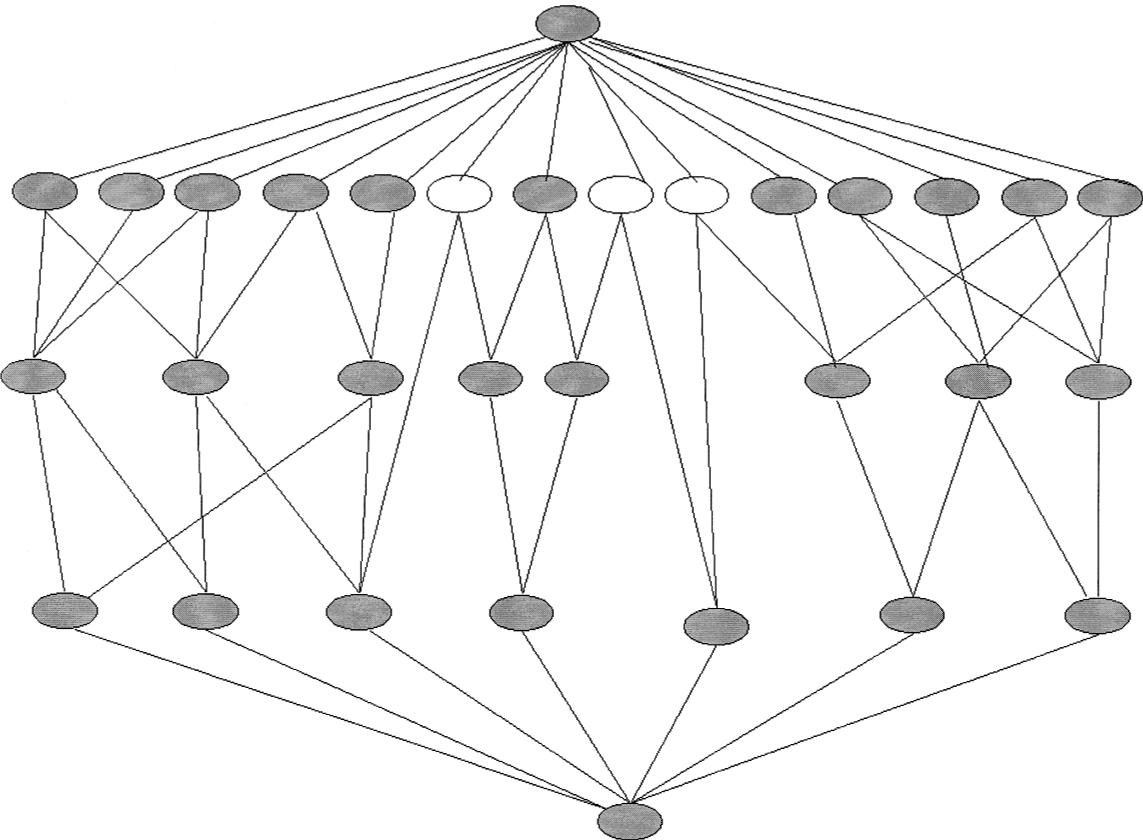
The core innovation lies in how the Galois lattice is traversed. A Galois lattice maps the relationship between actors and the cliques they inhabit.
1. The Lattice Construction
Nodes in the lattice represent sets of actors. The top represents sparse individual memberships, while the bottom (the universal lower bound) represents the intersection of all cliques.
2. The Modified Overlap Algorithm
Instead of identifying and removing "inconsistent" bridging cliques (which the authors found removed 62 out of 77 cliques in their large dataset), the modified algorithm:
- Iterates through each Layer of the lattice.
- Computes a binary overlap relation between node sets.
- Defines groups as the transitive closure of these overlaps, creating disjoint subsets.
- Ensures inclusion by compiling "node label sets" (actors exclusive to specific nodes) to prevent peripheral members from being lost.
Experimental Validation: A Military Case Study
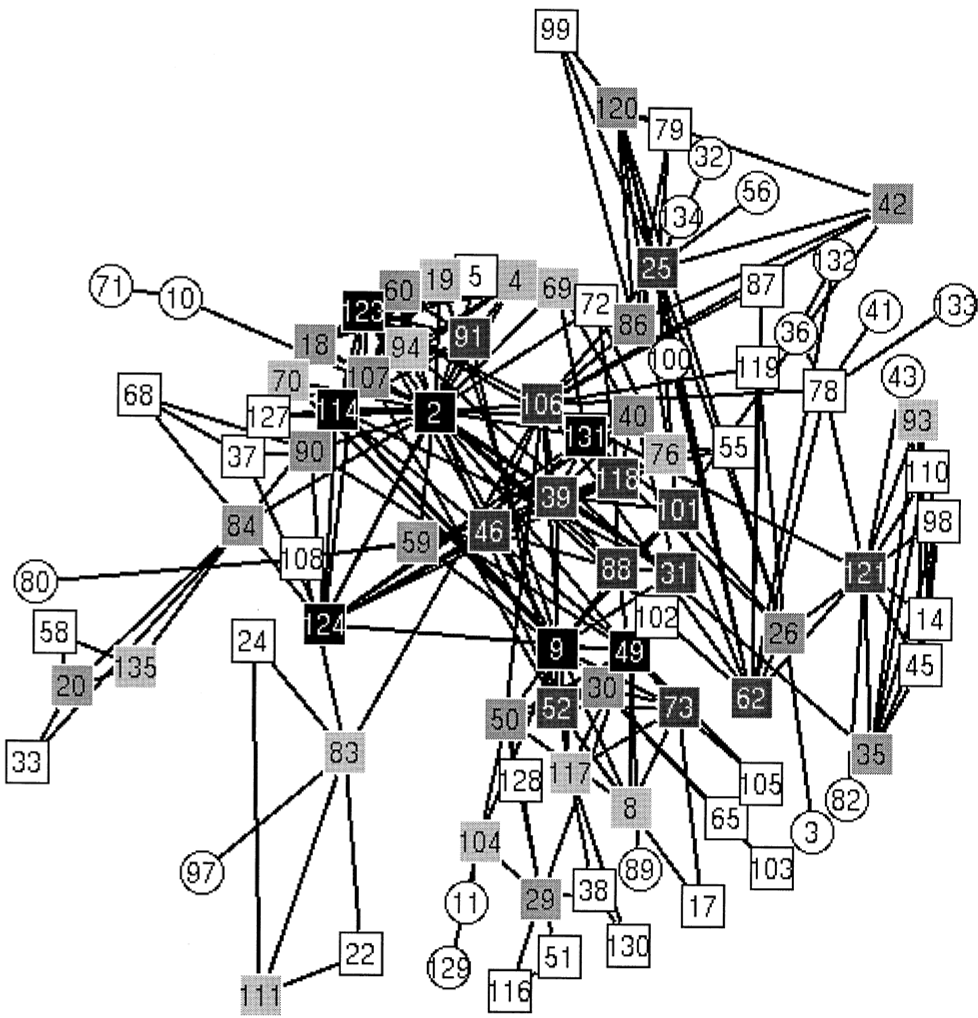
The researchers applied their method to a military organization's information flow (113 subjects). Using reciprocated high-weight links (importance 4 or 5), they mapped the "core business" interactions.
- The Problem with the Baseline: The original Freeman method failed to assign 48 out of 79 active clique members to any group because they were tied to "bridging" nodes.
- The Modified Success: As the algorithm moved from Layer 3 to Layer 5, large groups naturally fractured into smaller, specialized units. These weren't random; they corresponded perfectly to real-world work disciplines (e.g., specific technical units).
Depth and Status
One of the most profound insights is the concept of Actor Depth. An actor's depth in the lattice—how many links exist from the top to the lowest node they appear in—serves as a proxy for their status or "coreness." Core members appear deep in the lattice, effectively acting as the glue for multiple overlapping cliques.
Critical Insight & Conclusion
This work demonstrates that group structure is not a flat partition but a hierarchical evolution. The "bridging clique" technique is a specific case that works for simple, 3-layer lattices, but fails as networks grow in complexity.
The modified technique provides a filter for organizational noise: it correctly identifies individuals 40 and 101 as true "structural holes" (bridges) because they remain unassignable even at the most refined layers, while successfully clustering the rest of the core personnel—something prior methods could not achieve.