
Persistence Matters: Identifying the "Spine" of Evolving Social Networks
Determining interesting communities in evolving social networks
This paper introduces a methodology for identifying "interesting" communities in evolving social networks using snapshot-based and incremental construction methods. By tracking community membership via Jaccard similarity across time, the authors define new persistence metrics—Stable, Resistant, Spinal, Cohesive, and Preserved communities—to highlight groups that maintain long-term structural integrity.
TL;DR
In the fluid world of social networks, most communities are fleeting. This paper provides a rigorous framework to identify those that aren't. By analyzing temporal graphs through two distinct modeling lenses—Snapshot-based for transient events and Incremental for permanent ties—the authors successfully isolate "Spinal" and "Resistant" communities that define the long-term structure of a network.
The Dynamic Dilemma: Why Static Clusters Aren't Enough
Community detection is a staple of Network Science, but treating a social network as a static frozen image is a major oversimplification. In reality, nodes join and leave, and edges vanish and reappear. Prior work often struggled to bridge the gap between "temporal slices" (where a community exists at time ) and "evolutionary continuity" (whether the cluster at is actually the same social unit).
The authors' core insight is that persistence is the ultimate validator of community importance. Instead of looking for the densest group at a single moment, we should look for the groups that survive the "test of time."
Methodology: Two Ways to Build a History
Because not all networks behave the same way, the researchers proposed two strategies for snapshot construction:
- Snapshot-based Approach: Each edge belongs only to the time-window it was created in. This is ideal for transient interactions like sending an email.
- Incremental Approach: Snapshots grow cumulatively, including all edges from the beginning up to time . This is better for permanent relations, such as a citation in a paper or a friendship link.
Tracking Continuity
To track a community's survival, they used the Jaccard Index, modified to account for the increasing density in incremental snapshots.

The paper defines several high-value community types:
- Stable: Lives longer than a specific percentage of the network's total lifespan.
- Resistant: A stable community that never disappears once it forms.
- Spinal: The "Holy Grail" of clusters—existing from the very first snapshot to the last.
Experimental Results: The Resilience of the "Spine"
The methodology was tested on an Email dataset (transient) and a Physics Citation dataset (permanent).
Modularity Dynamics
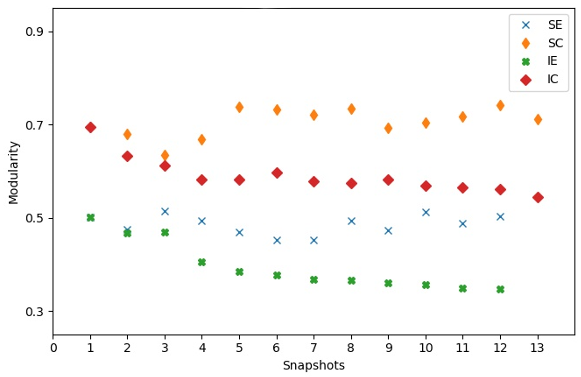
The authors tracked Modularity (), which measures the quality of clustering. Interestingly, they found that as incremental networks grow, modularity tends to decrease because the network becomes a "giant component," making it harder to find perfectly isolated clusters.
The "Spinal" vs. "Stable" Contrast
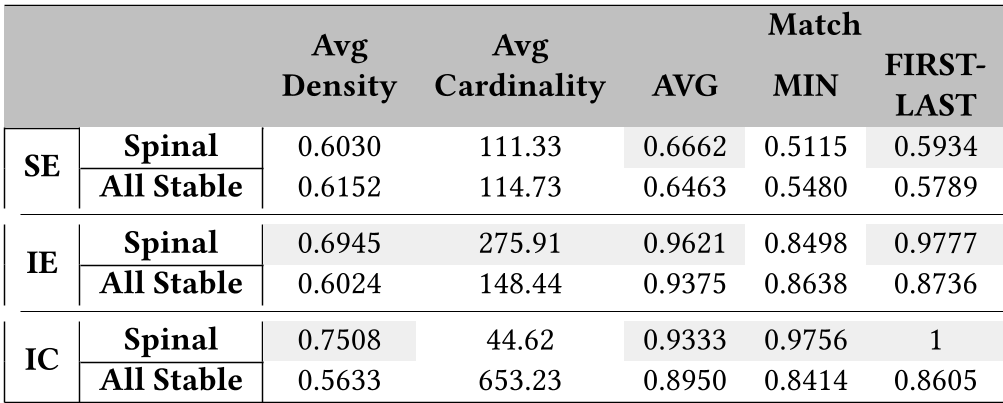
The most striking result (Table 4) shows that Spinal Communities are consistently denser than the average stable community. In the Citation-Incremental (IC) dataset, the Spinal community maintained a nearly perfect match index (1.0) between its first and last state, suggesting a remarkably resilient core of researchers that stayed together throughout the observation period.
Critical Insight & Conclusion
The value of this paper lies in its realization that longevity and density are correlated. Finding the "Spine" of a network allows researchers to filter out the noise of ephemeral interactions and focus on the structural foundations of social systems.
Limitations: The reliance on the CNM algorithm (which can be slow for massive graphs) and the manually defined thresholds for "matching" mean that results are sensitive to parameter tuning. Future work utilizing overlapping community detection or incremental clustering (where the previous state informs the current one) would likely yield even more nuanced results.
Takeaway: In any evolving system, look for the "Spine"—the high-density, high-match core—to understand the true trajectory of the network.