
Deciphering the Hierarchy: Determining Cluster Counts via Social Network Theory
Determining the Number of Clusters in Co-authorship Networks Using Social Network Theory
This paper proposes a social network theory-based method to determine the number of clusters (k) for spectral clustering in co-authorship networks. By identifying "group leaders" using Support Vector Machines (SVM) combined with centralities and a leader-merging algorithm, the method effectively finds the optimal community count, outperforming standard heuristic approaches.
In the realm of complex network analysis, identifying communities is akin to finding the hidden anatomy of data. While Spectral Clustering has long been the gold standard for identifying non-convex, global optimal structures, it suffers from a "Catch-22": you need to tell the algorithm how many clusters exist before it can find them.
This paper, authored by Qinxue Meng and Paul J. Kennedy, pivots away from purely statistical eigenvalue analysis and looks toward Social Network Theory to solve the "k-selection" problem.
TL;DR
The study introduces a novel pipeline for spectral clustering:
- Rank nodes via Centrality measures.
- Use SVM to classify "Group Leaders."
- Merge redundant leaders based on common neighbors.
- Use the resulting count as the input for Spectral Clustering. The result? A staggering Modularity of 0.984, leaving traditional methods in the dust.
The Motivation: Why Eigenvalues Aren't Enough
Traditional methods like the Scree Graph or Cumulative Percentage Variance treat the network as a generic matrix. They look for "elbows" or "gaps" in the eigenvalue plot. However, in real-world social networks (like the UTS co-authorship database used here), these gaps are often blurry or non-existent due to noise and overlapping collaborations.
The author’s insight is simple but profound: Communities in social networks are organized around leaders. If we can count the leaders, we can count the clusters.
Methodology: From Centrality to SVM
The authors define a "Leader" as a node that displays two specific behaviors:
- High Degree Centrality: They communicate frequently within their cluster.
- High Betweenness Centrality: They serve as bridges to other clusters.
1. The Classification Phase
By mapping these two features into a feature space, the authors use a Support Vector Machine (SVM) with a Gaussian kernel. This treats leader-detection as a classification task rather than a purely structural one.
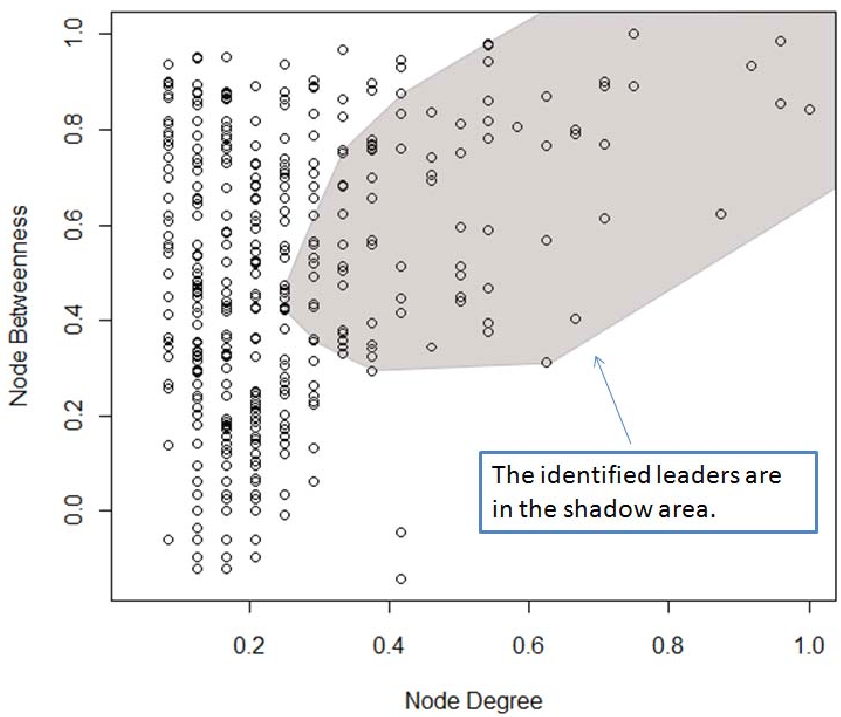 Above: The distribution of nodes in terms of degree-centrality (X-axis) and betweenness-centrality (Y-axis), showing how leaders emerge as outliers.
2. The Merging Algorithm
A single group (like a research lab) might have multiple "leaders" (e.g., a Professor and a Senior Postdoc). To avoid overestimating the cluster count, the authors implement Algorithm 1:
- If two identified leaders share more than two common neighbors, they are merged into a single representative unit.
Experiments: Does it actually work?
The researchers tested their approach on the UTS Research Master Enterprise (RME) database, a dataset representing a two-mode network of researchers and publications.
Performance Comparison
The study compared three methods for choosing the number of clusters:
- Cumulative Variance: Suggested 298 clusters.
- Scree Graph: Suggested 812 clusters (highly over-segmented).
- Proposed Social Method: Suggested 206 clusters.
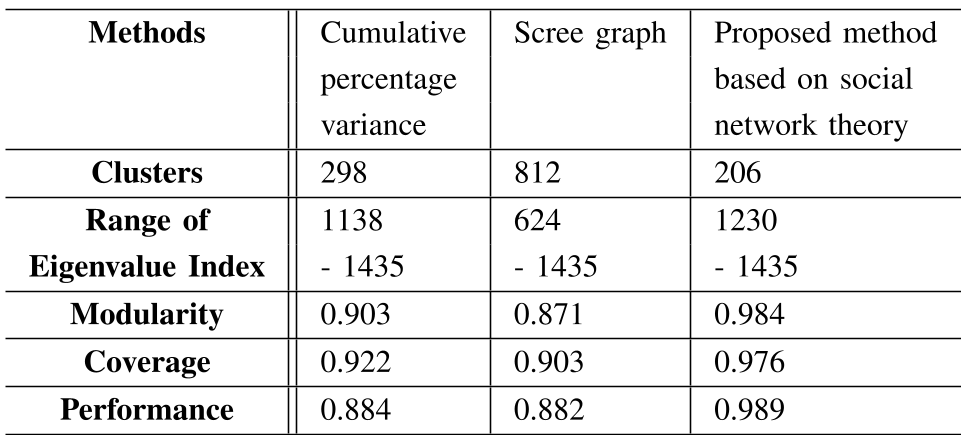
The metrics tell the story: The Social Network Theory approach achieved the highest Modularity (0.984), Coverage (0.976), and Performance (0.989). This suggests that the 206 clusters identified were far more representative of actual research collaborations than the mathematically "suggested" counts of traditional methods.
Critical Insight: The "Physics" of Social Groups
The success of this method lies in the Inductive Bias it introduces. Standard spectral clustering assumes that the "importance" of a node is captured entirely by the Laplacian's eigenvectors. This paper argues that local topology (centrality) and social hierarchy (leaders) are better proxies for determining the global scale of the network.
Limitations:
- Supervised dependency: The method requires a training set of known leaders/members to calibrate the SVM.
- Complexity: While more accurate, it adds a classification and merging step before the actual clustering begins.
Conclusion
Meng and Kennedy have effectively bridged the gap between Social Science and Matrix Topology. This work proves that when dealing with human-centric data—like co-authorship—the most accurate mathematical solutions often come from observing the social dynamics that created the data in the first place.