
From Clicks to Customers: Quantifying Relationship Marketing via Web Mining
Determining the performance of website-based relationship marketing
This paper presents a methodological framework that integrates web mining with Relationship Marketing Strategies (RMS) to evaluate corporate website performance. By analyzing 477,471 visitor sessions, the authors quantify how website structure and content moderate the effectiveness of brand equity building, relationship maintenance, and customer satisfaction.
TL;DR
To bridge the gap between technical web metrics and business value, this paper introduces a framework that transforms raw clickstream data into strategic insights. By aligning visitor activities—like browsing and fact-finding—with core marketing strategies such as brand equity and customer satisfaction, the authors provide a rigorous method to audit whether a website actually serves its intended business purpose.
Context: The Measurement Vacuum
In the digital age, a corporate website is the "window" through which the world views a company. Yet, most firms are flying blind. They either use surface-level metrics (e.g., page views) that don't reflect loyalty, or they focus solely on final transactions, ignoring the complex relationship-building that happens in between. This paper argues that Relationship Marketing Strategies (RMS) must be the yardstick for website evaluation.
Methodology: Bridging Management and Data Science
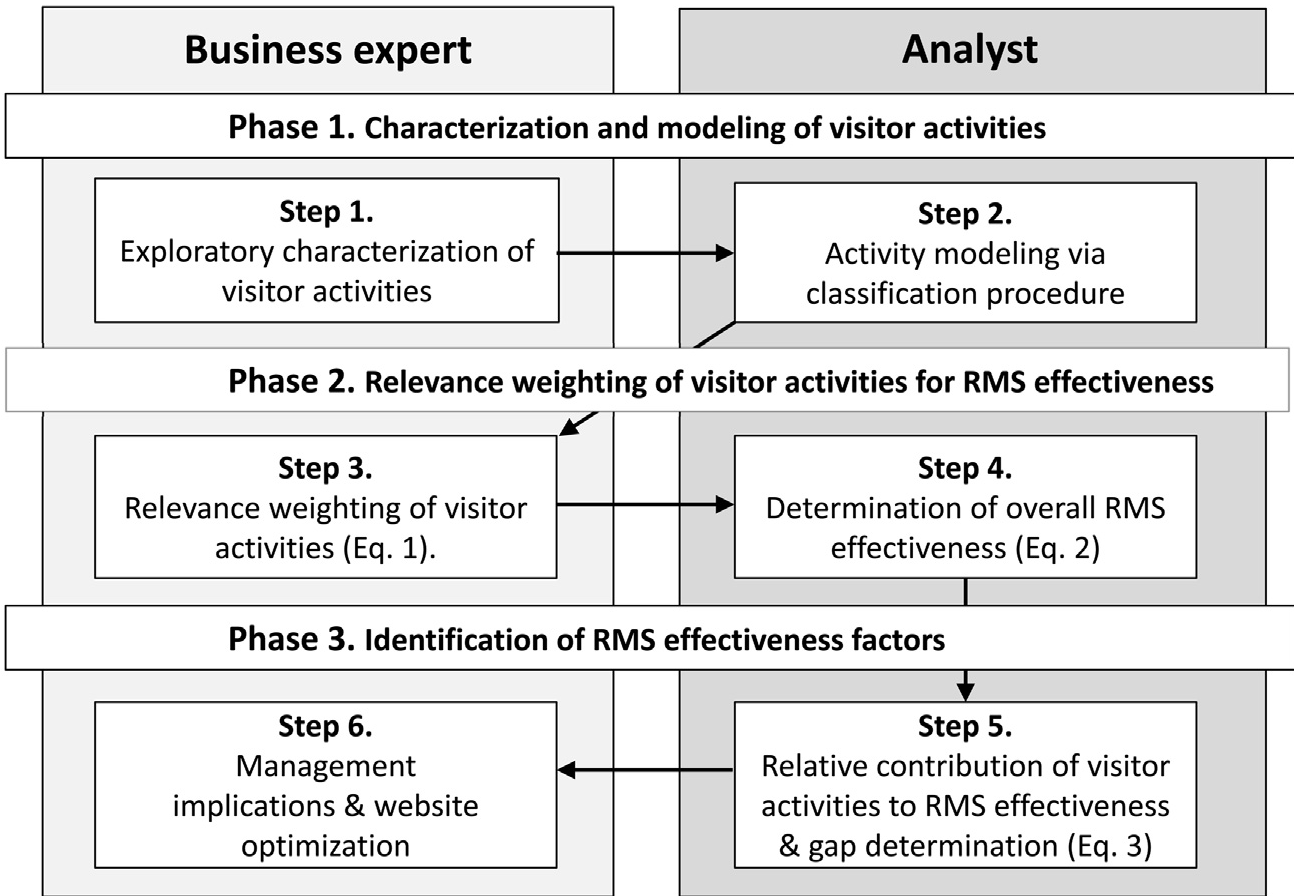
The core of the paper is an Extended Web Mining Approach. It doesn't just look at what happened; it looks at what should have happened based on managerial goals.
1. Modeling Visitor Intent
The researchers used C&RT (Classification and Regression Trees) to categorize sessions into specific behavioral archetypes:
- Browsing/Information Gathering: High click volume and long duration.
- Fact-Finding: Low page depth, specific target-page focus.
- Transactions: Specific events like downloads or purchases.
2. The Weighting & Effectiveness Heuristic
Not every click is equal. For a "Support" area, a long stay might indicate frustration (failure), whereas for a "Community" area, it indicates engagement (success). The framework allows managers to assign relevance weights () to different activities for each specific strategy.
Empirical Findings: The Performance Gap
The authors applied this to a German software developer's dataset (nearly 500k sessions).
Key Breakthroughs:
- The Support Paradox: The "Support" section had the highest failure rate (74.9%). Visitors were struggling to find specific information (Fact-finding), which directly undermines the RMS of "Customer Satisfaction."
- Community Success: The community area was highly effective (77.7%), driven by "Long Stay" behaviors, indicating strong relationship maintenance.
- Quantifying the "Gap": By subtracting the empirical contribution of an activity from its expected relevance (), the authors could pinpoint exactly where the site was failing the business.

Deep Insight: Why Why It Matters
The brilliance of this work lies in its Inductive Bias. Instead of letting a black-box model find arbitrary patterns, it forces the data to speak the language of marketing. By using Discriminant Analysis, the authors can tell a manager: "Your visitors are browsing, but they aren't finding facts, and that is why your Support costs aren't dropping."
Critical Analysis & Future Outlook
While powerful, the model relies heavily on the "Business Expert" to define weights. If the expert's intuition is wrong, the evaluation is flawed. Future iterations might benefit from integrating Multi-channel data (e.g., combining web logs with CRM data) to see if these "Effective" sessions actually lead to long-term Customer Lifetime Value (CLV).
Conclusion
This paper is a call to action for marketing analysts to move beyond "vanity metrics." By treating the website as a moderator of relationship marketing, companies can turn passive clickstream data into a demand-actuated roadmap for optimization.