
Decoding the "Fuzzy" Life: A Knowledge-Based Approach to Microbial Biosensor Uncertainty
9382_Determining the Sources of Measurement Uncertainty in Environmental Cell-Based Biosensing.
The paper introduces a knowledge-management expert system for quantifying measurement uncertainty in microbial (cell-based) biosensors. It employs a Fuzzy Fault Tree Analysis (FTA) framework to address the complexities of cellular transducers in environmental metrology.
TL;DR
Quantifying the accuracy of a living biosensor is a metrological nightmare. This paper moves beyond traditional "Guide to the Expression of Uncertainty in Measurement" (GUM) statistics by introducing a Fuzzy Fault Tree Analysis (FTA) framework. By treating biological variables as "fuzzy" events, the authors provide a structured way to calculate the uncertainty budget of microbial sensors in complex environmental matrices.
The Problem: When the "Sensor" is Alive
In standard analytical chemistry, we deal with physical constants and predictable instruments. In cell-based biosensing, the sensor is a living organism (algae, bacteria, or yeast). These cells act as both the recognition element (detecting the analyte) and the transducer (turning that detection into a signal like respiration or impedance).
The "Why it's hard" factor:
- Nonspecific Metabolism: Cells respond to things they aren't supposed to.
- Dynamic Complexity: A cell's response changes based on its age, "mood" (physiological state), and environmental stressors.
- Matrix Effects: In environmental monitoring, the sample's ionic strength or heavy metal content might affect the cell more than the actual target analyte does.
Methodology: Fuzzy Fault Tree Analysis (FTA)
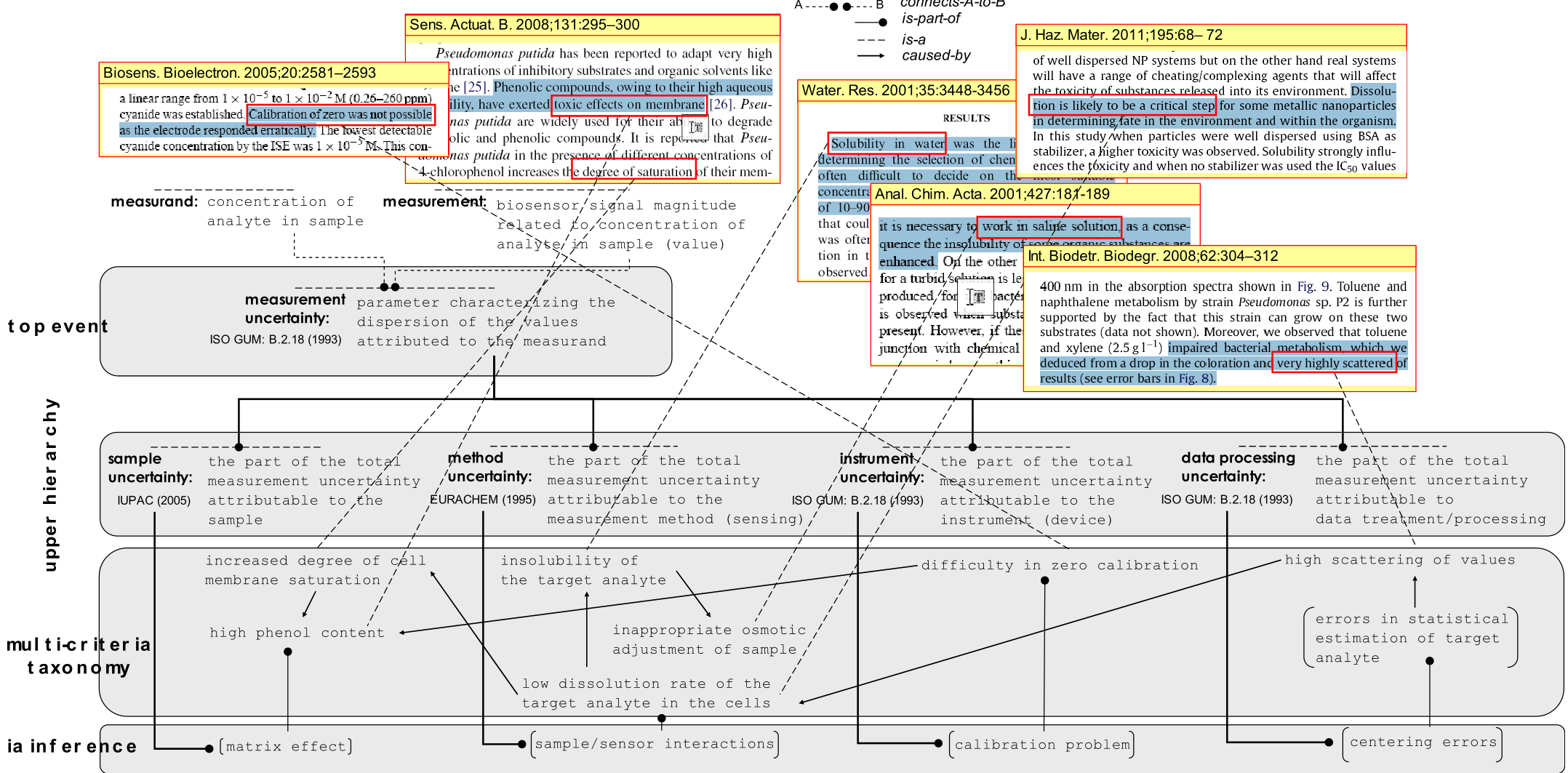
To solve this, the authors built an expert system. Instead of simple math, they used a Deductive Hierarchical Structure to trace the "Top Event" (Measurement Uncertainty) down to its root causes.
1. The Architecture
The system categorizes uncertainty into four branches:
- Sampling: Matrix effects, heavy metals, sample loss.
- Sensing: Intrinsic cell variability, membrane permeability, metabolic rate.
- Instrument: Calibration and baseline stability.
- Data Processing: Modeling errors and knowledge gaps.
2. The Fuzzy Inference Engine
Because biological processes are rarely "black or white," the authors used Fuzzy Sets (Low, Medium, High). Experts define rules—for example: IF membrane potential is low AND extracellular concentration is high, THEN sensing uncertainty is medium.
This approach allows the model to handle "synergistic" effects—where two small errors combined create a massive uncertainty spike.
Experimental Insights & Results
The study analyzed 763 articles to populate its knowledge base. The findings were stark:
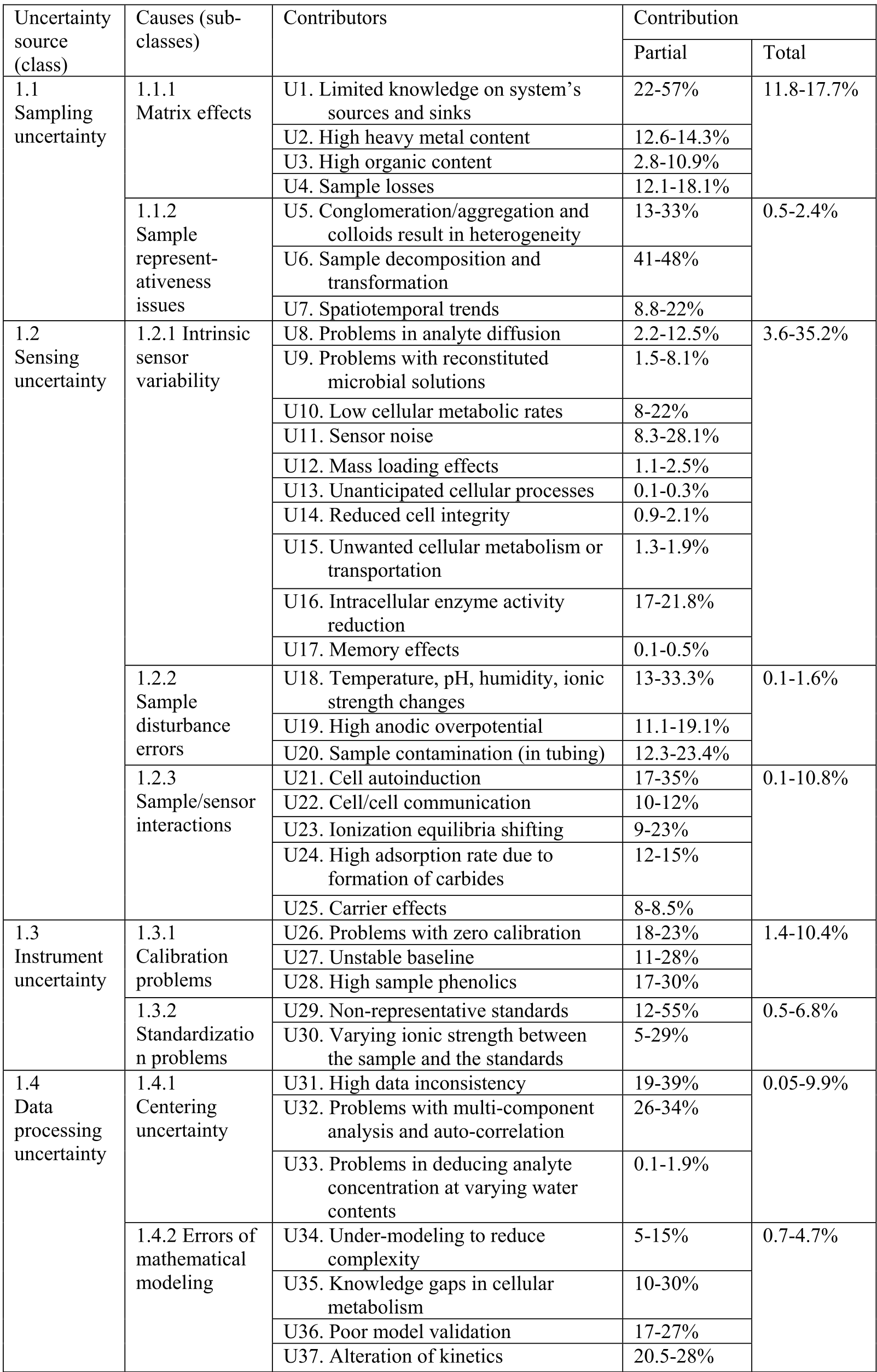
- Intrinsic Variability is King: Unlike chemical sensors where instrument noise is the main culprit, here, cellular processes contribute up to 35.2% of the uncertainty.
- Intracellular Indicators: Specifically, the loss of potassium ions () was identified as a critical "uncertainty generating event," signaling upcoming cell lysis or metabolic drops that ruin signal validity.
- Matrix Interference: In environmental water, the unpredictability of heavy metals and organics adds roughly 17.7% to the error margin.
Scientific Re-Evaluation: Why This Matters
The most profound insight from this work is the "Fitness-for-Purpose" criterion. The authors argue that if the natural heterogeneity of an environmental sample is already high, spending thousands of dollars to re-engineer a biosensor for 1% more accuracy is economically irrational.
The Limitations
While powerful, the model relies heavily on Expert Knowledge. If the experts (microbiologists/chemists) have blind spots in their understanding of a specific cell's pathway, the "Fuzzy Logic" will simply propagate that ignorance as a "low uncertainty" when it should be high.
Conclusion
This paper serves as a bridge between Metrology and Biology. By using Fuzzy FTA, it finally provides a way to quantify the "reliability" of living machines. For future sensor designers, the message is clear: the path to SOTA accuracy lies in better modeling of intracellular kinetics, not just better electronics.
Disclaimer: As an Academic Editor, I note that while this paper focuses on microbial sensors, the Fuzzy FTA framework is highly applicable to any "Bio-Hybrid" system where biological noise is a bottleneck.