
From Reviews to Reliable Insights: Validating Text Mining in Tourism Research
Determining tourist satisfaction from travel reviews
This study validates text data mining as a reliable proxy for traditional tourism surveys by comparing TripAdvisor reviews with governmental satisfaction data for Hokkaido, Japan. Using manual sentiment analysis on 1,158 samples across seven regions, the researchers established a strong positive correlation (Pearson's r) between review attitudes and official survey results.
TL;DR
Can a collection of TripAdvisor reviews replace a high-budget governmental survey? This research says yes. By comparing 1,158 TripAdvisor samples with the official Hokkaido Satisfaction Survey, researchers proved that online text mining isn't just "flavor text"—it is a statistically valid mirror of real-world tourist needs, provided we account for how different cultures express happiness.
The Problem: The High Cost of Knowing Your Customer
Destination Marketing Organizations (DMOs) currently rely on traditional surveys (face-to-face interviews at airports or terminals). These are plagued by:
- High Latency: It takes months to gather and process data.
- Response Biases: Tourists often choose "Very Satisfied" simply because an interviewer is standing in front of them (Social Desirability Bias).
- Extreme Response Bias: Digital users tend to post only when they are either ecstatic or furious, leaving the "middle ground" hollow.
Methodology: Mapping Chaos to Order
The researchers faced a hurdle: Reviews are "unstructured," while surveys are "structured." They developed a manual annotation pipeline to categorize review content into 11 specific topics like Meals, Accommodations, and Wifi accessibility.
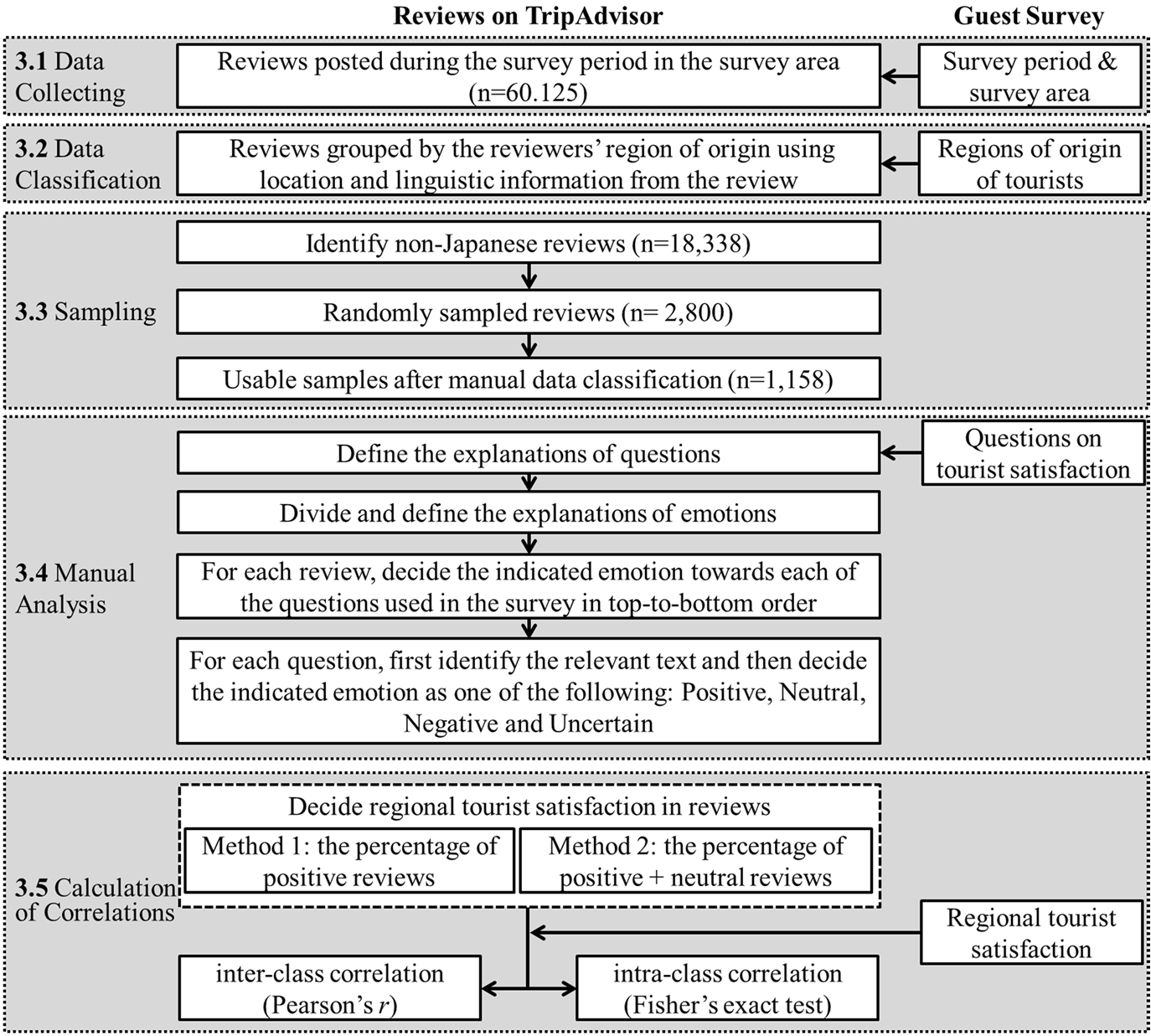 Figure 1: The Workflow from TripAdvisor crawling to Pearson Correlation calculation.
The study utilized two distinct aggregation logics:
- Method 1 (Positive Only): Counted only explicitly positive sentiments as "satisfaction."
- Method 2 (Positive + Neutral): Counted objective factual descriptions as "satisfaction," suspecting that many cultures describe a good experience simply by stating the facts of the service.
Key Results: Cultural Nuance in "Zero Stars"
One of the most profound findings was the Linguistic Split.
For English-speaking tourists (US, UK), their explicit "Positive" reviews correlated most strongly with survey satisfaction. However, for Chinese-speaking regions (Taiwan, Mainland China, Hong Kong), the "Neutral" reviews were critical. When researchers added "Neutral" reviews to the "Positive" count, the correlation with official data skyrocketed.
 Table 8: Strong correlations (p < 0.05) found across most regions, validating reviews as a survey proxy.
The "Neutral" Paradox
In Asian cultures, a review that says "The room was clean and 10 minutes from the station" (Neutral/Factual) often implies a satisfied customer, whereas an English speaker might use more superlative language ("Amazing location!"). Ignoring these factual accounts in Chinese reviews leads to an underestimation of tourist satisfaction.
Critical Insight: Why This Matters
The study reveals that traditional surveys might actually be over-reporting satisfaction. In the Hokkaido survey, satisfaction rates are often near 100%. The researchers suggest that the anonymity of TripAdvisor allows for a more "honest" distribution of feelings, whereas the extreme 100% scores in surveys are likely artifacts of interview pressure.
Limitations & Future Work
While the manual analysis proved the concept, it is not scalable to millions of reviews. The paper calls for:
- Automated Domain-Specific Dictionaries: Standard lexicons often miss regional terms (e.g., local Hokkaido food brands).
- Cross-Platform Validation: Testing if Yelp or Google Reviews yield the same reliability.
- Time-Sequence Tracking: Following a single user's journey to see if expectations versus reality (Expectation Disconfirmation Theory) shifts mid-trip.
Conclusion (Takeaway)
This research bridges the gap between traditional social science and modern data mining. It confirms that for DMOs, the "gold" is already in the data—they just need the right cultural "lens" to read it. If you want to know if Chinese tourists liked your hotel, count the "ok" and the factual descriptions; for the Americans, wait for the exclamation marks.