
eMLP: Elevating Legal Prediction Accuracy to 91.7% with Modular Neural Architectures
13828_Determining Worker Type from Legal Text Data using Machine Learning.
This paper introduces the eMLP (enhanced Multi-Layer Perceptron), a specialized neural network architecture designed for legal document classification, specifically for determining employment status (Employer vs. Contractor). The method achieves a SOTA accuracy of 91.7%, significantly outperforming standard ML baselines like Random Forests and SVMs.
TL;DR
The classification of legal employment status (Distinguishing between an independent contractor and an employee) is a high-stakes task that traditional machine learning often handles poorly. This paper presents eMLP, an enhanced Multi-Layer Perceptron that uses a modular feature-processing pipeline to achieve 91.7% accuracy, setting a new benchmark for automated legal reasoning.
Context & Positioning
In the landscape of AI and Law, we typically see two extremes: rigid logic-based systems or "black-box" text classifiers. eMLP sits in the middle—it treats structured legal features (like "Ownership of Tools" or "Chance of Profit") with the nuance they deserve, outperforming both traditional statistical methods and standard hidden-layer networks.
The Problem: The Fragility of Legal Inference
Legal datasets are often "shallow but wide," featuring categorical variables that represent complex human behaviors. Standard models like Random Forests or SVMs often fail to capture the hierarchical importance of these features. Furthermore, legal data is notorious for missing information; if a model relies too heavily on a single feature (like "Type of Job"), it fails when that data point is absent.
Methodology: The eMLP Architecture
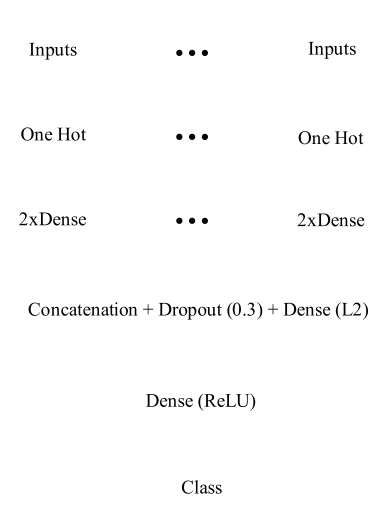
The core innovation of the eMLP is its "Parallel Processing" front-end. Instead of feeding a flat vector into the model, each input feature undergoes its own transformation:
- Isolated Embedding: Each feature is One-Hot encoded and passed through its own 2x Dense layers.
- Concatenation & Regularization: All feature-specific outputs are merged, followed by a Dropout of 0.3 and L2 Regularization to ensure the model doesn't "memorize" specific cases.
- Global Inference: A final ReLU-activated Dense layer maps these features to the final class.
Performance & Robustness
The results show a clear hierarchy of performance. The eMLP doesn't just win on accuracy; it wins on balance (F1 Score of 90.0).
| Model | Accuracy | Precision | Recall |
|---|---|---|---|
| eMLP | 91.7% | 89.4% | 90.6% |
| Random Forest | 87.8% | 86.4% | 83.6% |
| MLP (Standard) | 78.8% | 76.0% | 69.8% |
The "Missing Feature" Stress Test
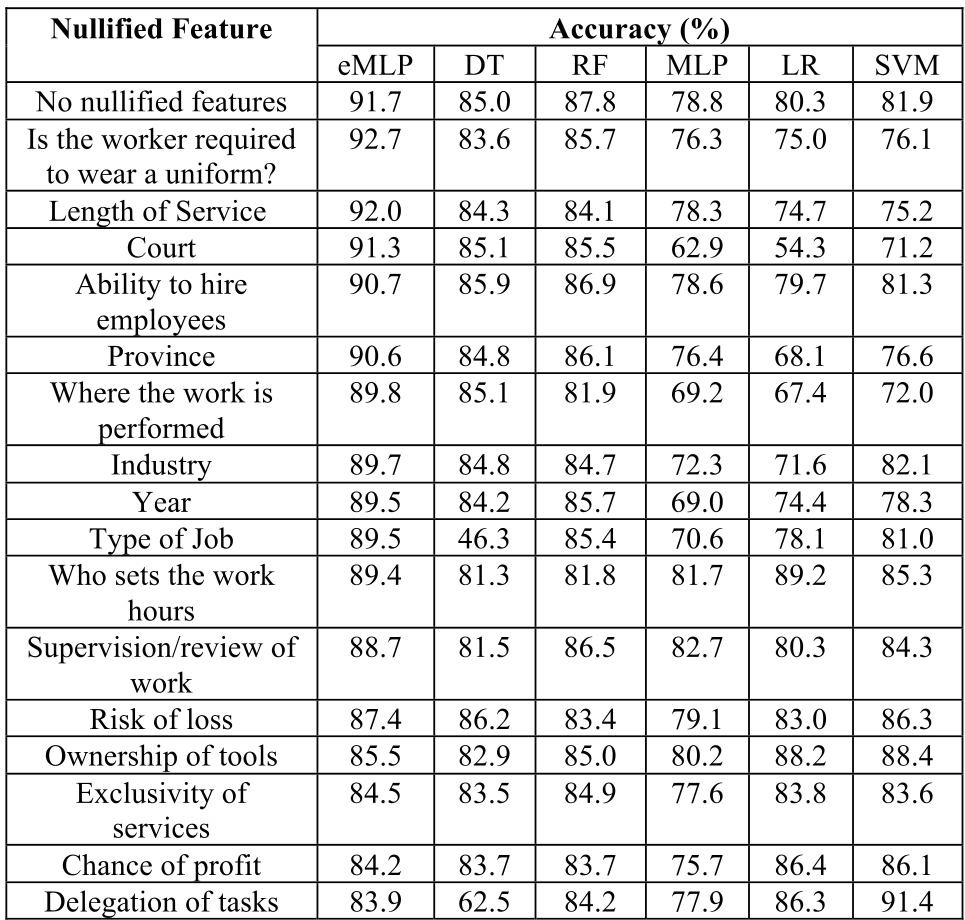
Perhaps the most impressive part of the study is the robustness analysis. When key features like "Delegation of Tasks" or "Ownership of tools" were nullified, the eMLP's accuracy remained stable (91.7% -> 89.4%), whereas Decision Trees saw massive performance swings (up to 8.81% deviation).
Critical Insight & Conclusion
Why does eMLP work? By assigning dedicated "sub-networks" to each legal feature, the model learns a more robust representation of how each factor contributes to the final judgment. It mimics a judge who evaluates each piece of evidence independently before weighing them together.
Takeaway: For researchers working with structured tabular data in specialized domains, the eMLP suggests that architectural modularity is superior to simple feature engineering or increasing the depth of a traditional MLP.