
CrowdUCB: Balancing Deterministic Payments and Optimal Learning in Crowdsourcing
15661_A Deterministic MAB Mechanism for Crowdsourcing with Logarithmic Regret and Immediate Payments.
The paper introduces CrowdUCB, a deterministic multi-armed bandit (MAB) mechanism designed for crowdsourcing environments. It utilizes an Upper Confidence Bound (UCB) approach to minimize social welfare regret to logarithmic O(ln T) while ensuring truthful cost elicitation and zero payment variance.
TL;DR
Crowdsourcing platforms often struggle to find the right balance between learning worker quality and managing strategic behavior regarding costs. CrowdUCB is a breakthrough deterministic mechanism that achieves the "holy grail" of MAB auctions: logarithmic social welfare regret and zero payment variance. By employing block allocations and Ex-Post Incentive Compatibility (EPIC), it ensures that workers are paid immediately and truthfully, matching the efficiency of the best non-strategic learning algorithms.
Problem & Motivation: The Regret-Variance Dilemma
In a typical crowdsourcing market, a requester wants to assign tasks to workers. The challenge is two-fold:
- Unknown Quality: The probability that a worker successfully completes a task is unknown.
- Strategic Costs: Workers act as self-interested agents who bid their costs .
Previously, researchers were stuck in a trade-off. Deterministic mechanisms (which are predictable and easy to implement) were thought to have a lower bound on regret of because strategic workers could manipulate the "learning" phase. Randomized mechanisms could reach regret but resulted in "lottery-like" payments that fluctuated wildly, frustrating workers.
The authors of CrowdUCB realized that the high-regret lower bounds for deterministic mechanisms were based on an unrealistic assumption: that workers have "god-like" knowledge of all future task outcomes. By shifting to a more realistic Ex-Post setting, they unlocked optimal performance.
Methodology: The Mechanics of CrowdUCB
1. The Allocation Rule (Optimism in the Face of Uncertainty)
CrowdUCB selects a worker who maximizes the UCB Index: Where is the requester's reward, is the Upper Confidence Bound of worker quality, and is the bid.
2. Block Allocations ()
To reduce auction overhead, CrowdUCB doesn't just assign one task. It assigns a block of tasks. The block size is carefully calculated: it is the maximum number of tasks that can be given such that even if the worker fails every single task in that block, they would still have been the optimal choice according to their UCB index.
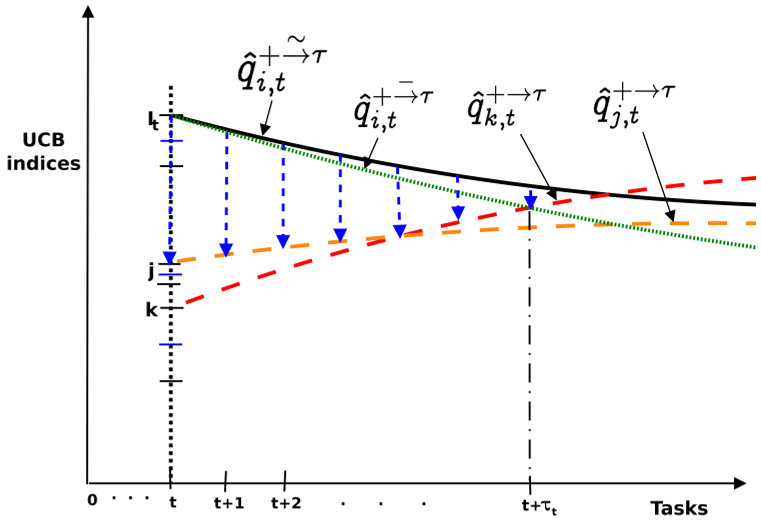 Figure 1: Illustration of a block allocation where receives multiple tasks until the UCB index potentially shifts.
3. Immediate Deterministic Payments
The payment is based on the externality the worker imposes on the system. It is the minimum bid the worker would have needed to stay the "winner" against the second-best alternative, adjusted for the "learning value" the requester loses by not picking someone else. Crucially, this payment is determined at the start and does not fluctuate based on the task's success or failure, ensuring Individual Rationality (EPIR).
Experimental Validation
The researchers compared CrowdUCB against the standard UCB1 algorithm and established randomized mechanisms.
- Regret Convergence: CrowdUCB's regret curve is identical to UCB1, confirming that the strategic "tax" is zero in the long run.
- Payment Stability: Unlike randomized mechanisms that show massive vertical spreads in total payments for the same instance, CrowdUCB remains a single, stable line.
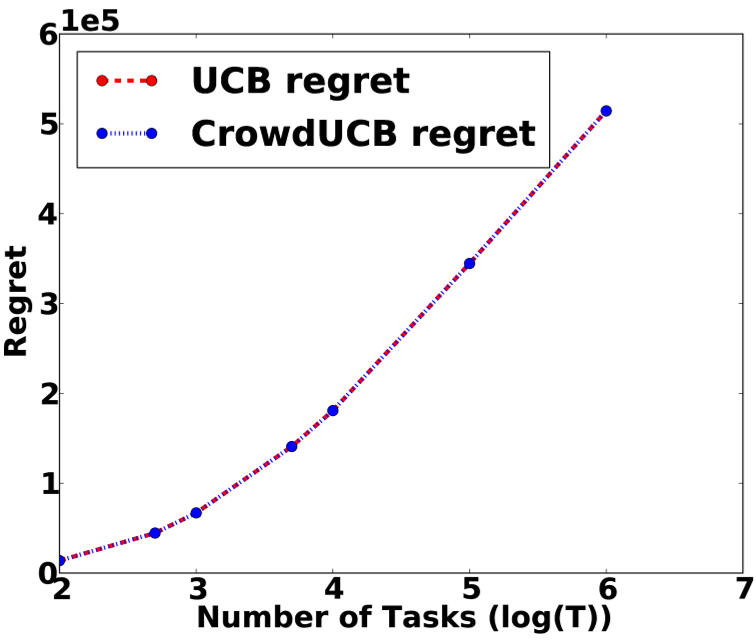 Figure 2: Social welfare regret of CrowdUCB vs UCB1 on a log scale.
Critical Insight & Conclusion
The genius of CrowdUCB lies in its pragmatism. By assuming that workers learn their own qualities alongside the requester (or don't know them at all), the mechanism simplifies the incentive structure.
Key Takeaways:
- Asymptotic Truthfulness: Even if workers know their qualities, the gain from lying vanishes as increases (-EPIC).
- Operational Efficiency: Block allocations solve the latency issue of per-task auctions in high-throughput crowdsourcing.
- Future Work: The next frontier involves Contextual Bandits, where worker costs or qualities might change based on the specific nature of the task (e.g., image labeling vs. translation).
CrowdUCB proves that we don't need to sacrifice fairness or predictability to achieve state-of-the-art learning efficiency in human-in-the-loop systems.