
Beyond Friendship Lists: Decoding Real-World Ties via Social Interaction Analysis (SIA)
Developing Compelling Social-Enabled Applications with Context-Based Social Interaction Analysis
The paper introduces a framework for constructing implicit social networks by analyzing Social Interaction Analysis (SIA) from daily communication logs like emails, SMS, and phone calls. It features a contextual weighting mechanism and demonstrates a "Social Helper" application that identifies the most relevant contacts during emergencies based on recent interaction data.
TL;DR
Researchers from Alcatel-Lucent Bell Labs have developed a framework that moves beyond static "friend lists" by building implicit social networks from emails, SMS, and calls. By analyzing the how and when of our digital interactions, the system can pinpoint your "closest" contact in specific contexts—such as identifying who spent the last 48 hours with a missing friend—providing a powerful tool for emergency communications and social discovery.
Contextualizing the Motivation: The Flaw of Explicit Networks
Most social platforms treat digital friendship as a binary, symmetric state: you are either friends with someone, or you are not. However, human relationships are far more nuanced. They are non-reciprocal (the person you email most may not email you most), context-dependent (work vs. personal), and ephemeral.
The authors argue that the true map of our social lives is hidden within our communication logs. By analyzing these implicit signals—how often we reply, who we include in CC, and which device we use—we can construct a much more accurate "Social Proximity" index.
Methodology: The Three-Layer SIA Framework
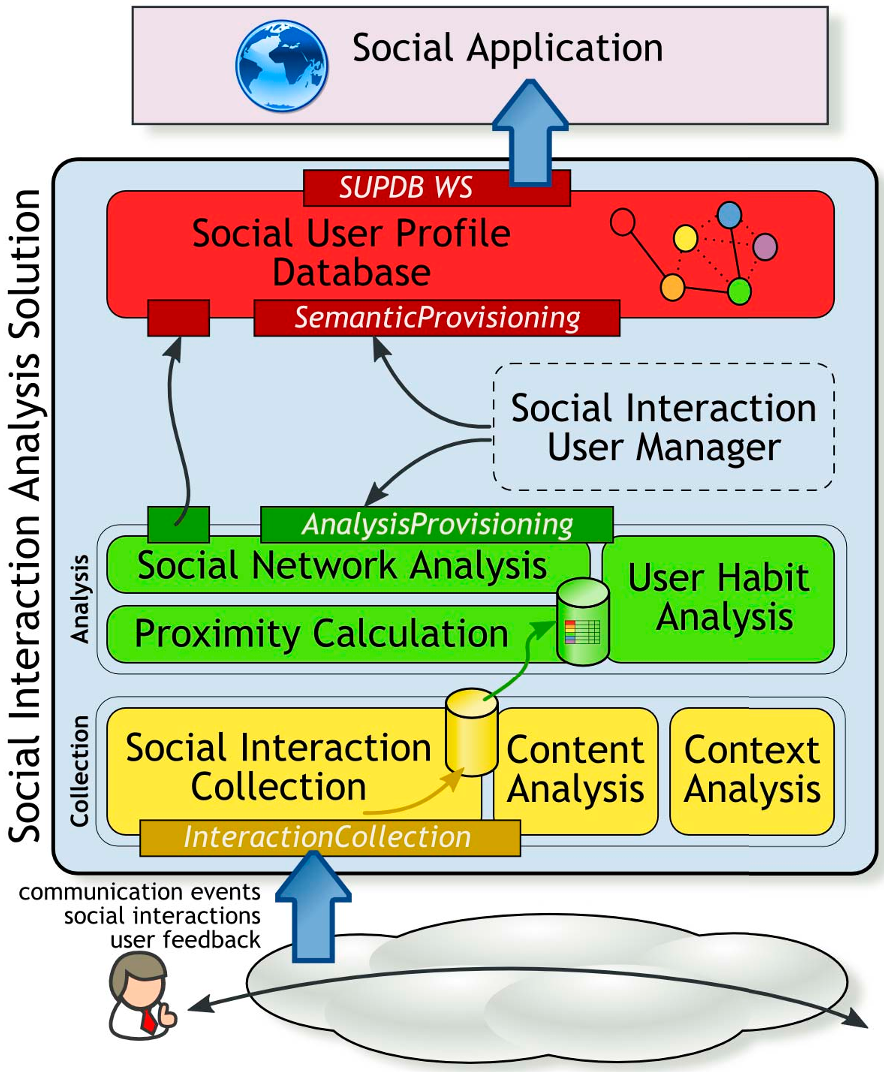
The paper proposes a robust architecture designed to turn raw logs into actionable social intelligence.
1. Collection & Normalization
The system gathers data from both end-terminals (apps on the phone) and network-level logs. It handles diverse formats (SMS vs. Email) and normalizes them into a unified XML structure. Importantly, it recognizes that different media carry different "weight"—for many, an SMS is more intimate than a professional email.
2. The Analysis Engine (The Core)
This is where the magic happens. The engine calculates a weighted, directed edge between users based on several key metrics:
- Frequency and Direction: Who initiates the conversation?
- Sendiness and Replyness: The probability of a user composing a message vs. responding.
- Groupiness: Inferred from shared email threads or mailing lists, indicating community membership even without direct interaction.
- Temporal Decay: Relationships are weighted differently based on time. A contact you spoke to yesterday is often more "contextually relevant" than a childhood friend you haven't emailed in a decade.
3. Semantic Presentation
The results are stored using FOAF (Friend of a Friend) and RDF vocabularies, accessible via SPARQL queries, allowing third-party apps to "ask" the network questions like "Who is Bob's most frequent work contact?"
Experimental Results: The 48-Hour Window
The authors validated their approach by analyzing historical email logs from six months to four years. They found that filtering these graphs by keywords or time frames significantly changed the topology, highlighting the importance of context.
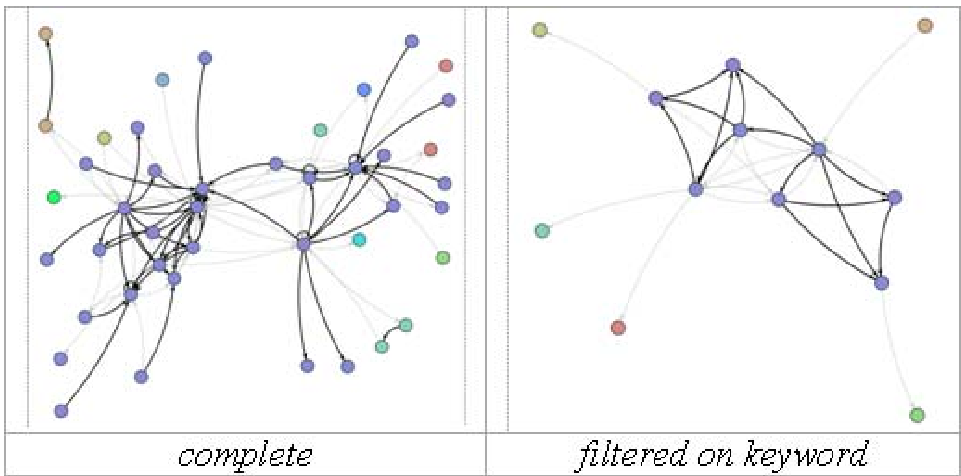
The standout application, Social Helper, addresses the "reachable person" problem. If a parent (Jena) cannot reach her son (Bob), the app uses the "last 48 hours" filter to find George—someone Bob has been intensely messaging about a party—even though Jena doesn't know George. George becomes the "social bridge."
Critical Insight & Future Outlook
The core strength of this work is its recognition of interaction context. By focusing on a rolling window of recent communication, the system moves from "historical archiving" to "real-time assistance."
However, two challenges remain:
- Subjectivity: One person's "close friend" is another's "annoying colleague," even with high interaction frequency. The paper suggests future work should include sentiment analysis of the content.
- Privacy: Collecting SMS and email content is highly sensitive. While the authors mention opt-in policies, the shift toward end-to-end encryption in modern apps (like WhatsApp/Signal) would require this system to run locally on devices rather than at the network operator level.
Conclusion
This SIA framework provides a blueprint for "Socially-Enabled Applications" that actually understand the dynamics of human connection. As we move toward more intelligent digital assistants, the ability to parse the "social proximity" of our interactions will be the difference between a tool that simply stores contacts and one that truly understands our social world.