
"But Where Would I Even Start?": Bridging the Gender Sensitivity Gap in HCI
"But where would I even start?": developing (gender) sensitivity in HCI research and practice
This paper presents a "close reading" analysis of 10 influential HCI publications to develop a framework for gender sensitivity in research. It proposes actionable recommendations for the design, funding, conduct, and presentation of HCI work, moving beyond binary notions toward intersectional and self-determined identity models.
TL;DR
As funding bodies increasingly demand "gender dimensions" in research, many HCI practitioners are left wondering how to move beyond a simple M/F checkbox. This paper provides a roadmap for developing (gender) sensitivity through a deep analysis of existing literature. It moves the needle from treating gender as a fixed biological variable to an intersectional, self-determined identity, offering a set of rigorous guidelines for every stage of the research lifecycle.
The Problem: The "Binary" Default and the Knowledge Gap
For decades, Computer Science and HCI have operated under an unmarked norm: the assumption of a white, able-bodied, cisgender male user. When gender is considered, it is often reduced to an "essentialist" binary—assuming that genitalia, behavior, and social roles are neatly aligned and fixed.
The authors argue that this lack of sensitivity leads to:
- Misgendering Machines: Systems (like Automated Gender Recognition) that fail to recognize trans and non-binary individuals.
- Exclusionary Design: Artifacts that assume body fat distribution or clothing preferences based solely on a binary label.
- Systemic Bias: Datasets that carry the "stereotypical baggage" of the society that produced them.
Methodology: Insights from Close Reading
Instead of a broad systematic review, the authors chose Close Reading. They looked at 10 specific papers to see how gender "seeps" into research, even when it isn't the primary focus.
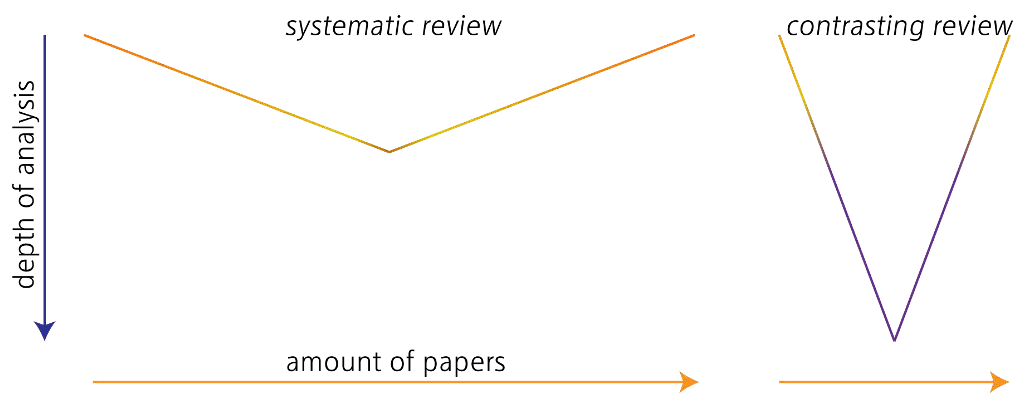 Figure 1: The authors opted for a contrasting review to gain deeper, situated insights rather than just surface-level breadth.
Key Discoveries from the Corpus:
- Karuei et al. (2011): Found that gender was a poor proxy for body characteristics. Instead of assuming "men have deeper pockets," researchers should measure physical attributes or clothing directly.
- Keyes (2018): Demonstrated that most research into Automatic Gender Recognition (AGR) is fundamentally trans-exclusive because it treats gender as an external classification rather than a self-identity.
- Ahmed et al. (2014): Showed that sensitivity requires checking who cannot participate (e.g., victims of violence who may find certain prompts triggering or unsafe).
The "How-To": Recommendations for the Field
The core contribution of this work is a structured set of recommendations for the research lifecycle:
1. Research Design: Articulate Early
Don't let gender be an "accidental" variable. Researchers must explicitly state their gender model (Essentialist? Performative? Identity-based?). Furthermore, they should plan for Positionality Statements—reflecting on how their own identities (race, class, gender) influence their interpretation of data.
2. Conducting Research: Respect Agency
- Self-Identification: Always allow participants to define their own gender.
- Trauma-Informed: Be aware of care responsibilities or historical trauma that might prevent participation from marginalized groups.
- Language: Use "singular they" for abstract users and ask for pronouns as a standard sign of respect.
3. Presenting Research: Context is King
Acknowledge the locale of your knowledge. Research conducted in a US college campus has limited "transferability" to a global context.
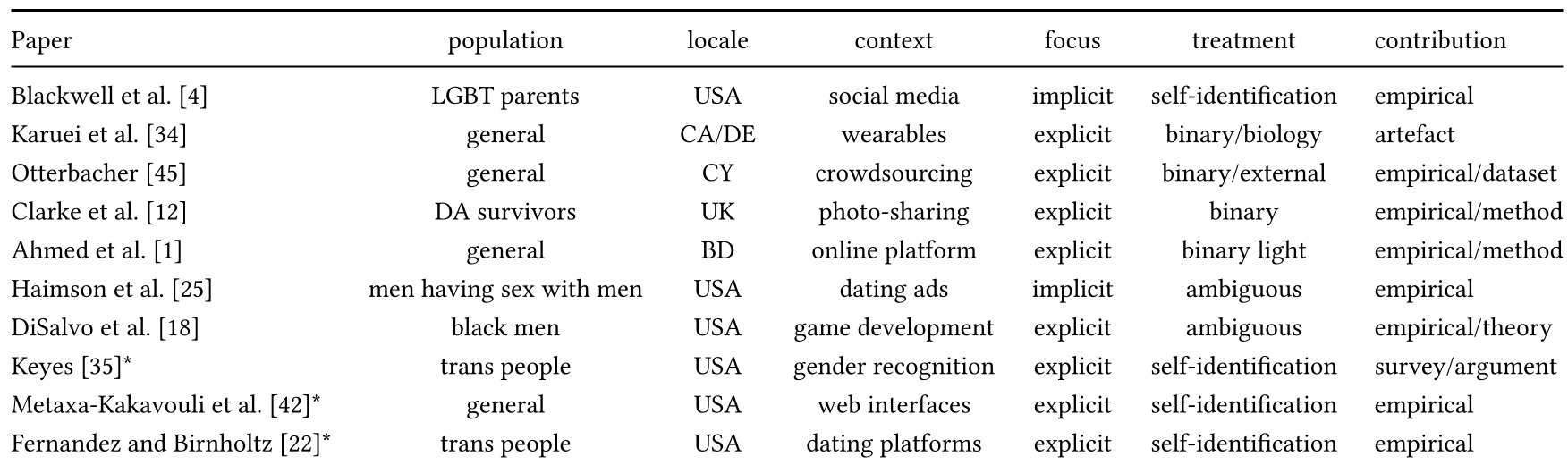 Table 1: The analyzed papers illustrate a spectrum from binary treatments to self-identification.
Critical Insight: Sensitivity as "Slow Science"
The authors conclude that gender sensitivity cannot be achieved through a "quick fix" or a formulaic checklist. It is a form of "Slow Science"—an ongoing process of "unlearning" dominant paradigms and developing the intuition to see what (and who) is missing from our research.
Conclusion
This paper serves as an essential starting point for HCI researchers. It moves the conversation beyond "inclusion as a requirement" to "equity as a methodology." By adopting an intersectional lens, we don't just produce "better" data—we design technology that is more just and representative of the human experience.
Takeaway: The next time you design a survey or a system, don't ask "M or F?" Ask: "Why am I asking for gender, and how can I respect the user's self-determination?"