
CEMR Corpus: Filling the Gap in Chinese Clinical Natural Language Processing
Developing a linguistically annotated corpus of Chinese electronic medical record
This paper introduces the first syntactically annotated corpus for Chinese Electronic Medical Records (CEMR), covering word segmentation, POS tagging, and phrase bracketing. The authors leverage this corpus to develop a state-of-the-art joint segmentation and tagging system that outperforms general-domain models like the Stanford Parser on clinical text.
TL;DR
Researchers have developed the first syntactically annotated corpus for Chinese Electronic Medical Records (CEMR), addressing a major bottleneck in smart healthcare. By creating a custom annotation scheme and a joint word segmentation and POS tagging system, they achieved a significant performance leap, proving that "in-domain" data is the key to unlocking clinical text analysis.
Background & Positioning
In the landscape of Medical Language Processing (MLP), English-speaking researchers have long benefited from resources like the GENIA and MiPACQ corpora. In contrast, Chinese clinical NLP has been stuck using models trained on general news text (like the Penn Chinese Treebank), leading to poor performance due to the specialized vocabulary and unique "medical shorthand" used by doctors. This paper marks a foundational shift, moving from rule-based clinical extraction to high-precision statistical models trained on indigenous medical data.
The Challenge: Why General Models Fail in the Clinic
Medical records aren't written like newspapers. The authors identified two primary hurdles:
- Lexical Ambiguity & Terminology: Words like "maxillary sinusitis" (上颌窦炎) risk being fractured by general segmenters, losing their clinical meaning.
- Elliptical Syntax: Doctors frequently omit subjects or predicates (e.g., "right-sided central facial palsy" instead of "the patient has..."), creating "flat" syntactic structures that confuse standard parsers.
Methodology: Engineering a Clinical Treebank
The authors sampled 2,553 sentences from a Level-A hospital, covering various sections like "Discharge Instructions" and "Chief Complaints."
The Annotation Architecture
The team adapted the PCTB guidelines, training linguists with the help of medical doctors to ensure technical accuracy. They measured Inter-Annotator Agreement (IAA), reaching 91.22% for syntax, which rivals established English clinical treebanks.
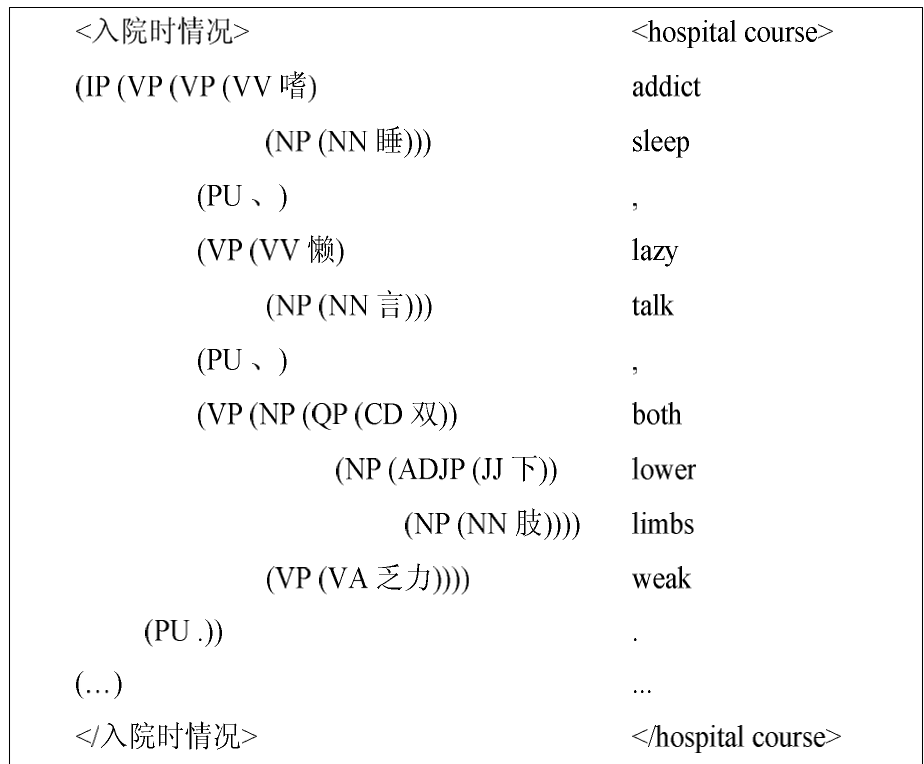 Fig 1: Example of a syntactically annotated CEMR sentence showing the Nested Phrase Structure.
The S&T System
To process this data, they moved away from simple "pipeline" models (segment then tag). Instead, they built:
- Joint S&T Model: A character-based model that treats segmentation and tagging as a unified task.
- Beam Search Integration: Replacing Viterbi search to explore a wider space of high-probability tags.
- Transformation-Based Learning (TBL): A post-processing "error correction" layer that uses rules to fix common mis-taggings based on the specific grammatical regularity of medical text.
Experimental Results: The Power of In-Domain Data
The results were stark. Using a general-domain model (PCTB) on medical data yielded a dismal 53.58% F1-score for parsing. Once trained on the CEMR corpus—even with a relatively small number of sentences—the F1-score jumped to 80.36%.
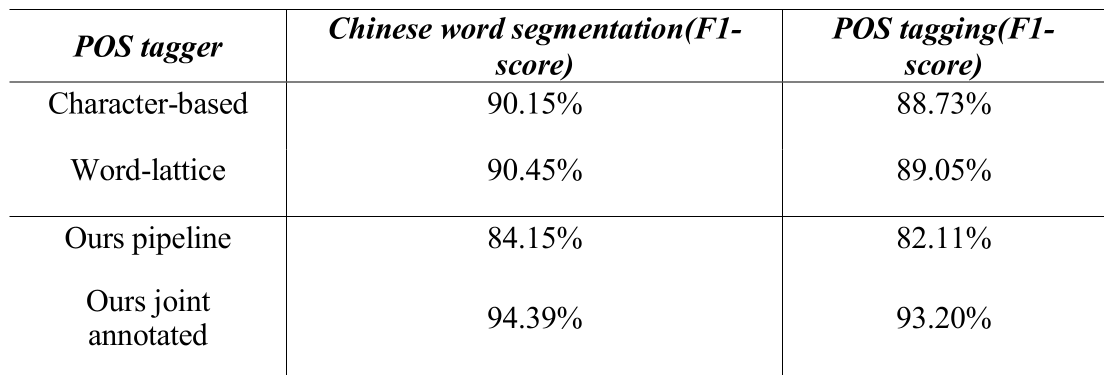 Table 1: Performance of the Joint Annotated System vs. State-of-the-Art Baselines.
Key finding: Their Joint Annotated Framework achieved an F1 of 94.39% for segmentation and 93.20% for POS tagging, significantly outperforming the Word-lattice based models which are considered SOTA in the general domain.
Critical Insights & Future Outlook
The study reveals a fascinating "domain within a domain" problem. Models trained on neurology records performed poorly on general surgery records (68.64% F1). This suggests that clinical NLP might require even more granular adaptation than previously thought.
Limitations: The corpus size (2,553 sentences) is still modest compared to general-domain benchmarks. However, it serves as a high-quality "seed" for future expansion.
Takeaway: The "rule-based" method can thrive again in clinical sub-domains because these texts have stronger grammatical regularity than general language. For developers in the healthcare space, this paper is a clear signal: stop fine-tuning general models and start investing in high-quality, domain-specific annotation.