
Quantifying the Unspoken: Predicting Patient Satisfaction via Machine Learning
Developing Parameters for a Technology to Predict Patient Satisfaction in Naturalistic Clinical Encounters
This study develops a predictive model for patient satisfaction in naturalistic clinical encounters using a Decision Tree machine learning approach. By analyzing 110 videotaped interactions, the researchers identified key nonverbal and demographic parameters that correlate with how much patients like their clinicians and achieved a validation accuracy of approximately 54.3% using the top four features.
TL;DR
In healthcare, the "vibe" of a clinical encounter is often hard to measure. This study utilizes Decision Tree machine learning to analyze videotaped doctor-patient visits, discovering that mutual gaze duration, total social touch, and patient age are the strongest predictors of clinician "likeness." The findings serve as a technical foundation for building real-time feedback systems to help doctors improve their bedside manner dynamically.
Problem & Motivation: Beyond the Survey
Standardized questionnaires are the industry standard for measuring patient satisfaction, but they suffer from recall inaccuracies and "measurement effects" where patients may not remember the emotional nuances of a visit accurately.
The researchers recognized that while we know eye contact and handshakes are good, we don't know the exact quantitative thresholds that transition a patient's perception from "good" to "excellent." Furthermore, the interaction between a patient's demographics (like income and age) and these nonverbal cues is rarely studied in a unified computational framework.
Methodology: Decision Trees for Transparency
The study leveraged a curated dataset of 110 videotaped encounters. Unlike "black box" neural networks, the authors chose Decision Trees specifically for their interpretability—essential for medical guidelines where clinicians need to know "why" a model reached a conclusion.
1. Feature Engineering
The team extracted 59 features, but through a rigorous pruning process, they focused on:
- Nonverbal: Total social touch time, % of visit in mutual gaze, and Time per Mutual Gaze (a novel metric).
- Demographic: Age, gender, education, and household income.
2. The Model Pipeline
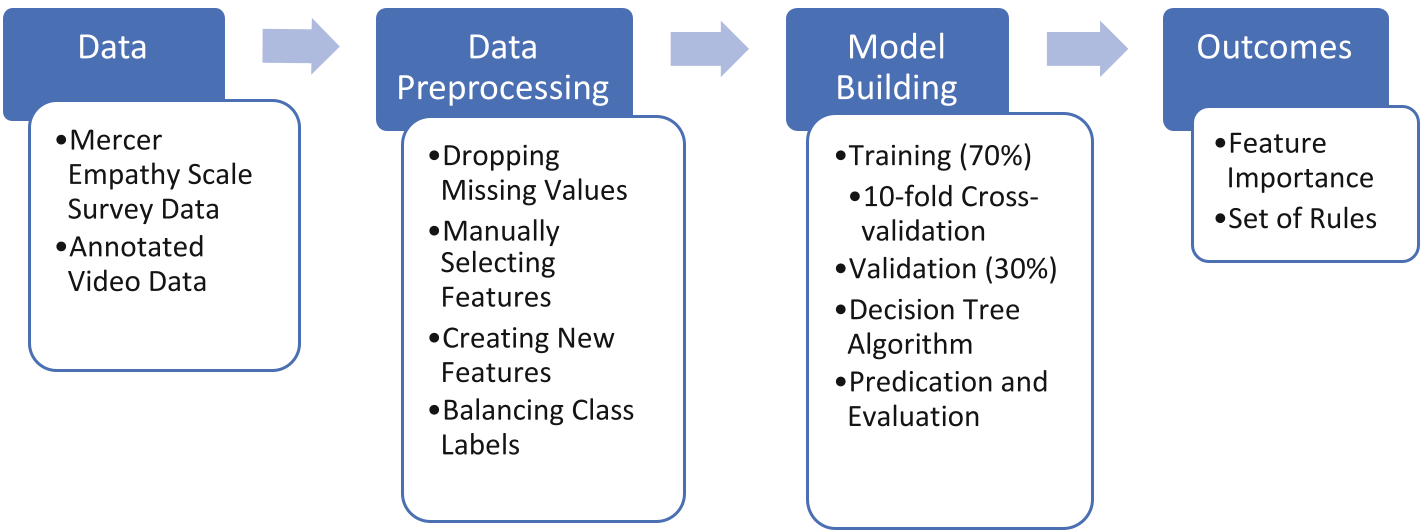 The researchers used stratified sampling and 10-fold cross-validation to ensure the model was robust, focusing on the CARE (Consultation and Relational Empathy) measure as the ground truth.
The "Sweet Spot" for Eye Contact and Touch
The model identified a hierarchy of importance. Interestingly, it wasn't just that you made eye contact, but how long each gaze lasted.
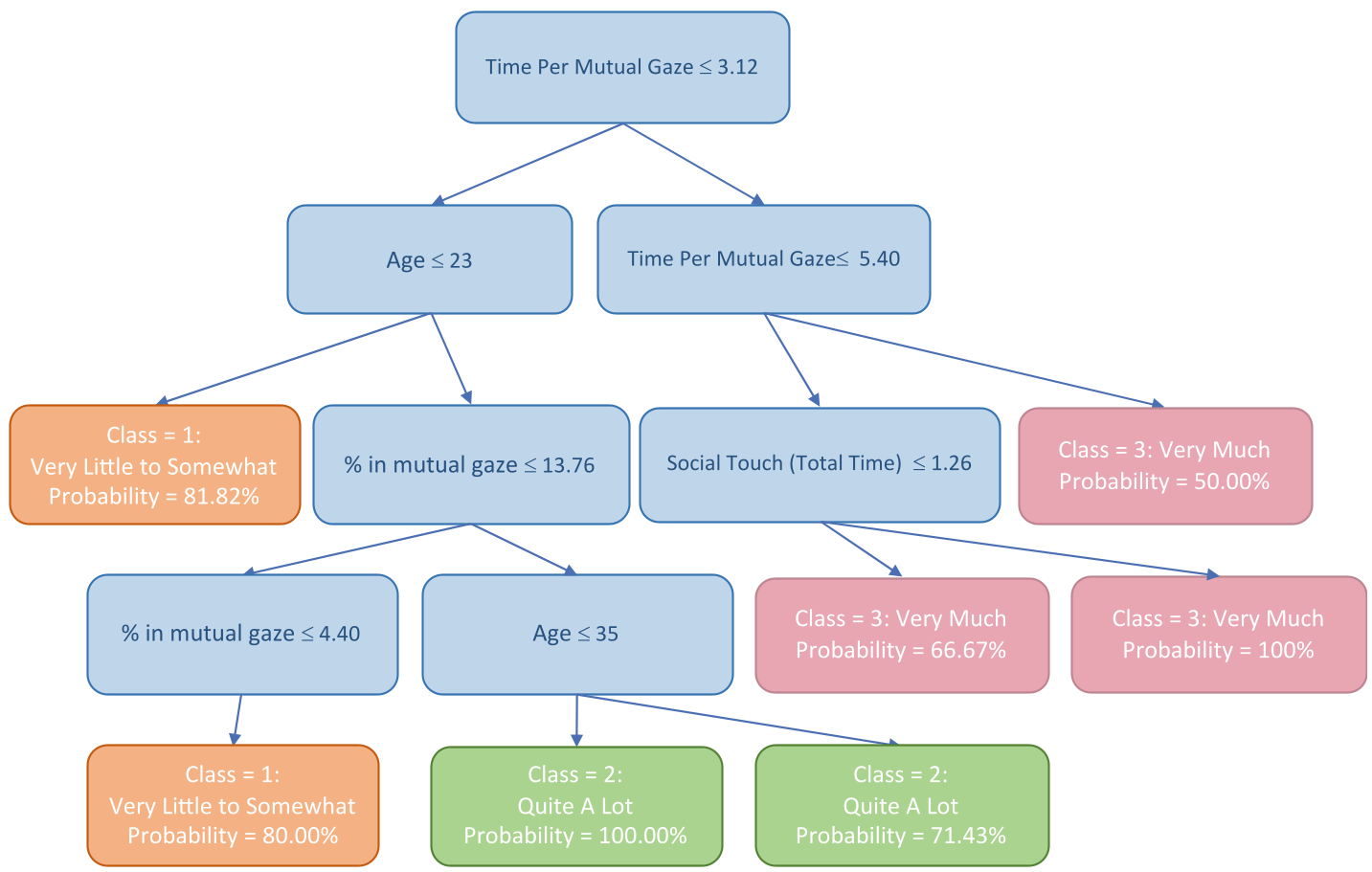
Key Quantitative Rules (The "Aha!" Moments):
- The Mutual Gaze Threshold: Patients reported the highest satisfaction when individual mutual gazes lasted between 3.12 and 5.40 seconds. Gazes shorter than this felt "insufficient," while excessively long gazes can become uncomfortable.
- Social Touch: A duration of >1.26 seconds for social touch (like a handshake) was a significant booster for patients rating the clinician as "Very Much" liked.
- Demographic Interaction: Older patients (>23 programs in this context) were generally more sensitive to these nonverbal cues and more likely to report higher satisfaction when they were present.
Experimental Results: Precision in Empathy
The simplified model using only the top four features achieved a Training Accuracy of 61.29% and a Validation Accuracy of 54.29%. While these numbers might seem modest compared to standard CV tasks, in the highly noisy, subjective realm of human psychology and naturalistic settings, they provide a statistically significant signal.
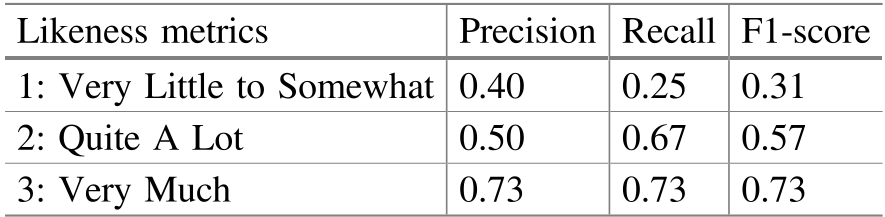 The model was particularly adept at identifying "Excellent" (Level 3) likeness, with higher precision and recall than lower levels.
Deep Insight & The Future of Health IT
Takeaway
This research proves that patient satisfaction is a "computable" metric derived from specific physical behaviors. It suggests that a physician's "instinct" for empathy can be augmented through training on measurable parameters.
Limitations
The study was limited by a small sample size (93 records after cleaning) and focused on a single condition (the common cold). There is also the "Hawthorne Effect"—the presence of cameras likely altered the behavior of both doctors and patients.
Future Outlook: Real-time Biofeedback
The authors envision a Real-time Automatic Feedback System. Imagine a clinician wearing a subtle AR device or a dashboard that nudges them: "You haven't made eye contact in 3 minutes" or "Slow down your physical interactions." This blend of machine intelligence and human empathy could redefine the clinical environment of 2026 and beyond.