
From Polls to People: Synthesizing Authentic Artificial Societies via Homophily
Developing Social Networks for Artificial Societies from Survey Data
The paper introduces a methodology for building large-scale "Artificial Societies" by transforming empirical survey data (World Values Survey) into agent-based models. It utilizes the principle of homophily and Bayesian Belief Networks (BBN) to endogenously elicit social structures and agent cognition, achieving a traceable, one-to-one representation of real-world populations like Indonesia.
Executive Summary
TL;DR: This paper presents a robust framework for instantiating artificial societies directly from empirical survey data. By leveraging the World Values Survey (WVS), authors Stephen Lieberman and Jonathan Alt demonstrate how to "ensoul" agents with real-world belief systems and socioeconomic attributes. The result is a dynamic Homophily Network where social structure emerges naturally from agent similarity, bridging the gap between individual cognition and collective social dynamics.
Context: This work is a significant step in Social Computing and Agent-Based Modeling (ABM). Rather than designing top-down social rules, it treats social structure as an endogenous outcome of individual identities, situating it firmly as a SOTA methodology for "evidence-based" social simulation.
Problem & Motivation: The "Social Context" Gap
For decades, researchers have been adept at modeling a single agent's brain—using Bayesian networks or cognitive architectures—but have struggled to place that agent in a realistic society. Most simulations use "frozen" or randomized social networks that fail to capture the nuanced, shifting alliances of real human collectivities.
The authors argue that a society's structure is not a fixed background; it is a distribution of social factors. The challenge is: How do we translate thousands of rows of survey data into a living, breathing social fabric?
Methodology: The Geometry of Human Association
The methodology is divided into two core layers: Internal Cognition and Social Structure.
1. Internal Agent Attributes
Each agent is modeled using a Bayesian Belief Network (BBN). By performing feature selection on survey items (e.g., "willingness to fight in a war"), the authors identify which factors (cultural, economic) influence an agent's stance. This creates a "narrative identity" that acts as a lens for interpreting simulation events.
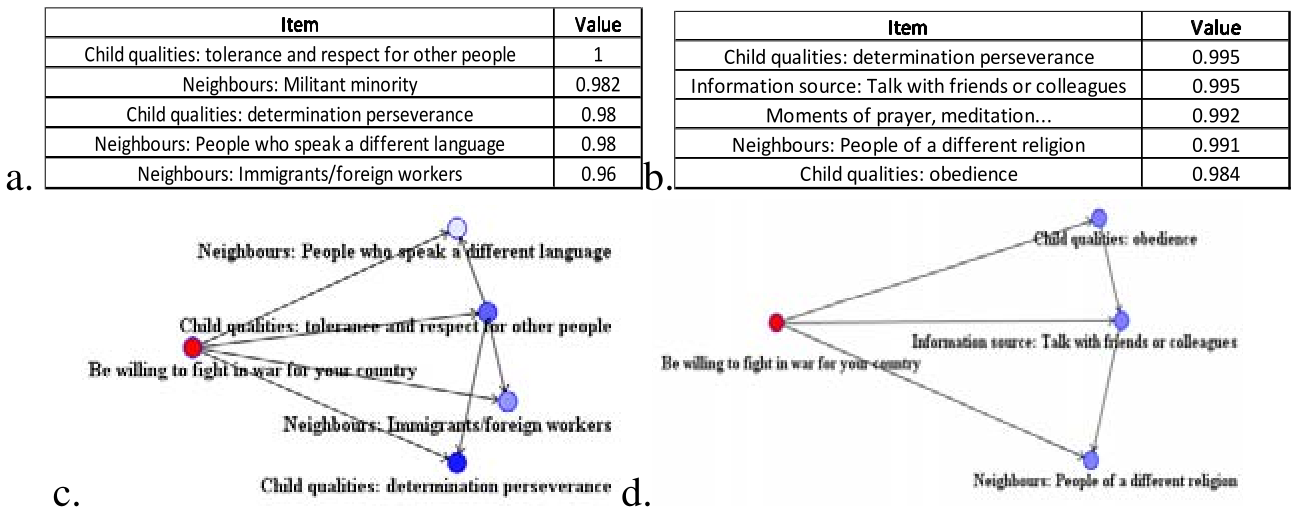 Figure 1: Comparison of cognitive BBNs for different socio-demographic subtypes.
2. The Homophily Network (Blau Space)
The brilliance of the paper lies in its use of Homophily—the principle that "birds of a feather flock together."
- Distance Calculation: The authors select dimensions like Age, Job Prestige, Social Class, and Income.
- Vector Space: Every agent is a point in an -dimension hypercube.
- Link Weight (): The link strength between Agent and Agent is the inverse of their Euclidean distance.
This creates a fully connected, weighted network where high-weight links represent a high likelihood of communication.
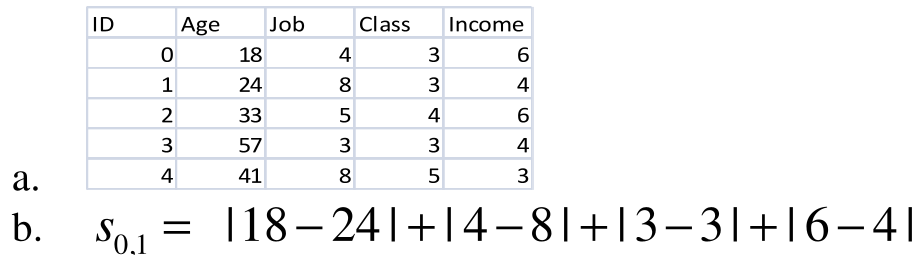 Table 1: Example of how simple social distances are derived from survey responses.
Experiments & Results: Visualizing Indonesia
The authors applied this to a 2015-respondent survey of Indonesia. After filtering for complete data, 1,050 agents were generated.
Key Findings:
- Structural Emergence: At a link-weight trim of 90, the simulation revealed two massive, distinct clusters. This suggests that Indonesian society is characterized by two major socio-heterogeneous groups with very little cross-communication.
- Factions and Key Players: Increasing the trim to 99 (showing only the strongest ties) revealed highly cohesive components with no central "core," indicating a society built on dense, local clusters.
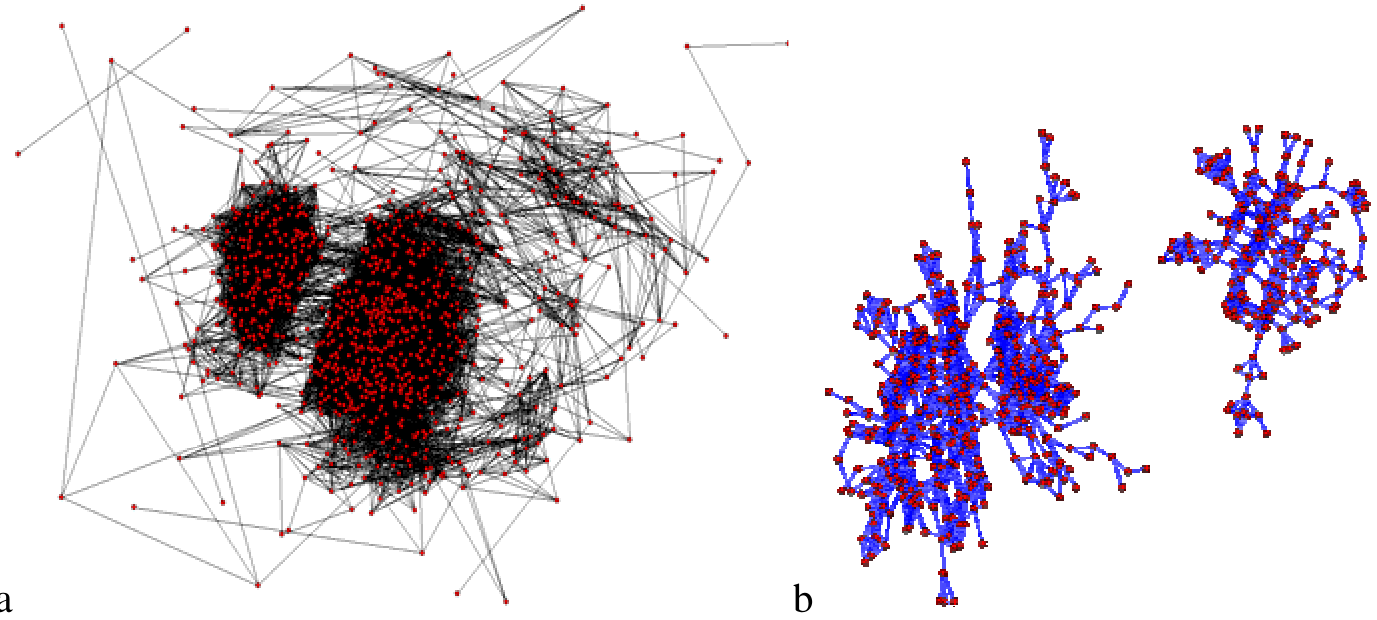 Figure 4: The homophily network of Indonesia at different trim levels, showing emergent clustering.
Critical Analysis & Conclusion
Takeaway
The core contribution is the traceability of the model. Every agent behavior and social link can be traced back to an actual survey response. This allows for "validation via waves"—comparing simulation outputs against subsequent years of real-world survey data to check for predictive accuracy.
Limitations
- Dimensionality Sensitivity: The authors admit they don't yet know the optimal number of survey items () needed for a "perfect" representation.
- Static Snapshots: While the attributes change, the initial network is a snapshot in time. The dynamic evolution of these networks requires more research into how survey responses themselves shift over time.
Future Outlook
This approach paves the way for "Simulation as Public Policy." By modeling how information (or a specific policy) spreads through these empirically grounded networks, decision-makers can predict societal reactions with far greater granularity than traditional polling alone.