
Beyond the Paycheck: Decoding Crowd Worker Motivation through SDT
Development and Validation of Extrinsic Motivation Scale for Crowdsourcing Micro-task Platforms
This paper develops and validates a specialized scale for measuring the extrinsic motivation of workers on crowdsourcing micro-task platforms. Based on Self-Determination Theory (SDT), the authors adapt the Work Extrinsic Intrinsic Motivation Scale (WEIMS) to the crowdsourcing context, achieving a validated 12-item instrument for assessing motivation types.
TL;DR
Researchers from the Technical University of Berlin have developed a validated 12-item scale to measure the extrinsic motivation of crowd workers. Moving beyond the "money-only" myth, this tool uses Self-Determination Theory (SDT) to categorize motivation into levels of autonomy, providing a framework for platforms to design better incentive structures that improve both data quality and worker satisfaction.
Background: The Motivation Myth in Crowdsourcing
In the world of micro-task platforms like Amazon Mechanical Turk, there is a prevailing assumption that workers are essentially "biological CPUs" driven solely by small monetary rewards. However, the academic consensus has shifted: workers are human, and their motivation is a complex spectrum.
While previous work suggested that intrinsic motivation (doing a task because it's fun) improves quality and extrinsic motivation (doing it for money) improves speed, this paper argues that extrinsic motivation itself has multiple layers. Some extrinsic motives are "controlled" (pressure-driven), while others are "autonomous" (goal-aligned). Understanding this nuance is critical for the long-term sustainability of crowdsourced ecosystems.
Methodology: Adapting the WEIMS Scale
The authors grounded their research in the Self-Determination Theory (SDT) continuum, which ranges from Amotivation to Intrinsic Motivation. They adapted the existing Work Extrinsic Intrinsic Motivation Scale (WEIMS) and tested it on 222 workers.
The Filtering Innovation
To ensure the data was reliable—a common challenge in crowdsourcing research—the authors implemented a clever post-processing step. They used a weighted Euclidean distance formula to calculate an Inconsistency Score (IS) for each participant, effectively weeding out "random clickers" before the factor analysis began.
Model Architecture
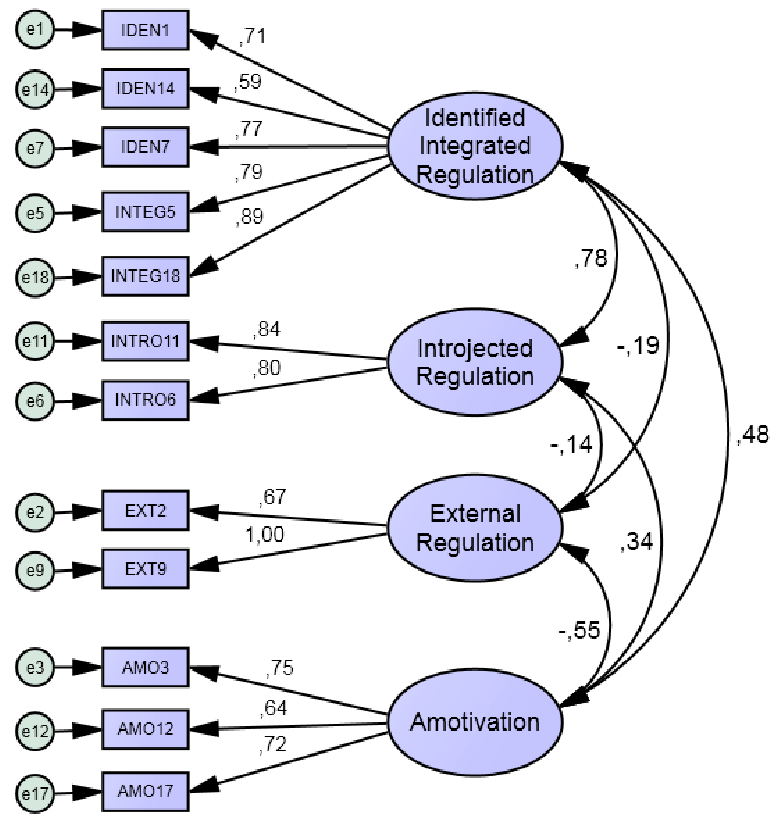
The researchers used Confirmatory Factor Analysis (CFA) to verify how the items grouped together. The resulting model structure is shown below:
Key Insights from the Results
The study yielded a surprising structural finding: Integrated and Identified regulations merged.
In standard organizational psychology, "Identified" means you value the task's goal, while "Integrated" means the task is part of your identity. In the micro-task world, these two appear indistinguishable. For a crowd worker, choosing work that aligns with their lifestyle is functionally the same as work that has become part of who they are.
Performance Metrics
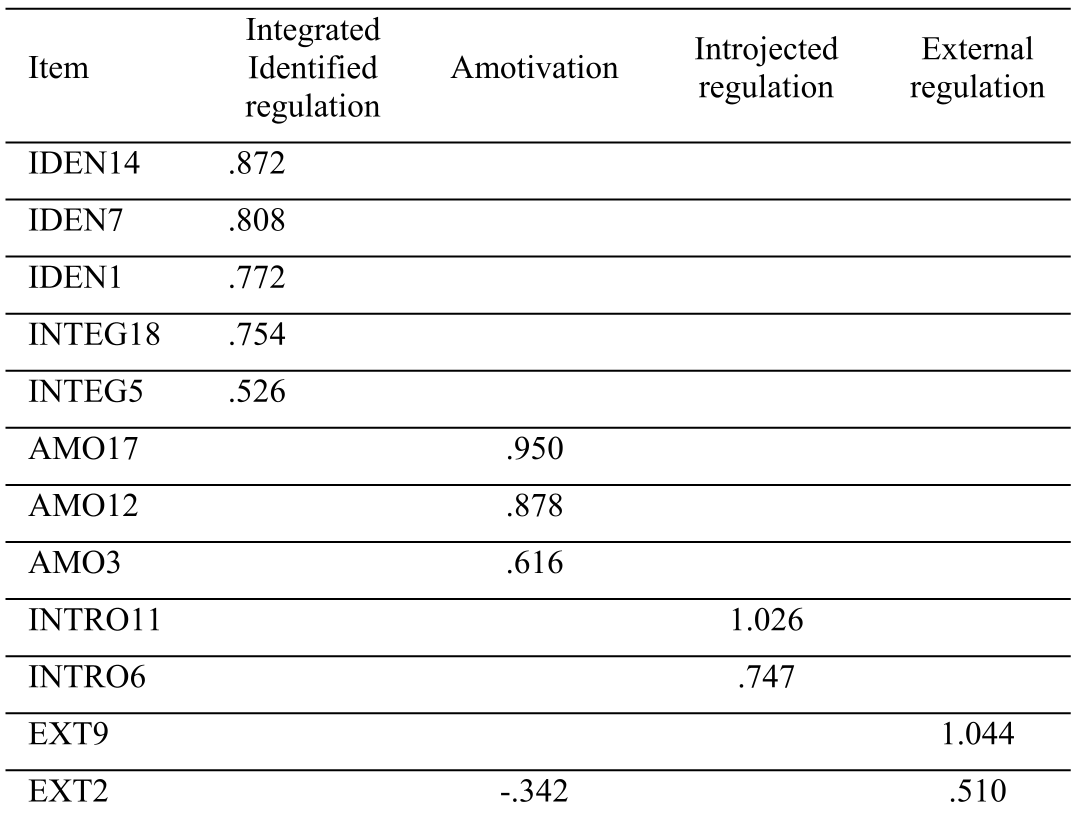
The final 12-item scale showed robust statistical fit:
- Composite Reliability (CR): 0.95 (Extremely high internal consistency).
- RMSEA: 0.069 (Indicates a good fit for the model).
- CFI: 0.962 (Strong evidence that the factor structure is accurate).
Critical Analysis & Conclusion
This paper provides a necessary bridge between high-level psychological theory and the practical management of "the crowd." By providing a validated tool, the authors enable platform providers to move away from "one-size-fits-all" payment models.
Takeaway for Designers: If you want a loyal, high-quality workforce, your platform must do more than just pay. It needs to foster Identified Regulation—making workers feel that these micro-tasks are helping them achieve personal career goals or a desired lifestyle.
Limitations: The study was limited to US-based workers on MTurk. Future work must validate this scale across different cultures (e.g., India) and different platform types (e.g., volunteer-based or high-skill crowdsourcing) to see if the "Identity" and "Goal" factors remain merged.
Future Outlook
As AI development continues to demand massive amounts of human-annotated data, the "Motivation Scale for Crowdsourcing" will become a standard diagnostic tool for measuring the "health" of the human-in-the-loop pipeline.