
PC or Smartphone? How the "Device" Reshapes Our Social Interactions
The Impact of “Device” in Social Networking: An Explorative Study with Turkish Social Network Site Users on the Nature of Interactions through Personal Computers and Smartphones
This study investigates how the nature of social networking site (SNS) interactions differs between Personal Computers (PC) and smartphones. Using Principal Component Analysis (PCA) and OLS regression on a sample of Turkish users, the research identifies device-specific usage patterns, revealing that while PC remains the primary platform for content-heavy tasks, smartphones are relegated to quick, interactive updates.
TL;DR
Is your smartphone just a smaller version of your computer, or does it change how you socialize? This study analyzes 203 Turkish SNS users to prove that devices are not neutral. While PCs are the playground for "power users" and content discovery, smartphones are restricted by technical hurdles like poor multitasking and high connection costs, turning social networking into a fragmented, "quick-check" activity.
Background: The Device as a Filter
In the early days of Social Networking Sites (SNS), research focused heavily on what people did. However, as the world transitioned to mobile, a new question emerged: Does the "Device" act as a filter for our social behavior? This study looks at the Turkish market—a region with high social media penetration but unique economic and technical constraints—to see if the hardware in your hand dictates the "friends" you interact with.
The "Multitasking" Bottleneck
The authors identify a crucial "Insight": The nature of your social interaction is limited by the Inductive Bias of the hardware. Specifically, the study highlights that:
- PCs allow for exploration. Users are more likely to meet new people because they can open multiple tabs, watch a video while reading a profile, and navigate complex interfaces easily.
- Smartphones serve as "interaction silos." Because mobile apps in 2011 (and to an extent today) struggled with seamless multitasking, users focused almost exclusively on existing friends rather than discovering new ones.
Methodology: From Survey to Math
To get past simple surface-level observations, the researchers used Principal Component Analysis (PCA). They grouped activities into two main categories:
- Passive Multimedia Sharing: Videos, music, and links (Dominantly PC).
- Interactive Information Sharing: Status updates, photo posting, and comments (Balanced, but leaning Smartphone for frequency).
 The study utilized OLS regression models to determine the impact of age, gender, and frequency on these specific factors.
Key Results: Where the Platforms Diverge
The empirical evidence reveals a clear hierarchy in device usage:
- Content Consumption: YouTube, Picasa, and Flickr remain "PC-first" due to screen size and data speeds.
- Social Maintenance: Facebook remains the "home base" for both, but the type of activity differs. On smartphones, users mostly view photos and profiles (low effort), while on PCs, they engage in deeper comments and group management.
- The Gender Aspect: On PCs, women showed significantly higher sharing activity than men. On smartphones, frequency of use was the only significant driver for interactive sharing, regardless of gender.
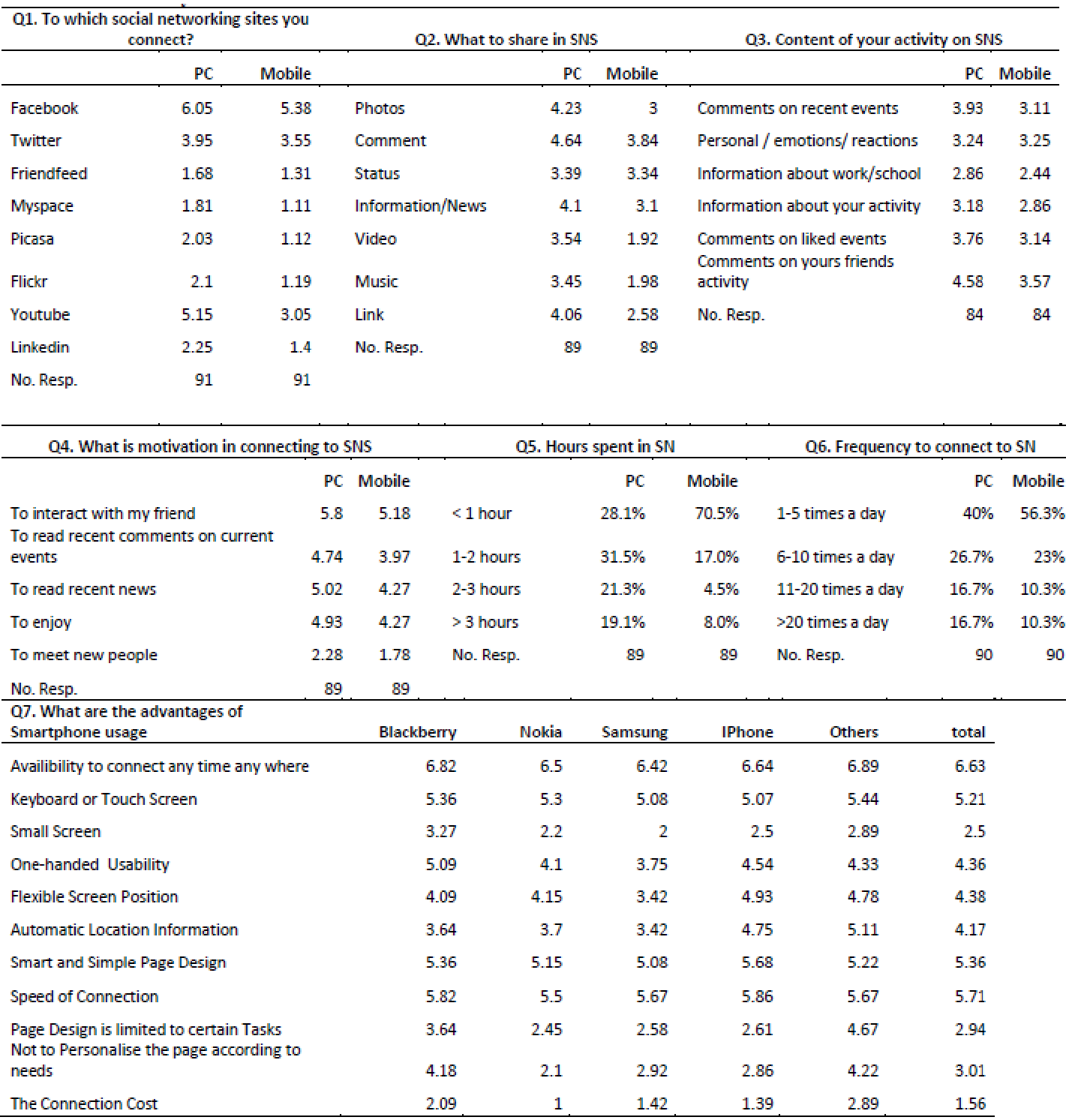 The data confirms that while 'Availability anywhere' is the smartphone's killer feature, 'Connection Cost' and 'Small Screen' remain significant psychological barriers.
Deep Insights & Future Outlook
The study concludes that the "nature of interactions" is highly sensitive to Device Constraints.
- Cost and Cognition: In regions like Turkey, the "Connection Cost" (as seen in Table A1) prevents the smartphone from becoming the primary consumption device for heavy media.
- Social Silo-ing: The mobile interface encourages "low-friction" social tasks, which might explain why digital social circles become more insular over time as mobile usage increases.
Limitations: The study was conducted in 2011. While the mathematical approach is robust, the rise of 5G and modern "Super-Apps" like Instagram or TikTok has likely mitigated the "multitasking" and "cost" constraints mentioned. However, the core takeaway remains: The interface is the architect of the interaction.