
D2D-MSN: Bridging Social Ties and Physical Wireless Efficiency
Device-to-Device Communication in Wireless Mobile Social Networks
This paper introduces a theoretical framework for Device-to-Device (D2D) communication in Wireless Mobile Social Networks (D2D-MSN). It proposes the "D2D-MSN Throughput" metric to evaluate spectral efficiency by integrating social-contextual link distance distributions with stochastic geometry (Poisson Point Processes).
TL;DR
This research pioneers a mathematical framework for Device-to-Device (D2D) communication within Wireless Mobile Social Networks (MSN). By modeling social behavior through power-law distance distributions and using stochastic geometry, the authors define a new metric—D2D-MSN Throughput—to optimize how resources are split between traditional cellular links and direct device interactions.
Problem & Motivation: The Missing Social Link
Traditional D2D research treats user distribution as purely random or static. However, in the real world, "social context" dictates communication: you are more likely to share data with someone nearby (a friend in the same room) than someone across the city.
Existing models failed to account for:
- Spatial distribution of users in a dynamic mobile environment.
- Social-contextual distance: The physical distance between a source and a destination is not uniform; it follows a power-law distribution.
- Mode Selection Logic: When exactly should a phone stop talking to the base station (BS) and start talking directly to another phone?
Methodology: Stochastic Geometry meets Social Graphs
The paper models the network as a Poisson Point Process (PPP) with spatial density . The core innovation lies in the Transmission Mode Selection based on a distance threshold .
1. The Power-Law Distance Distribution
The authors assume that the probability of node A communicating with node B is inversely proportional to their distance with a power exponent . This captures the "small-world" nature of social interactions.
2. Network Architecture
The network splits resources:
- Cellular Mode: Exclusive channels, noise-limited environment.
- D2D Mode: Shared channels ( portion of total), interference-limited environment.
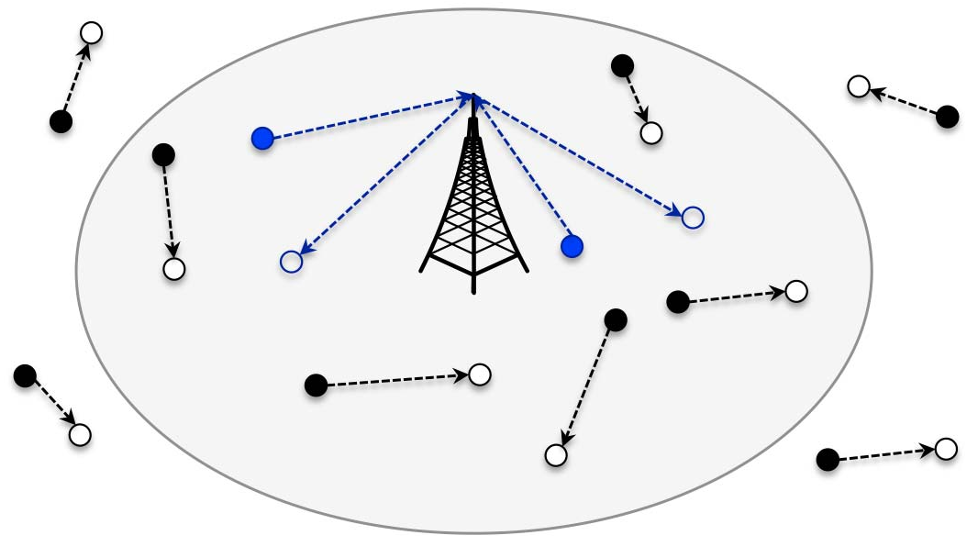 Fig 1: Cellular users (blue) vs. D2D users (black) in a spatial PPP distribution.
Experiments & Results
The study utilizes D2D-MSN Throughput (), measured in bits/Hz/sec/m², as the primary success metric.
Key Insight: The Social Exponent ()
As shown in Figure 3, the optimal probability of selecting D2D mode () is heavily dependent on the social tie strength (). When is high (meaning users frequently talk to nearby neighbors), D2D mode is significantly more beneficial. If is low (social ties are distance-independent), D2D communication actually degrades performance due to interference.
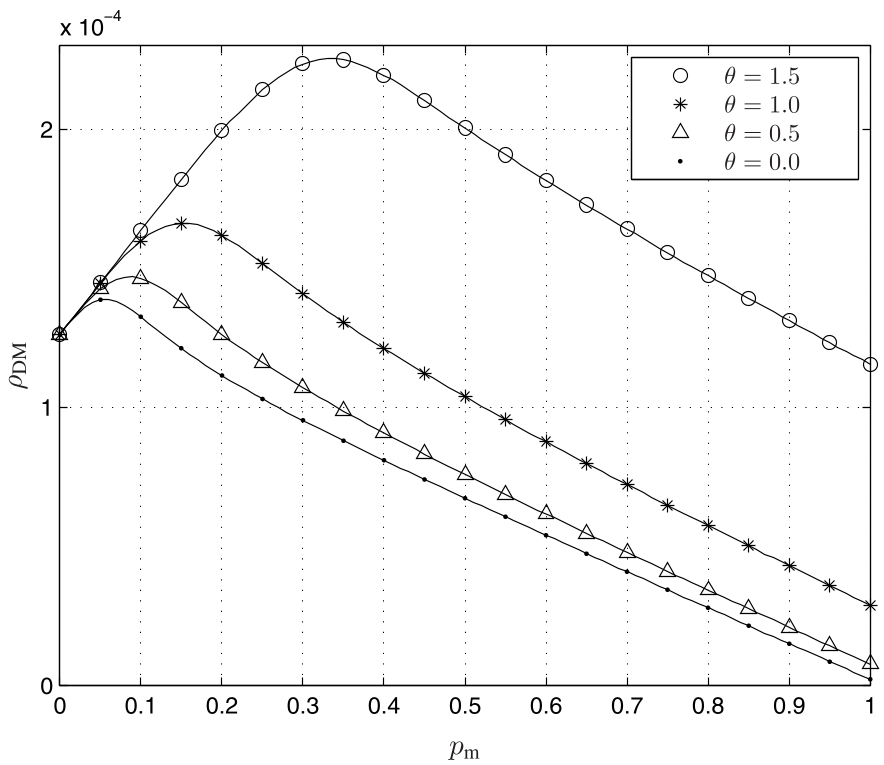 Fig 3: Throughput vs. Mode Selection Probability across different social exponents.
Joint Optimization
Figure 4 illustrates the delicate balance between the resource portion () and the selection threshold. If you have many D2D users ( is high), you must allocate more spectral resources () to them; otherwise, the mutual interference collapses the network throughput.
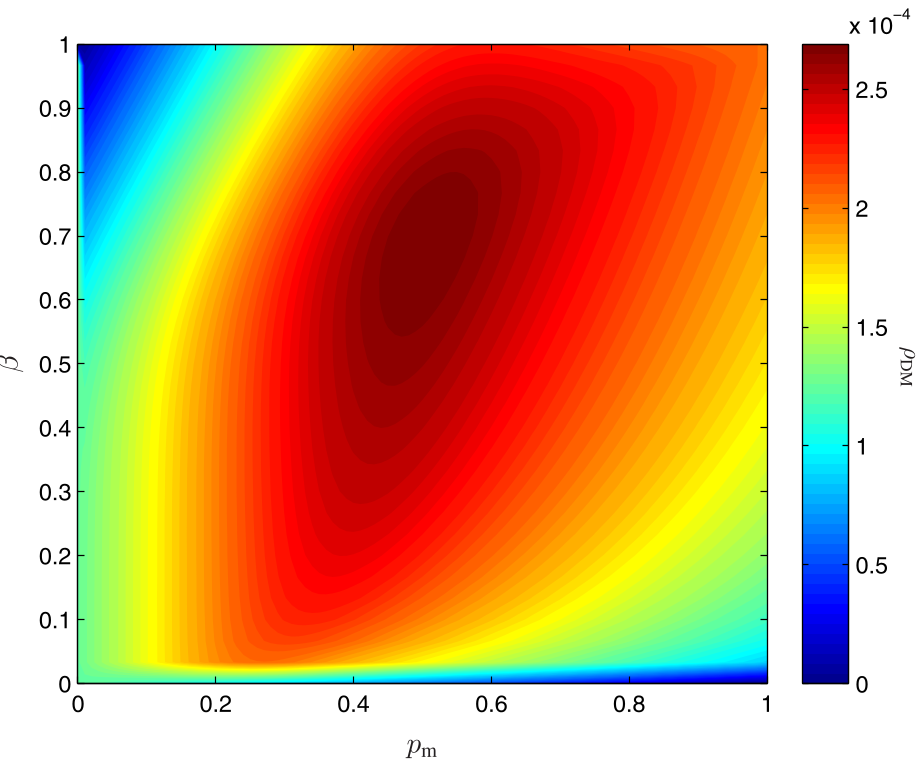 Fig 4: Finding the "Sweet Spot" for resource allocation and mode selection.
Critical Analysis & Conclusion
Takeaway
The research successfully proves that social context is a first-class citizen in network design. Spectral efficiency isn't just about signal power; it's about matching the network's logical topology to the users' social topology.
Limitations
- Mobility: The model assumes a snapshot of a PPP, but social networks are highly mobile.
- Interference Simplification: The assumption that inter-cell interference is negligible might not hold in ultra-dense 5G/6G deployments.
Future Outlook
This framework provides a roadmap for Slicing in 6G. By analyzing the "social temperature" of a geographical area, operators can dynamically adjust and to maximize throughput in real-time.