
DEVS Modeling of Social Influence: Mapping the Informal Pulse of Organizations
DEVS modelling and simulation of human social interaction and influence
This paper presents a formal framework for modeling and simulating human social interaction and information influence using the Discrete Event System Specifications (DEVS) and Cell-DEVS formalisms. It integrates epidemic-based spreading algorithms (SIR model) and bounded confidence theories into a modular, hierarchical simulation architecture to predict behavioral changes within social networks.
TL;DR
Information in a company doesn't just flow through hierarchy; it spreads like a virus during coffee breaks. This paper introduces a formal, modular simulation framework based on DEVS (Discrete Event System Specifications) to model how individual opinions evolve when exposed to new information, borrowing logic from epidemiology to predict organizational behavioral shifts.
Background: Beyond Static Social Graphs
Most social influence research relies on static models that treat individuals as simple transmitters or obstacles. However, human reaction to change—such as the implementation of a new ERP system or a shift in corporate policy—is rarely purely rational. It is driven by dynamic interactions and bounded confidence. The researchers argue that we need a "low-level" behavioral specification language to make these simulations reusable and verifiable.
Methodology: The DEVS & Cell-DEVS Architecture
The core of this work lies in the conversion of social theories into a formal mathematical framework.
1. The Atomic Agent
Each individual is an Atomic DEVS model. They are not just dots on a graph; they possess:
- Static Attributes: Age, religion, language, and social status.
- Dynamic Variables: Opinion level (0-10), interest, and unsatisfied needs.
- Internal Logic: A trust factor () determines if an incoming message is even considered.
2. The Information Epidemic
The authors transpose the SIR (Susceptible-Infected-Removed) model to information diffusion:
- A-type (Active): Holds information and is actively spreading it.
- B-type (Uninformed): Hasn't received the info but is susceptible.
- C-type (Passive): Received it but won't pass it on.
3. Bounded Confidence (BC)
This is the mathematical "filter." An agent only updates their opinion if the sender's opinion is close enough to their own. If the gap is too wide, the receiver ignores the message—an intuitive reflection of "confirmation bias."
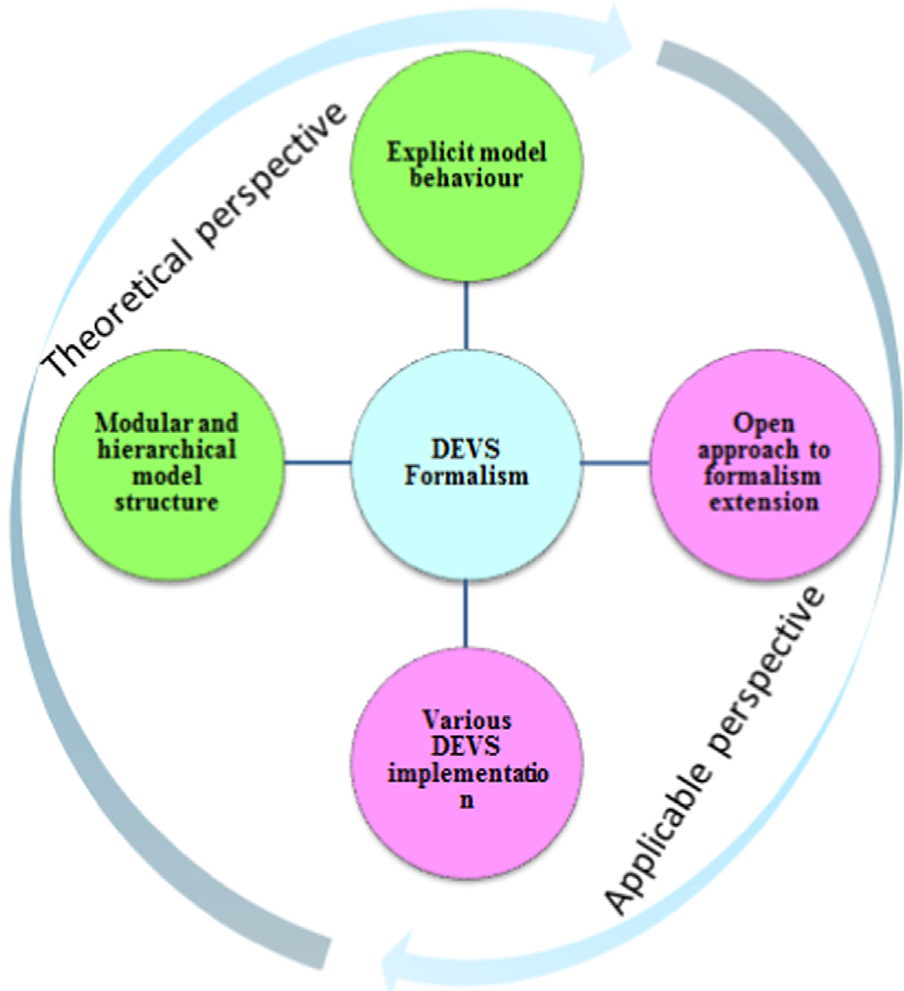 Figure 1: The theoretical advantages of DEVS, emphasizing hierarchical modularity and structural coupling.
Experiments: Simulating the Innovation Adoption
Using the CD++ toolkit, the researchers simulated a population of 441 agents on a 21x21 grid.
- The Setup: 10 "info-sources" (blue cells) were seeded into a population with randomized initial opinions (Red = high support, Yellow = low support).
- The Interaction: Using a Von Neumann neighborhood (N, S, E, W), agents influenced their neighbors based on the BC mechanism.
- The Result: The simulation captured how informal communication paths can either "activate" a workforce or leave isolated "white cells" (uninformed/uninterested parties) despite physical proximity.
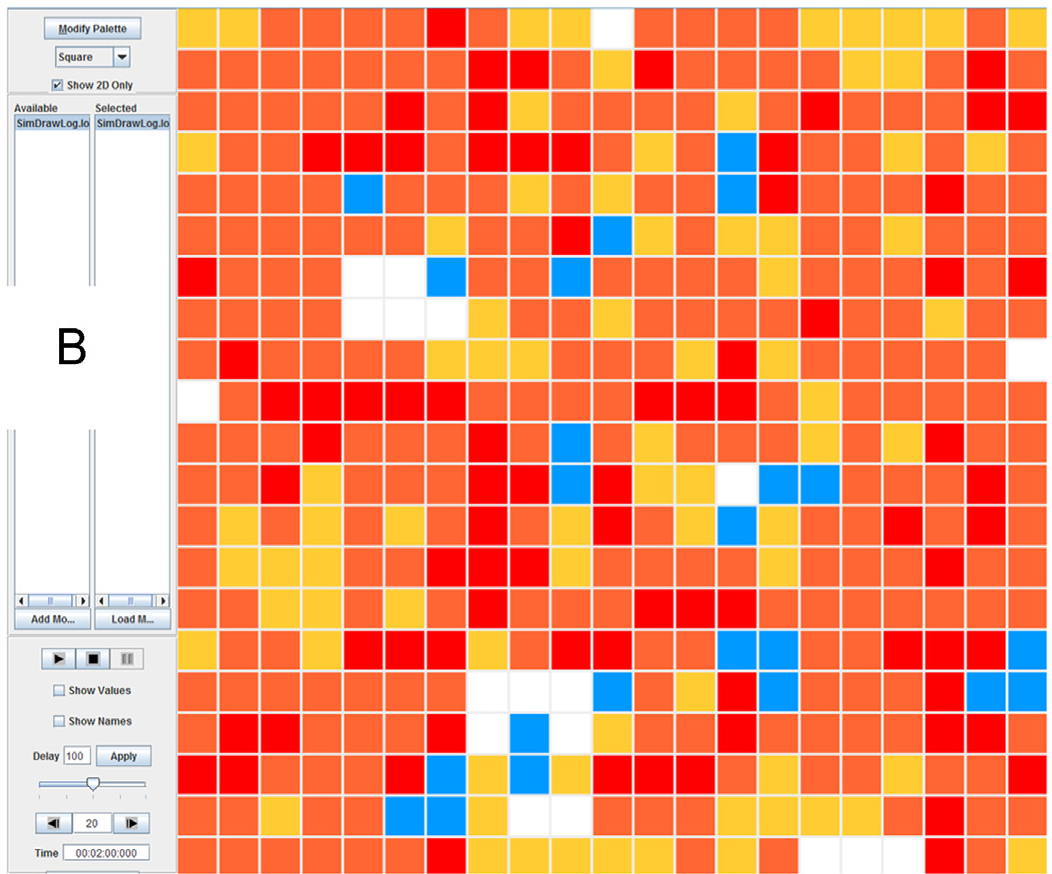 Figure 2: Simulation evolution (A) at initialization and (B) at the end, demonstrating opinion convergence and diffusion gaps.
Critical Insight: Why This Matters
The real value here isn't just seeing a "heatmap" of opinions; it is the Influence Maximization (IM) potential. By running multiple DEVS simulations, an organization can identify which "nodes" (employees) are the most effective seeds for information spread.
Unlike black-box AI models, the DEVS approach provides operational semantics. You can trace why a specific group resisted a change by looking at the specific trust thresholds and opinion variables within the model.
Future Outlook & Limitations
While the current study uses a 2D grid (an abstract geographical representation), the authors acknowledge that real social networks are multi-layered (family, work, digital). The next frontier for this research is integrating Realistic Social Media data and multi-level network graphs to move beyond the "lattice" constraint toward a true "Small World" network topology.
Conclusion
By treating information like a biological contagion and modeling the human mind as a discrete event system, this paper provides a robust blueprint for "Social Industrial Engineering." It moves human behavior from a "soft" variable to a specifiable, simulatable component of the enterprise system.