
Security Through Social Trust: Redefining P2P Access Control via Social Networks
DHT Network with Link Access Control Using a Social Network
This paper introduces a Distributed Hash Table (DHT) network that integrates social network relationships to enforce link-level access control. By leveraging real-world "friend" connections, the system establishes trusted routing paths and utilizes dynamic node movement to mitigate path expansion within a pure Peer-to-Peer (P2P) architecture.
TL;DR
To combat the rampant anonymity and security leaks in traditional P2P networks, this paper proposes a hybrid architecture that maps real-world social relationships onto a DHT framework. By replacing anonymous links with "Trusted Links" between friends, the system enforces access control at the network layer while maintaining efficiency through dynamic node repositioning.
Problem & Motivation: The Anonymity Trap
The power of P2P networks—their decentralization and anonymity—is also their greatest weakness. In networks like Gnutella or Winny, any node can connect to any other node. This openness facilitates:
- Information Leaks: Sensitive data being cached by untrusted relay nodes.
- Malicious Injection: Anonymous peers altering data during transit.
- Sybil/Spoofing Threats: Malicious actors creating numerous fake identities to overwhelm the network.
The authors argue that the missing ingredient is Contextual Trust. In the real world, we share information based on a chain of trust (Friends, or Friends-of-Friends). Translating this social graph into a P2P topology could inherently solve the access control dilemma.
Methodology: Mapping Humanity onto the DHT
The proposed architecture is built upon a circular DHT (similar to Symphony), but with a sophisticated multi-link structure:
1. The Tri-Link Architecture
- Short Links: Basic structural links between adjacent nodes to maintain the ring.
- Trusted Links: The core innovation—links representing social acquaintances. Service data (files, voice, private info) only travels through these links.
- Manager Links: Used to track nodes as they move across the network.
2. The ID Duality & Dynamic Movement
One major problem with social-only networks is the "Small World" dilemma: social graphs are often inefficient for routing. This paper introduces:
- Static ID: A permanent identifier used for authentication and certificates.
- Dynamic ID: A transient position on the DHT circle.
To keep the path lengths short, nodes physically move their position (change their Dynamic ID) on the circle to be closer to their social "friends."
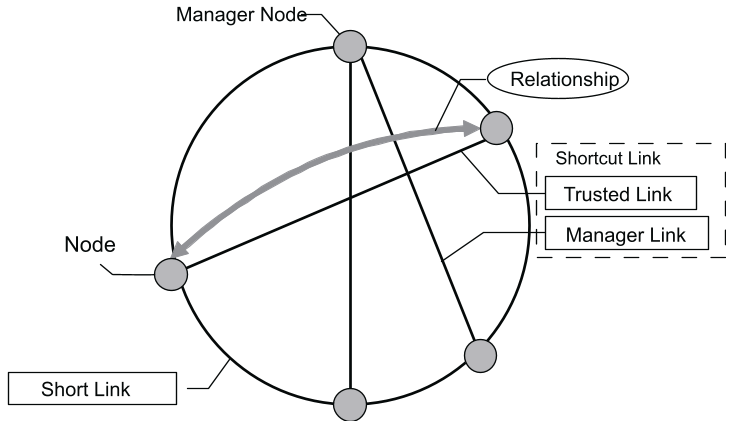 Figure 1: The proposed network utilizes multiple link types to balance structure and trust.
3. Authentication Flow
When Node A wants to connect to Node B (a friend of a friend), the request must be validated through the mutual contact (Node C). This creates a "Service Link" that acts as a secure tunnel for actual data exchange.
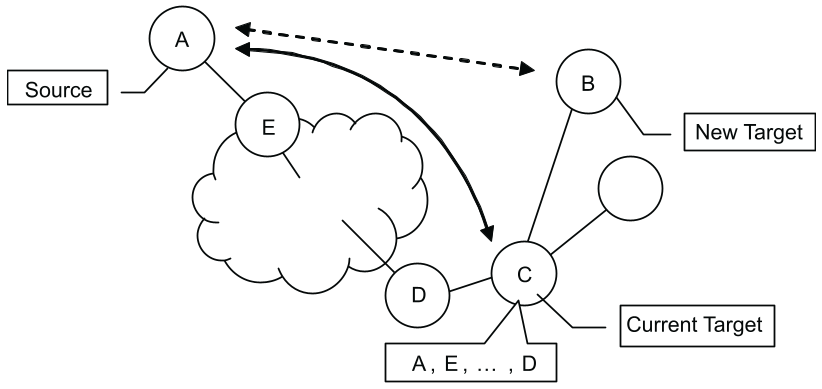 Figure 2: The multi-step authentication process ensures only verified socially-connected peers can exchange sensitive data.
Experiments & Results: Efficiency vs. Security
The authors evaluated the system using a simulator following power-law social distributions. Key findings include:
- Scalability: The average number of connections per node grows slowly. Even at 50,000 nodes, the average connection count is roughly 14.7, which is notably lower than standard Chord implementations (which typically grow at ).
- Resilience: Because nodes can refuse connections at the forwarding stage, the network is inherently resistant to DoS attacks. Malicious nodes without social capital are effectively isolated.
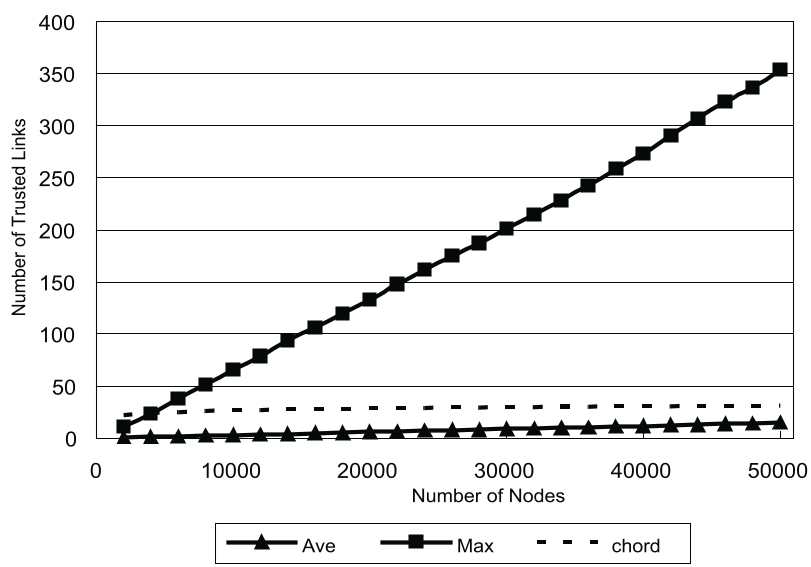 Figure 3: Average number of trusted links remains manageable even as node count increases.
Critical Analysis & Conclusion
Takeaways
The paper successfully demonstrates that Link Access Control is a powerful alternative to pure encryption or centralized permissioning. By making the "connection" itself the unit of trust, the network becomes a self-policing ecosystem.
Limitations
- Bootstrapping: A user cannot join the network without a pre-existing friend. This creates a high barrier to entry for solo users.
- Island Networks: If social clusters are too tight, the network may fragment into "islands" that cannot communicate with each other, though the authors cite the "Small World Phenomenon" as a mitigating factor.
- Privacy of Meta-data: While service data is protected, the "Manager Nodes" still know the mapping between Static and Dynamic IDs, which could be a point of vulnerability.
Future Outlook
As decentralized technologies (Web3) move away from pure anonymity toward Decentralized Identifiers (DIDs) and "Social Graphs" (like Lens Protocol), the techniques proposed here regarding dynamic DHT movement and link-based access control will likely see a resurgence in interest.