
From Proof to Performance: 70 Years of NLP Research Rhetoric
« De nos jours, ce sont les résultats qui comptent » : création et étude diachronique d'un corpus de revendications issues d'articles de TAL
The paper introduces a large-scale corpus of over 15 million sentences from NLP articles (ACL Anthology and ArXiv) published between 1952 and 2024, annotated with rhetorical claim categories. Using a fine-tuned SciBERT model, the authors perform a diachronic study revealing a significant shift in how NLP research is communicated, moving from simple contribution statements to highly structured, result-oriented abstracts.
TL;DR
Researchers from Université de Lorraine and Paris-Saclay have mapped the evolution of NLP research from 1952 to 2024. By analyzing 15 million sentences, they've demonstrated a dramatic shift: NLP abstracts have moved from brief descriptions of what was built to standardized narrations of why it matters and exactly how much it beat the existing state-of-the-art.
The Rhetorical Shift: Why it Matters
Scientific writing is never neutral; it is a persuasive act designed to convince peers of a study's value. In the modern "publish or perish" climate, the way we frame "claims" (the fundamental assertions of a paper) can cross the line from healthy advocacy to scientific overclaiming. This paper seeks to quantify these trends by creating a massive corpus of NLP writing, allowing us to see the "biography" of our field through its shifting syntax.
Methodology: High-Granularity Argumentative Zoning
The authors developed a taxonomy of 8 claim categories, including CONTEXT, CONTRIBUTION, RESULT, and LIMITATION.
To scale this up, they utilized:
- Manual Annotation: 14k+ sentences were meticulously labeled to create a gold-standard dataset.
- SciBERT Classification: A SciBERT model was fine-tuned, achieving a weighted F1-score of 0.89, to label the remaining 15 million sentences.
- Diachronic Analysis: They tracked how these labels appeared in abstracts across different eras (Pre-1995, 1995-2009, 2010-2024).
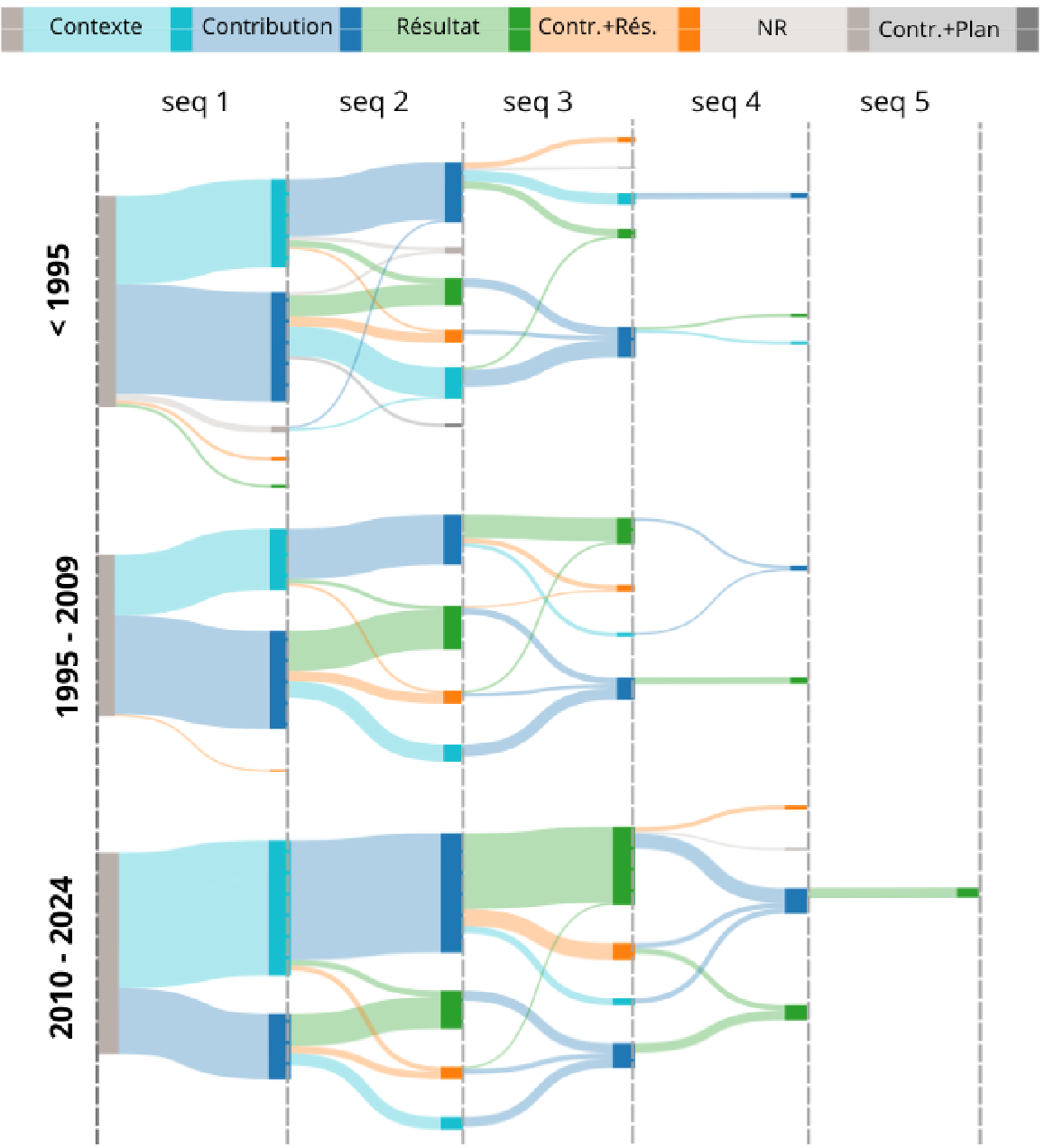 Figure 3: Sankey diagrams showing the increasing standardization and lengthening of abstract structures over three decades.
Key Findings: The "Results" Era
The most striking discovery is the "Result-ification" of NLP.
- Abstract Lengthening: In the early days, an abstract was often just a single "Contribution" sequence. Today, it is a multi-stage funnel: setting the context, describing the method, and summarizing the results.
- The Rise of Benchmarks: The inclusion of results in abstracts has skyrocketed. In 1978, fewer than half of NLP abstracts bothered to mention specific results. In 2024, nearly 90% do.
- The ArXiv vs. ACL Divide: Interestingly, ArXiv pre-prints tend to be more contextual and narrative-driven than formal ACL anthology papers, perhaps reflecting a less formal but more competitive promotional style.
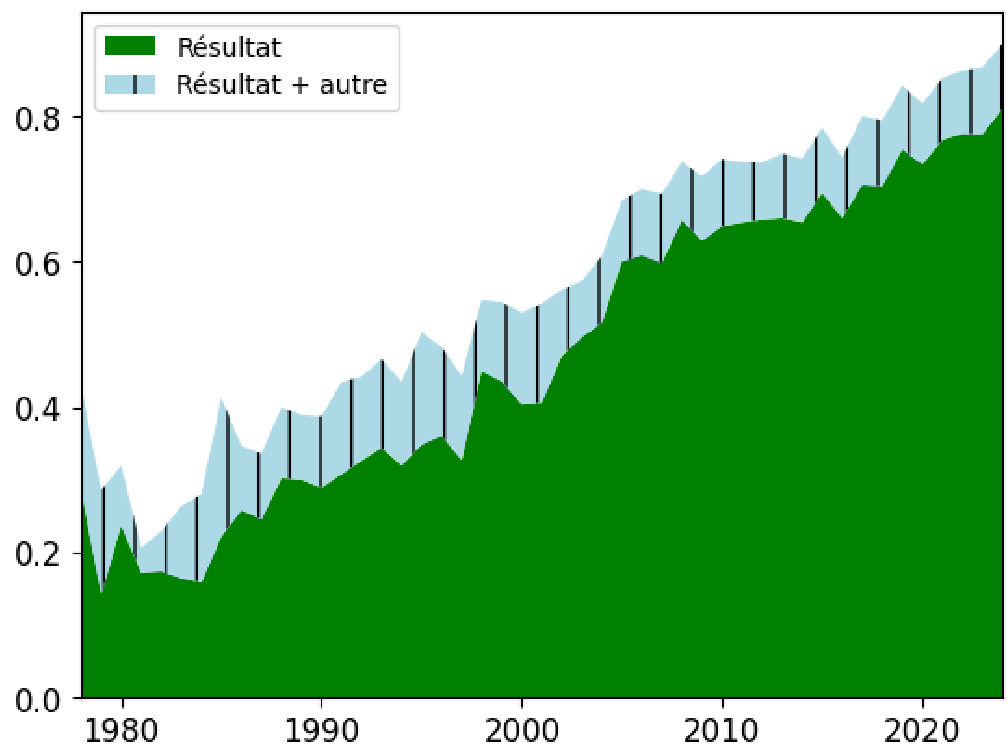 Figure 2: Percentage of articles including at least one RESULT sequence in their abstract by year.
Critical Insight: The Cost of Normalization
The authors argue that NLP is adopting the IMRAD (Introduction, Methods, Results, and Discussion) structure common in medicine. While this makes papers easier to skim in an age of information overload, it reflects a "Evaluation Paradigm."
The focus on "beating the benchmark" in the abstract—often without mentioning LIMITATIONS (which appear in only 3.4% of abstracts despite being in 70% of full papers)—suggests that the pressure to present "clean" and "superior" results may be marginalizing high-impact exploratory work that doesn't fit the SOTA-chasing mold.
Conclusion
This study provides a mirror for the NLP community. As we move toward 2025, our "results-first" rhetoric is a double-edged sword: it proves our field's maturity and utility, but it may also be narrowing our scientific vision to whatever fits in a standardized abstract sequence.
Project Resources: The authors have released the 15M sentence corpus and the fine-tuned SciBERT model to encourage further "NLP for NLP" research.