
Persuasive AI: Merging Social Psychology with Neural MCTS for Smarter Dialogue Management
Dialogue management in conversational agents through psychology of persuasion and machine learning
The paper proposes a multidisciplinary framework for Dialogue Management in task-oriented agents, integrating the Theory of Planned Behavior (TPB) from social psychology with Reinforcement Learning. Using a Neural Monte Carlo Tree Search (Neural MCTS) approach similar to AlphaZero, the agent learns to personalize messages to induce behavior change (reducing red meat consumption).
TL;DR
This research bridges the gap between Social Psychology and Machine Learning by developing a conversational agent that doesn't just talk, but persuades. By leveraging the Theory of Planned Behavior (TPB) and Neural Monte Carlo Tree Search, the system creates a personalized "psychological profile" of the user through minimal questioning to select the most effective message framing—successfully demonstrated in the context of reducing red meat consumption.
Problem & Motivation: The "Blind" Dialogue Agent
Most current task-oriented agents operate on cold logic or massive, uninterpreted datasets. They lack social intuition. In fields like health coaching, simply providing information isn't enough; you must overcome "reactance" (human resistance to being told what to do).
The authors identified that existing Reinforcement Learning (RL) approaches to dialogue require too much data because they start from scratch. Their insight? Use well-established psychological models as a prior to guide the AI's learning process.
Methodology: From Psychology to Probability
The researchers followed a rigorous three-step technical pipeline:
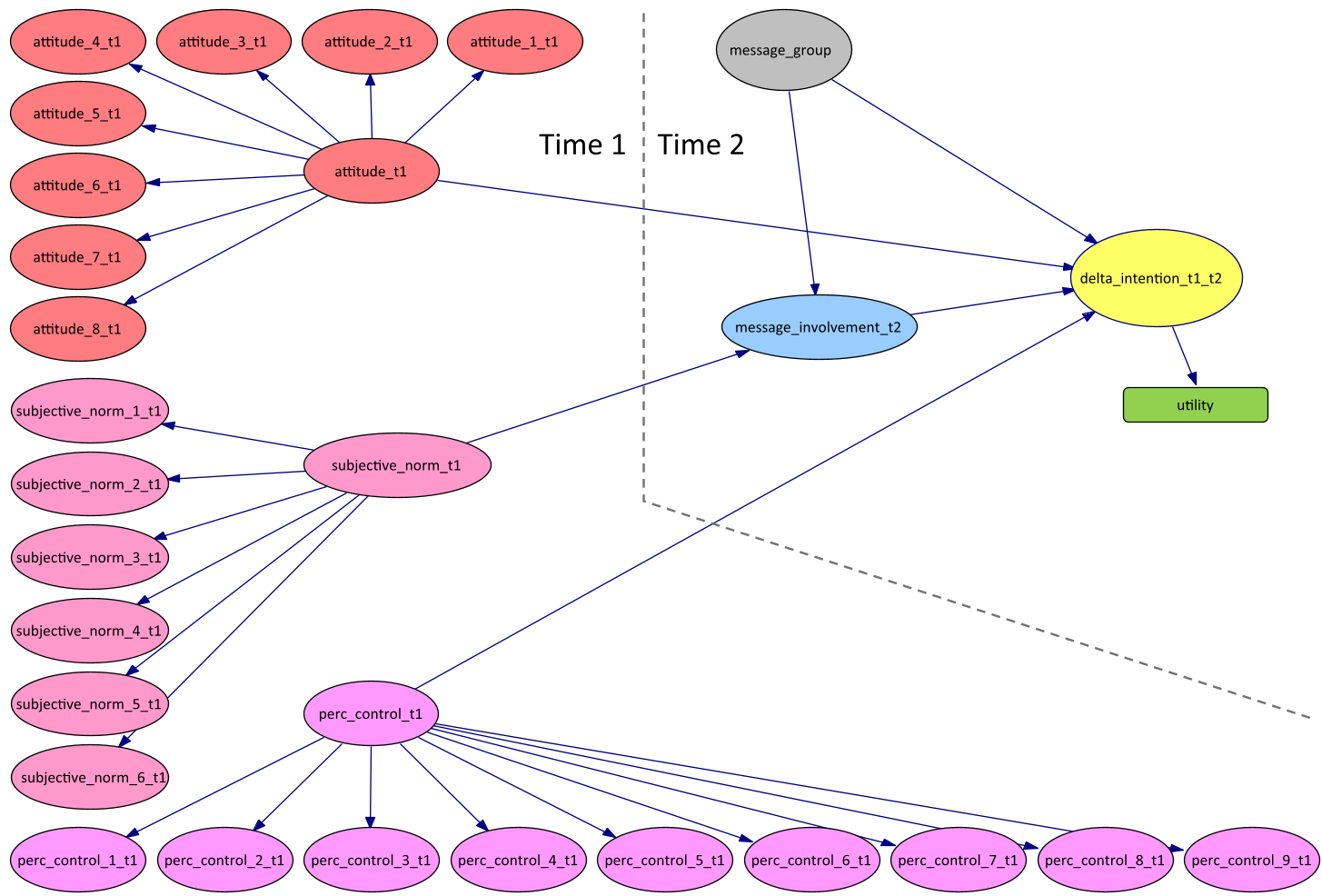
- The Psychosocial Step: Using a sample of 545 participants, they validated how "frames" (Gain, Non-Loss, Non-Gain, Loss) influence intentions. They used Structural Equation Modeling (SEM) to map how variables like "Subjective Norms" and "Attitude" dictate message involvement.
- The Probabilistic Bridge: They translated the SEM into a Dynamic Bayesian Network (DBN). This turned psychological theories into a mathematical predictor capable of forecasting a user's change in intention based on their answers.
- The Optimization Step: They framed the dialogue as a Partially Observable Markov Decision Process (POMDP). Since the state space is massive (~10³³ possible policies), they applied a single-player version of Neural MCTS (inspired by AlphaZero) to find the optimal sequence of questions and the best final persuasive message.
Key Findings: The Power of "Non-Loss" Framing
The study yielded both psychological and computational breakthroughs:
- Universal Persuader: "Non-loss" framed messages (e.g., "If you eat little red meat, you will avoid damaging your health") were the most effective across the board, regardless of the user's initial mindset.
- Personalization Triggers: "Gain" frames only worked well when users felt a high social pressure (subjective norm) to change.
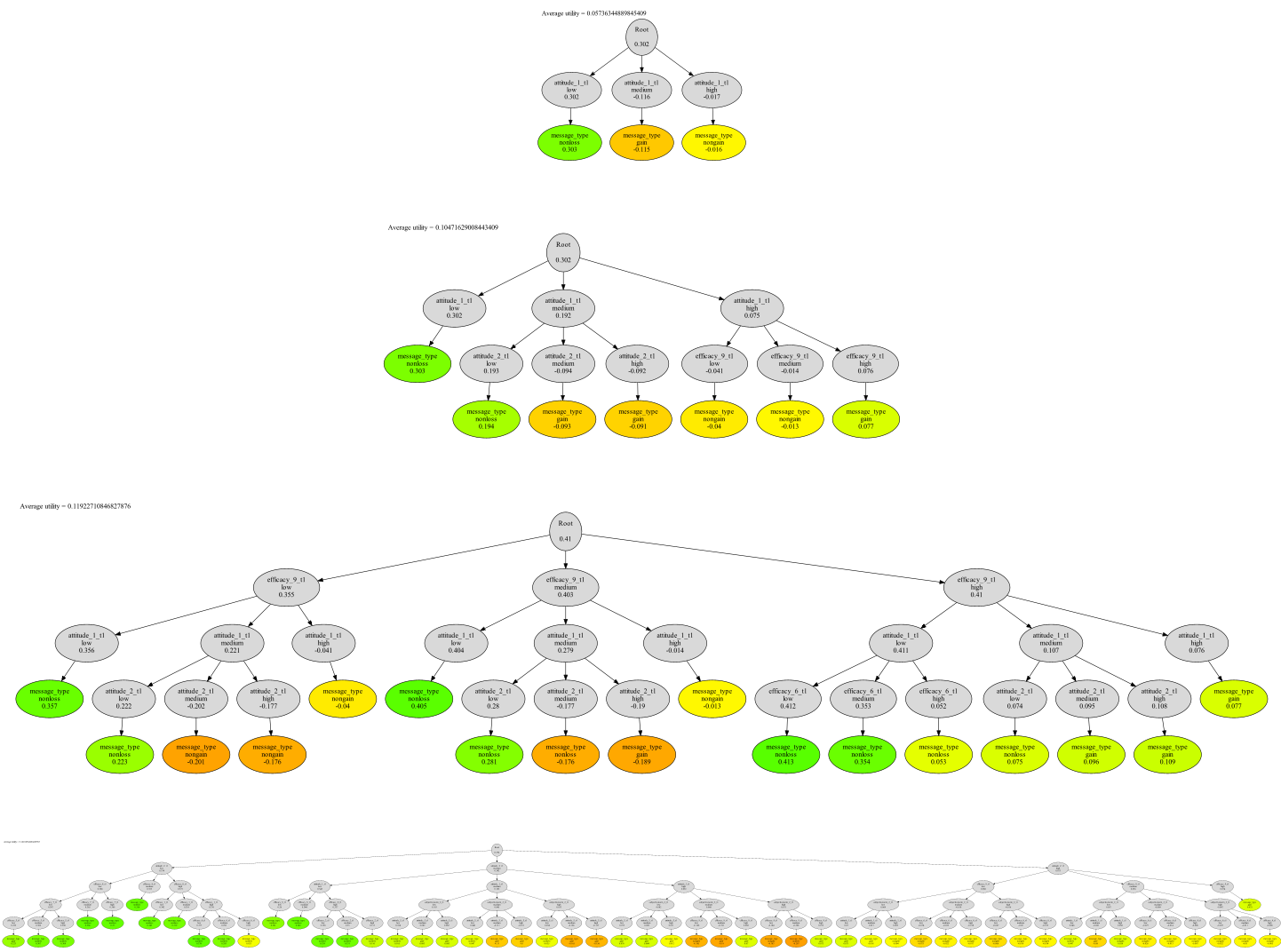
- Efficiency vs. Utility: The Neural MCTS successfully optimized the trade-off between being annoying (asking too many questions) and being effective. As shown in the policy trees, even asking just 2-3 targeted questions significantly boosted the probability of picking the "winning" message.
Critical Insight & Future Outlook
The brilliance of this work lies in its deterministic output. While the search process (Neural MCTS) is highly complex, the resulting policies are simple, tree-like structures. This means developers can "bake" highly sophisticated psychological intuition into lightweight conversational agents.
Limitations: The study is exploratory and focused on a single behavior (meat consumption). Whether these specific psychological "priors" hold across different cultures or more complex behaviors (like drug adherence) remains an open question for future research.
Conclusion
This paper serves as a blueprint for the next generation of "Humanized" AI. By treating dialogue management as a psychological optimization problem rather than just a linguistic one, we move closer to agents that truly understand the person behind the screen.