
Differential Diagnosis 2.0: ML Deciphers the Blood Signature of Dengue and Chikungunya
Differential Diagnosis of Dengue and Chikungunya in Colombian Children Using Machine Learning
This paper presents a machine learning-based framework for the differential diagnosis of Dengue and Chikungunya in pediatric patients using a small set of simple blood parameters. By employing L2 Regularized Logistic Regression on data from 447 Colombian children, the study achieved a SOTA-level ROC AUC of 0.8694 using only three common laboratory predictors.
TL;DR
Dengue and Chikungunya are the "twins" of tropical medicine—clinically similar but pathologically distinct. Researchers in Colombia have developed a Machine Learning approach that differentiates the two in children with over 85% AUC accuracy. The breakthrough? It doesn't rely on unreliable symptoms but on three simple numbers from a standard blood test: Platelets, White Cells, and Hematocrit.
Background Positioning
In the landscape of global health, this work represents a critical shift from "high-tech dependency" to "smart-data utility." While most AI research focuses on complex imaging or genomic sequencing, this study targets the Point-of-Care reality of rural clinics in the Americas and the Caribbean.
The Problem: The Diagnostic Fog
For a pediatrician in Cartagena, a child with a high fever and a rash could have Dengue—which can lead to fatal shock—or Chikungunya—which is rarely fatal but causes long-term joint issues.
- The Subjectivity Trap: Infants cannot describe "arthralgia" (joint pain), a key differentiator.
- The Resource Gap: Confirmatory PCR tests take days and require labs that many frontline clinics simply don't have.
- The Priority: We need a way to flag "High-Risk Dengue" immediately using the most basic tools available.
Methodology: Simplicity as a Feature
The researchers collected data from 447 pediatric patients at the Hospital Infantil Napoleón Franco Pareja. Instead of using a laundry list of symptoms, they focused on the Triad of Blood Markers:
- Platelets: Indicators of clotting and vital for Dengue staging.
- White Blood Cell Count: A general marker of viral response.
- Hematocrit: Measuring the volume of red blood cells to detect plasma leakage (common in severe Dengue).
The Model Architecture
The team compared three classic ML architectures:
- L2 Logistic Regression: Chosen for its interpretability. They added polynomial features (interactions between variables) to see if, for example, the combination of low platelets and high hematocrit was more predictive than either alone.
- Support Vector Machines (SVM): Utilizing a Gaussian Kernel to map the data into a higher-dimensional space.
- CART Decision Trees: Highly visual and favored by doctors, though often prone to overfitting.
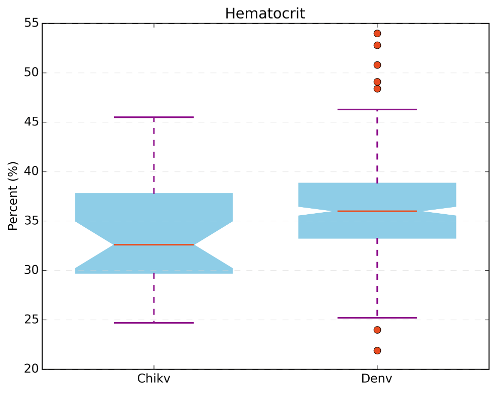 Figure 1: Distribution of blood markers between Dengue (0) and Chikungunya (1). Note the significant difference in platelet counts.
Experiments & Results: The Power of Platelets
The results were clear: Logistic Regression with L2 Regularization emerged as the winner.
| Model | Parameter | ROC AUC |
|---|---|---|
| L2 Logistic Regression | λ = 990.001 | 0.8694 |
| Gaussian SVM | γ = 0.10, C = 0.02 | 0.8653 |
| CART | Gini Partition | 0.8036 |
Key Insight: The Hematocrit-Platelet Interaction
The model revealed that Platelet Count is the single most important predictor. A higher platelet count strongly suggests Chikungunya, whereas the interaction between low platelets and high hematocrit is a "red flag" for Dengue.
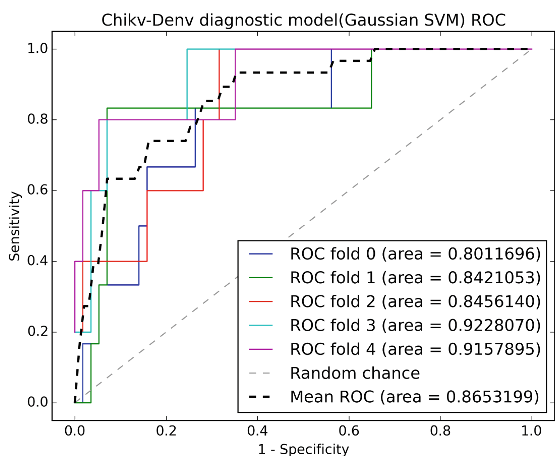 Figure 2: ROC Curves for the top-performing models. Both LR and SVM showed strong discriminatory power.
Critical Analysis & Conclusion
Takeaway
This research demonstrates that we don't always need "Big Data" or "Deep Learning" to solve life-and-death problems. A well-tuned, interpretable Logistic Regression model can transform a $10 blood test into a powerful diagnostic tool.
Limitations
- Class Imbalance: The dataset had far fewer Chikungunya cases (8.7%) than Dengue. While the authors used stratified sampling, more data from Chikungunya "waves" would strengthen the model's robustness.
- Age Bias: The median age of Chikungunya patients was much lower (0.24 years) than Dengue patients (7.82 years), which might introduce confounding factors the model is picking up on.
Future Outlook
The next step is Multi-centre validation. If these weights hold true across different populations (e.g., Southeast Asia or Sub-Saharan Africa), this algorithm could be integrated into hospital EMR systems to provide real-time diagnostic alerts the moment the lab results are uploaded.