
DP-DE: Redefining Railway Timetabling with Dual-Population Differential Evolution
5581_A Differential Evolution Algorithm With Dual Populations for Solving Periodic Railway Timetable Scheduling Problem.
This paper introduces DP-DE, an enhanced Differential Evolution algorithm with Dual Populations, to minimize passenger waiting time in Periodic Railway Timetable Scheduling (PRTS). It handles variable service cycles and outperforms state-of-the-art evolutionary algorithms and deterministic methods on the Guangzhou Metro System and artificial benchmarks.
Executive Summary
TL;DR: This paper tackles the "Periodic Railway Timetable Scheduling" (PRTS) problem, a nightmare of combinatorial optimization. By introducing DP-DE (Differential Evolution with Dual Populations), the authors successfully minimized average passenger waiting times for the Guangzhou Metro. The core innovation lies in a "Global" vs "Local" population split that prevents the algorithm from getting stuck in the local optima typical of complex transit networks.
Strategic Positioning: This work bridges the gap between theoretical evolutionary computation and large-scale industrial logistics. It is a benchmark-setting paper for applying metaheuristics to the "Variable Cycle" PRTS problem—a more realistic but harder version of the classic scheduling task.
Problem & Motivation: Beyond Fixed Cycles
Managing a metro network isn't just about moving trains; it’s about synchronizing transfers. Prior work often relied on:
- Deterministic Algorithms (B&B): Mathematically precise but computationally explosive as the number of stations grows.
- Simplified Models: Assuming trains run at the same frequency all day.
The reality is messier. During rush hours, cycles (headways) are short; in the evening, they are long. The variable cycle model proposed here creates a variable linkage problem. If you change the departure of line A, it ripples through every transfer point in the network, creating a massive, non-linear search space where traditional Genetic Algorithms (GA) and Simulated Annealing (SA) often stall.
Methodology: The Power of Two
The authors' "Insight" is that no single mutation strategy is perfect. Instead of a single "Swiss Army knife" algorithm, they build two specialized teams.
1. Dual Population Hybridization Mechanism (DPHM)
- Global Population (GP): Its job is Exploration. It uses
rand/1andcurrent-to-pbest/1mutation schemes. Parameters and are randomized per iteration to sweep the search space and maintain diversity. - Local Population (LP): Its job is Exploitation. It uses the
best/1scheme, focusing all energy on refining the current best solution found.
2. Bidirectional Migration
The secret sauce is how these populations talk. Instead of one-way "cloning," they use a unique migration operator:
- GP to LP: The best of GP replaces the worst of LP to inject fresh "genetic material."
- LP to GP: The best of LP updates the best of GP to ensure the global search stays anchored to high-quality regions.
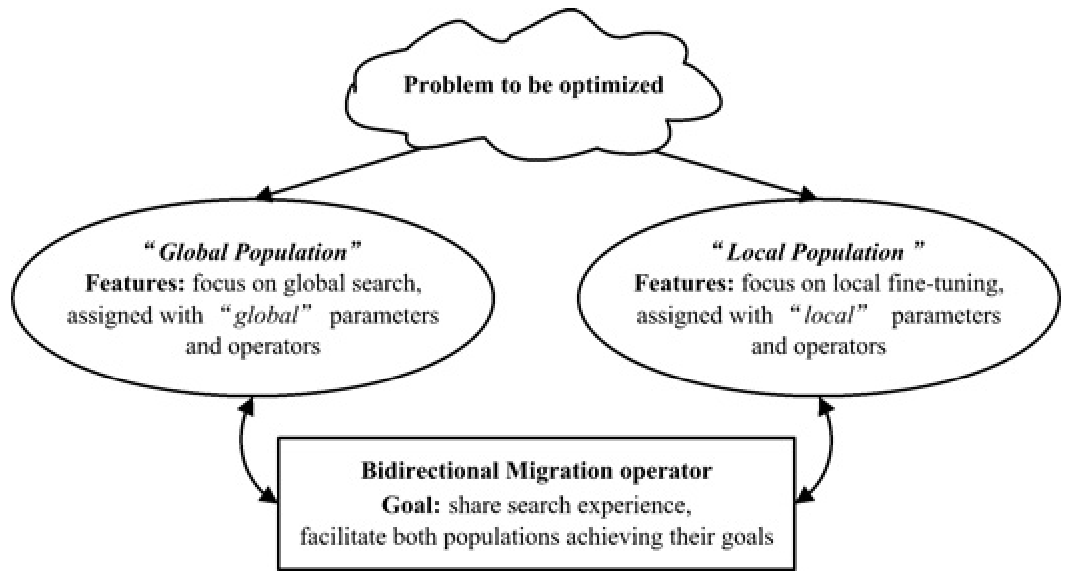 Figure 1: The synergistic workflow between Global and Local populations.
Experiments: Solving the Guangzhou Metro
The researchers tested DP-DE against a gauntlet of 7 SOTA algorithms, including CMA-ES, JADE, and CLPSO.
Key Results on Guangzhou Metro (16 lines):
- Waiting Time Reduction: Optimized from 221.5s down to 157.3s (28.98% improvement).
- Robustness: DP-DE showed the lowest "Mean" and "Worst" values across 30 independent runs, proving it is far more reliable for real-world deployment than standard DE or GA.
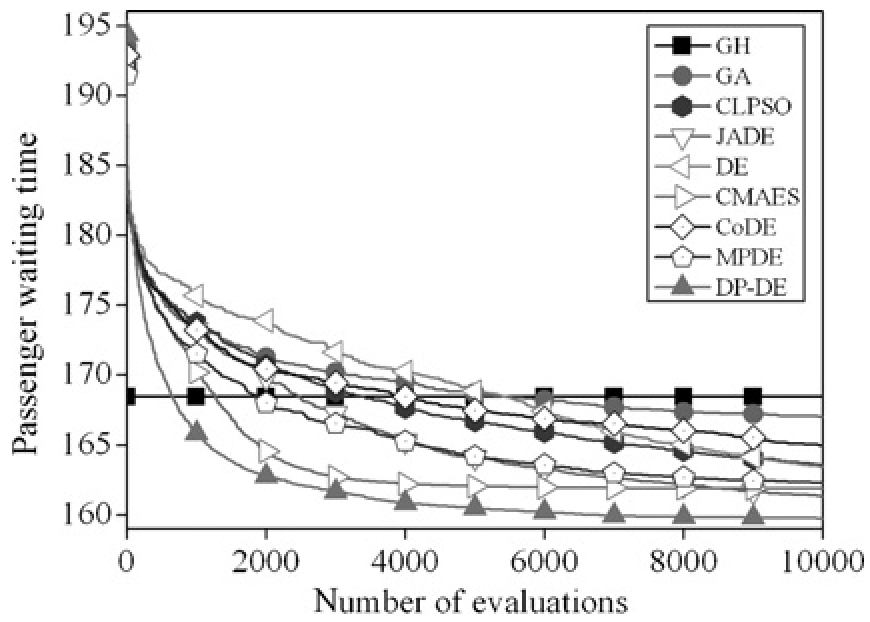 Figure 2: Convergence curves showing DP-DE (bottom line) reaching lower error rates faster than competing EAs.
Critical Analysis & Future Outlook
Why it works: By separating the population, DP-DE avoids the "premature convergence" trap. The Global population acts as a scout, while the Local population acts as the specialized engineer. The bidirectional migration ensures the engineer doesn't get tunnel vision and the scout doesn't wander uselessly.
Limitations: While the model accounts for variable cycles, it still assumes deterministic traveling times. In the real world, "signal delays" and "passenger door obstructions" introduce stochastic noise that this model doesn't yet account for.
Future Work: The next leap will likely involve Dynamic Rescheduling—applying these dual-population benefits to "living" timetables that adjust in real-time as delays occur.
Takeaway
DP-DE proves that in the world of heavy infrastructure, cooperation is better than adaptation. By balancing global diversity and local precision, we can shave minutes off millions of daily commutes.