
TS-DE: Accelerating Evolutionary Design through a Two-Step Subpopulation Strategy
Differential Evolution Algorithm With Two-Step Subpopulation Strategy and Its Application in Microwave Circuit Designs
This paper introduces a Two-Step (TS) subpopulation strategy for Differential Evolution (DE) algorithms, designed for both Single-Objective (SOP) and Multi-Objective Optimization (MOP). By dividing the population into superior and inferior groups, the method accelerates convergence and enhances diversity, achieving state-of-the-art results in benchmark tests and microwave circuit design.
TL;DR
Differential Evolution (DE) is a cornerstone of stochastic optimization, yet balancing "speed" (exploitation) with "robustness" (exploration) remains a challenge. This paper presents the Two-Step (TS) Subpopulation Strategy, a parameter-free structural enhancement that splits populations into "Superior" and "Inferior" tiers. By using the inferior group to "challenge" and refresh the superior group, the algorithm achieves faster convergence and better diversity. It proved its real-world mettle by solving a rigorous 4-objective microwave circuit design problem that stumped traditional methods.
Problem & Motivation: The Mutation Dilemma
In the world of DE, the Mutation Operator is the engine of discovery. Standard strategies face a trade-off:
- Greedy Strategies (e.g., DE/best/1): Target the best individuals. Result? High speed, but high risk of getting stuck in local optima (Prematurity).
- Random Strategies (e.g., DE/rand/1): Treat all individuals equally. Result? Strong global search, but painfully slow convergence.
The authors' insight is inspired by nature: Good parents are more likely to produce good offspring. However, simply favoring the best leads to stagnation. The TS strategy creates a competitive dynamic between subpopulations to ensure that only the most "useful" genetic information propagates while maintaining the diversity needed to escape local traps.
Methodology: The Two-Step Engine
The TS strategy is elegantly simple. Unlike other variants that add complex penalty functions or adaptive parameters, it modifies the flow of evolution.
The Two-Step Workflow
- Sorting & Division: Every generation, the population is sorted. For Single-Objective tasks, this uses Fitness; for Multi-Objective tasks, it uses Nondominated Sorting and Crowding Distance. The population is split 50/50 into a Superior Subpopulation (SP) and an Inferior Subpopulation (IP).
- Step 1 (Evolution of the Weak): The IP evolves first to generate offspring.
- Temporary Superior Population (TSP): The new offspring are compared with the SP. The best among them form a "Temporary Superior Population."
- Step 2 (Refinement of the Strong): The SP evolves using the high-quality vectors from the TSP as mutation bases.
The figure above illustrates the algorithmic flow for SOP, highlighting the competitive replacement mechanism.
Why it Works: The Diversity Intuition
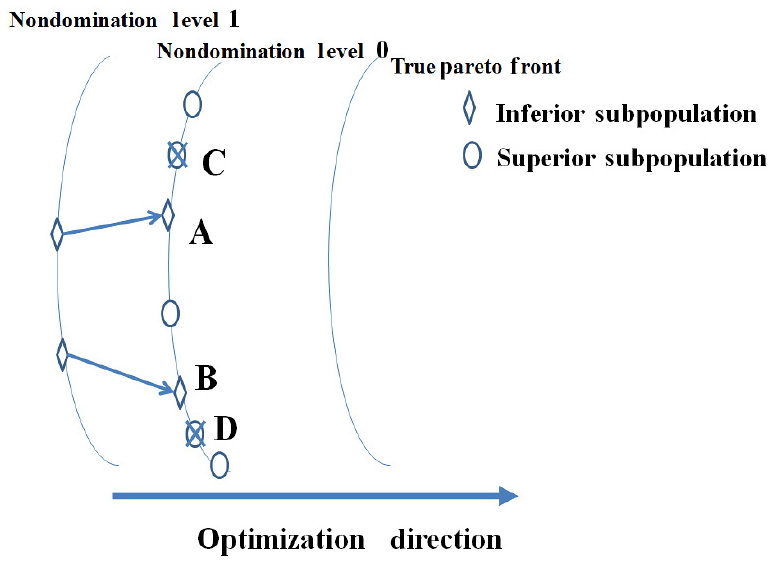
In Multi-Objective Optimization (MOP), the strategy aids diversity. If the inferior group produces offspring in less crowded areas of the Pareto front, those individuals replace "crowded" members in the superior group. This "push" from the bottom ensures the algorithm doesn't just find the front, but spreads across it perfectly.
Experiments & Results: Benchmarks and Circuits
The authors integrated the TS strategy into famous DE variants like jDE, SaDE, JADE, and CoDE.
SOTA Comparison
In tests on the CEC 2005 benchmark functions (D=30 and D=50), TS-enhanced variants consistently outperformed their original versions. In the Multi-Objective arena (ZDT and DTLZ problems), TS-NSDE showed dramatic improvements in the "Convergence Metric" () and "Diversity Metric" ().
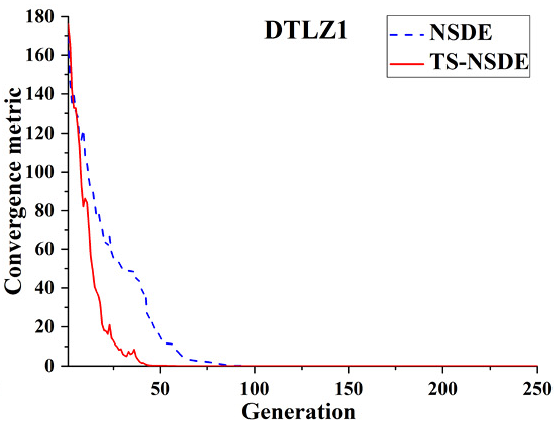 Fig 2: Average convergence metric values show TS-MODEs (solid lines) reaching the Pareto front significantly faster than standard MODEs.
Real-World Application: Microwave Coupler Design
The true test was the design of a Broadband 3-dB Quadrature Coupler. This involved 4 decision variables and 4 objectives (Return Loss, Insertion Loss, Phase Difference, and Isolation).
- TS-NSDE was the only algorithm to meet all stringent industrial requirements (e.g., dB, Phase error ).
- Traditional MODEA and NSGA-II failed to reach the required thresholds within the same computational budget.
Critical Analysis & Conclusion
Takeaway
The TS Subpopulation Strategy is a "versatile plug-in." Its beauty lies in its simplicity—it requires no additional parameters, meaning it doesn't add to the "user-tuning" burden that plagues many modern EAs. It effectively bridges the gap between single-population and distributed DE variants.
Limitations & Future Work
While the 50/50 split works well, the authors note that the optimal subpopulation size might vary for different problems. Future research could explore dynamic sizing of these subpopulations. Additionally, testing this on even higher-dimensional "Many-Objective" problems (>10 objectives) would be the next frontier for this strategy.
In conclusion, by rethinking how superior and inferior individuals interact, this paper provides a powerful tool for engineers tackling complex, high-dimensional design spaces.