
DID Model: Rethinking Social Influence via Linear Differential Equations
Differential Information Diffusion Model in Social Network
The paper introduces the Differential Information Diffusion (DID) model, a novel framework for modeling temporal-spatial information spreading in social networks using a system of linear differential equations. By integrating topological structure, semantic content similarity, and dynamic user interaction probabilities, the model achieves a more realistic simulation of influence compared to traditional epidemic or heat diffusion models.
TL;DR
The Differential Information Diffusion (DID) model moves beyond simple "infected/susceptible" metaphors. It treats information as a dynamic density flowing through a network, governed by a system of linear differential equations. By factoring in semantic similarity and individual user activity, it provides a mathematically rigorous way to track how influence evolves at every specific node over time.
Context: Why Traditional Models Fall Short
Classical models in social influence typically fall into two categories:
- Epidemic Models (SIR/SIS): These track the number of people influenced but ignore who they are and how they are connected.
- Heat Diffusion Models: While they account for topology, they follow the Law of Conservation of Energy. In the real world, if I share a secret with you, I don't "lose" the information—the total "energy" of information in the system increases.
The DID model addresses these gaps by creating a "Kernel of Information Diffusion" () that allows for non-conservative spreading.
Methodology: The Mechanics of Diffusion
The core of the DID model is its ability to define the rate of change in information density () across all nodes simultaneously:
The Kernel Matrix ()
This isn't just a standard adjacency matrix. Each entry represents the probability node adopts info from node , calculated by:
- : The semantic similarity between the users' content.
- : The probability node will receive/adopt info.
- : The probability node will send/broadcast info.
The Solver
Instead of simple iterative steps, the authors use the Matrix Exponential resolver:
This allows the model to be "split" into time intervals, where the parameters of user activity ( and ) can be updated dynamically as users become more or less active.

Experiments and Visualizing the "Spread"
The authors tested the model using several scenarios. In "Case 2", they simulated nodes 2 and 6 as "pure senders" (not receiving any info). The resulting curves show how density rapidly drops at the source while neighboring nodes (like node 8) spike in density due to high similarity and connectivity.
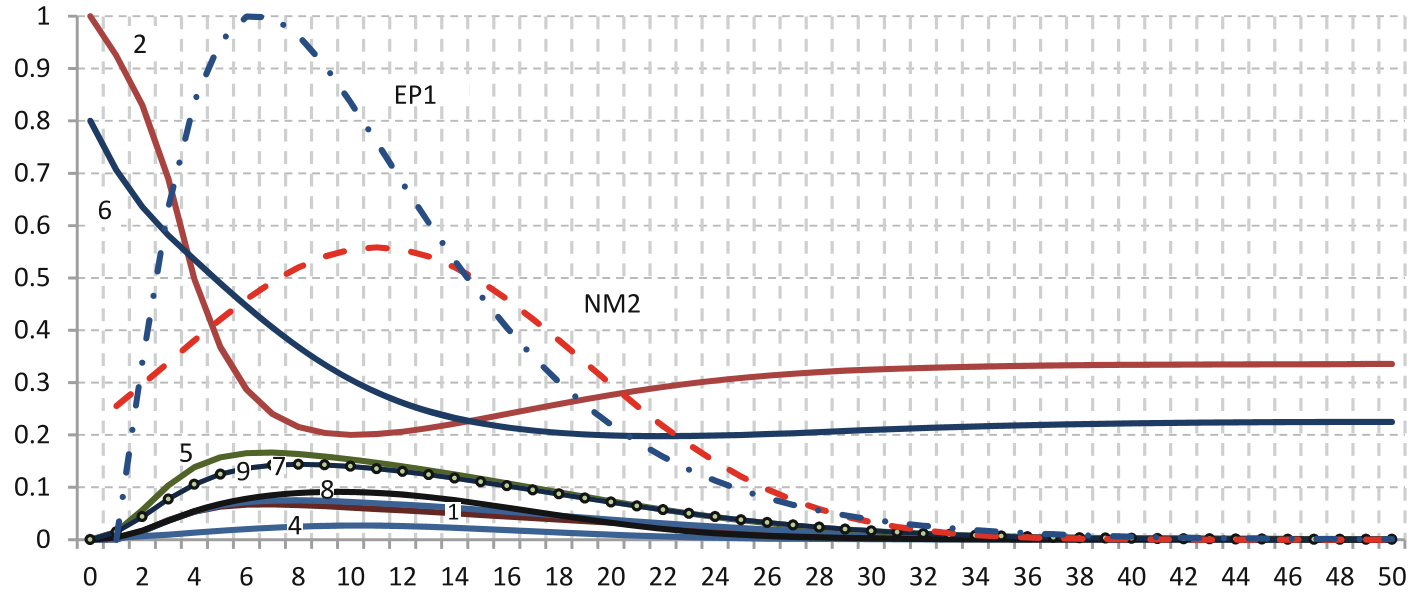 The graph above depicts how density stabilizes over 50 time-steps, reflecting the equilibrium of influence.
Validating with Network Topology
An essential part of the paper is the "Accordance Test." Is this mathematical model actually respecting the physics of the network? Using TOPSIS (a multi-criteria decision-making method) to rank nodes by their Centrality (Degree, Closeness, Betweenness) and comparing it to the DID model's density ranking, the authors found a high correlation.
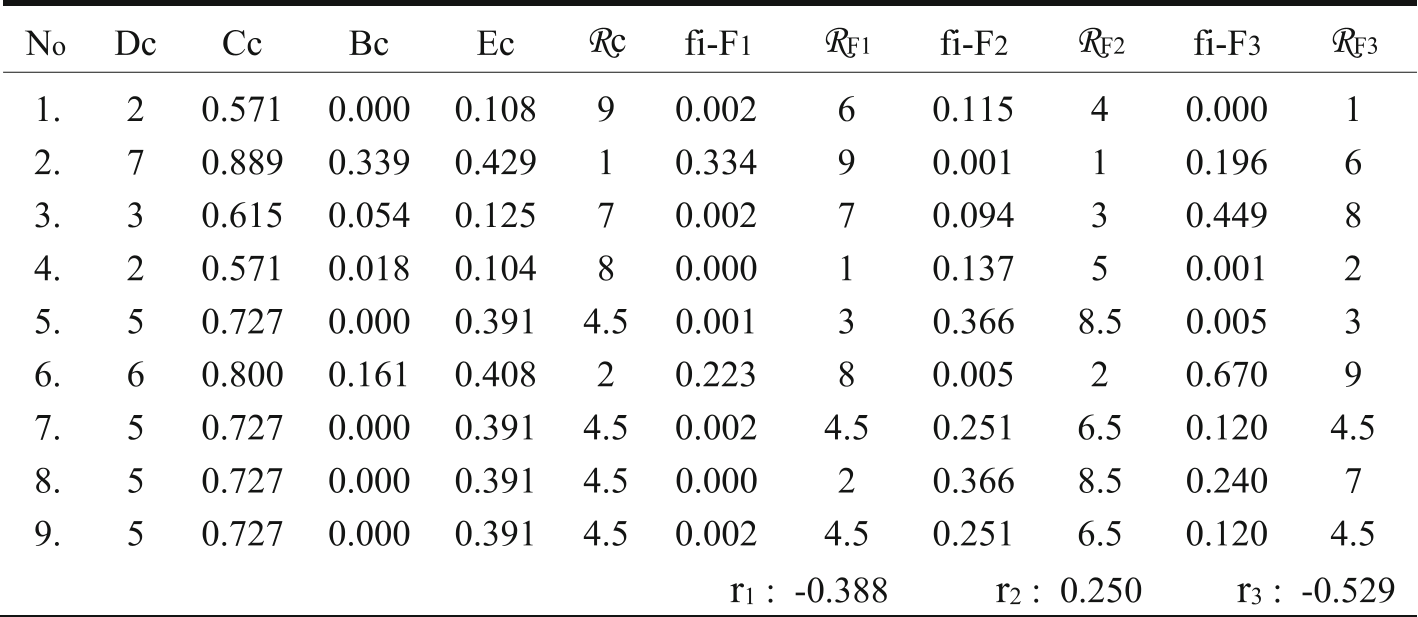 Table 1: Statistical proof that the DID model aligns with the inherent importance of nodes in the graph.
Critical Insight & Conclusion
The DID Model succeeds because it treats social networks as a spatial-temporal manifold rather than just a static graph.
- Efficiency: The computational cost does not exceed , making it feasible for moderate-sized networks.
- Flexibility: It can handle time-varying interactions by recalculating the matrix exponential at discrete intervals.
Limitations: The paper currently demonstrates results on a smaller dataset. The next frontier for this work will be scalability—how the matrix exponential computation handles millions of nodes in modern platforms like X (Twitter) or Weibo.