
Out-link Privacy: Bridging the Gap Between Graph Utility and Differential Privacy
A Guide to Differential Privacy Theory in Social Network Analysis
The paper provides a comprehensive theoretical framework for applying Differential Privacy (DP) to Social Network Analysis (SNA). It evaluates existing standards (Node and Edge Privacy) and introduces Out-link Privacy, a novel standard that enables high-utility query results for sensitive graph metrics like triangle counts and centrality.
TL;DR
Social Network Analysis (SNA) is a goldmine for research, but releasing even "anonymized" graphs is a privacy nightmare. This paper introduces Out-link Privacy, a middle-ground standard that allows researchers to release accurate triangle counts and centrality measures—metrics previously thought "too sensitive" to privatize—by refocusing on what an individual actually contributes to the network.
The Sensitivity Trap: Why Graph Privacy is Hard
In the world of Differential Privacy (DP), noise is added to results based on Global Sensitivity (): the maximum change one individual can cause to a query result.
In tabular data, is usually small (e.g., if you remove one person from a "count" query, the result changes by exactly 1). In graphs, it's a disaster. If you remove one highly-connected node (Node Privacy) or one critical bridge edge (Edge Privacy), the number of triangles or the "closeness" of the entire network can shift drastically. To cover this potential change, you'd have to add so much noise that the resulting data becomes useless "static."
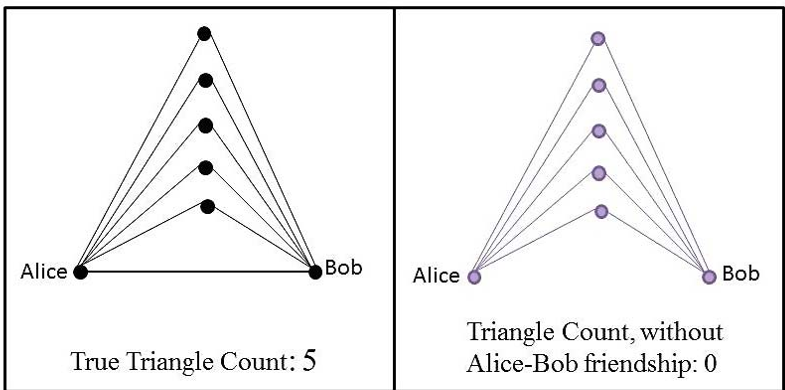 Figure: Evidence of why edge-sensitivity for triangle counts is unbounded (dependent on ).
The Solution: Out-link Privacy
The authors propose a new standard: Out-link Privacy.
- The Intuition: Treat the network like a survey. Each person (participant) provides a list of their friends (out-links).
- The Guarantee: An attacker cannot tell if a specific person participated in the survey.
By framing privacy around the contributor's knowledge rather than the global graph structure, the authors can use Ego-Network Analysis. Instead of counting all triangles in the whole graph at once, they ask each node about their own "neighborhood."
Algorithm Highlight: Private Clustering Distribution
Instead of releasing a single sensitive "Clustering Coefficient," the authors use a 2D histogram of (Degree vs. Triangle Count).
- Localize: Each node reports its degree and local triangles.
- Bin: Nodes are mapped into a 3x3 grid (Low, Med, High degree/clustering).
- Noisify: Since adding/removing one person only changes one bin count by one, the sensitivity is 1.
- Utility: The resulting noise is tiny (Laplacian noise with ), keeping the structural distribution highly accurate.
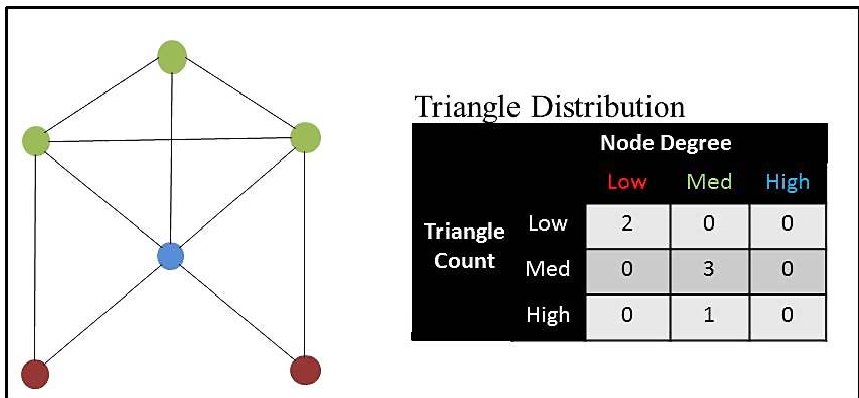 Figure: The 2D histogram approach allows representing social cohesion with minimal noise.
Rethinking Centrality: The Popularity Graph
The paper also tackles Centrality (who is important?). Traditional measures like Betweenness are too sensitive. The authors propose the Popularity Graph:
- Participants list 3 "popular" friends.
- An artificial graph is built where edge weights increase when two people are mentioned together.
- Noise is added to these weights .
- The result is a "synthetic" skeleton of the network's influence structure that protects individual identities but reveals community clusters.
Critical Analysis & Takeaways
This work is a pragmatic pivot in DP theory. While Node Privacy is the "gold standard," it is often mathematically impossible to achieve with useful results. Out-link Privacy acknowledges that in many real-world scenarios, we only need to protect the act of contribution and the specific connections reported by an individual.
Limitations:
- Subject Privacy: While it protects "participants" (who provide data), the "subjects" (people mentioned by others) have a slightly weaker guarantee, though the authors argue anonymity and noise still provide significant cover.
- Directed vs. Undirected: The model works best for directed surveys; applying it to fixed undirected datasets requires probabilistic sub-sampling.
Future Impact: This ego-centric approach to DP paves the way for privatizing more complex structures like motifs and community memberships, moving us away from "all-or-nothing" privacy toward high-utility, theoretically-grounded data sharing.