
PHDP & rPHDP: Bridging Topologic Integrity and Differential Privacy in Social Networks
Differential Private Social Network Publication and Persistent Homology Preservation
This paper introduces PHDP and rPHDP, two differential privacy-based anonymization schemes for Online Social Networks (OSNs) that leverage persistent homology to preserve complex topological structures. The methods outperform traditional dK-2 and E-R models by maintaining high-dimensional graph utilities like "holes" and "cliques" while satisfying rigorous edge differential privacy.
TL;DR
Researchers have long struggled to share Social Network data without compromising user privacy or destroying the graph's "soul"—its complex web of relationships. This paper introduces a framework that uses Persistent Homology (a tool from Algebraic Topology) to protect delicate structures like "holes" and "cliques" in a graph while injecting Differential Privacy (DP) noise. The result? Anonymized data that still works for real-world tasks like influence maximization.
The "Blind Men and the Elephant" Problem in Graph Utility
Existing anonymization techniques often focus on shallow statistics: degree distribution (how many friends people have) or clustering coefficients. However, these are like describing an elephant by feeling its trunk—you miss the whole picture. Traditional DP-based methods often "smear" the graph's topology to hide individual edges, accidentally filling in crucial "holes" or breaking vital "cliques." This makes the resulting data useless for analyzing how information actually flows through a network.
Methodology: The Power of Persistent Homology
The authors shift the focus to Persistent Homology, which tracks topological features across multiple scales.
1. Identifying Structures
They identify two key types of structures:
- Simplicial Complexes (Holes): Polygons or voids that represent gaps in connectivity.
- Simplicial Toplexes (Cliques): Highly dense, fully-connected subgraphs.
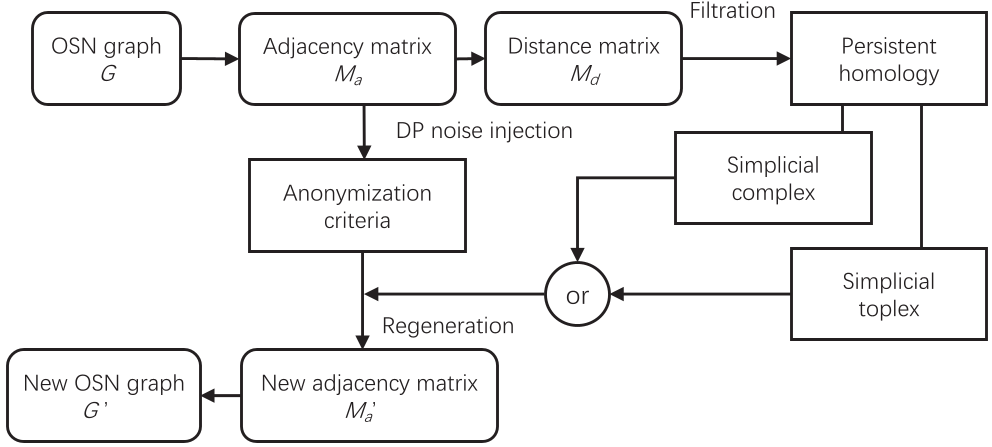
2. The Anonymization Pipeline
The scheme, as shown in the architecture below, splits the graph's adjacency matrix into four sub-zones based on whether they contain these persistent structures.
3. Noise Injection & Regeneration
- MCMC & Exponential Mechanism: Instead of simple Gaussian noise, they use a Markov Chain Monte Carlo (MCMC) process to sample the number of edge flips that satisfy -Differential Privacy.
- Regeneration Rules: The core innovation lies here. When adding or deleting edges, the algorithm follows strict rules to ensure that a "hole" or "clique" identified in the original graph is not accidentally created or destroyed in the noisy version.
Experimental Results: High Stakes, High Utility
The authors tested their methods (PHDP for holes, rPHDP for cliques) against classic models like dK-2 and Erdos-Renyi (E-R).
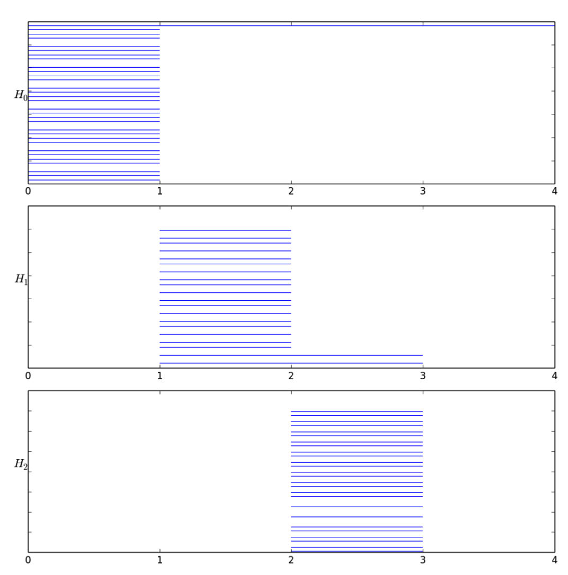
Topological Fidelity (Barcodes)
Using "Barcodes" (a visual representation of how long topological features persist), they proved that PHDP mimics the original graph's structure far more accurately than dK-2, which tends to generate hundreds of "ghost" holes.
Application Performance: Influence Maximization
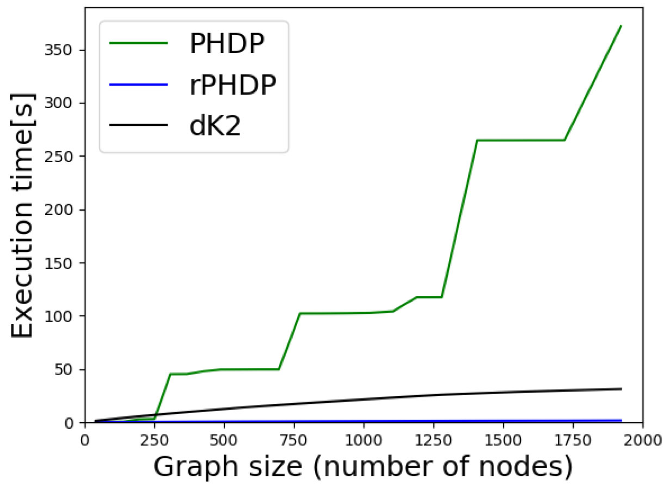
In tests of information diffusion, PHDP maintained a much lower error rate (RMSE) compared to dK-2 and E-R. While rPHDP was faster, PHDP proved superior for applications where the "gaps" in the network (the holes) dictate how a message spreads.
Efficiency Benchmarks
Interestingly, rPHDP (the clique-focused version) is significantly faster, making it a viable candidate for large-scale production social networks.
Critical Insight & Conclusion
The genius of this work lies in recognizing the "Squishing" phenomenon. In social networks, high-dimensional shapes often collapse into 2D polygons or cliques. By focusing on these "squished" persistent structures, the authors provided a way to keep the most important parts of a graph "fixed" while using the rest of the graph as a "privacy buffer."
Summary (Takeaway): If you need to anonymize a graph but care about its global connectivity and diffusion properties, stop looking at degree distributions and start looking at its Homology. PHDP provides the mathematical rigor of Differential Privacy without turning your data into a topological mess.
Limitations: PHDP can be computationally expensive as the number of simplices grows. While rPHDP solves the speed issue, it is less effective at preserving the specific "hole" structures that might be critical for certain niche research.