
Differentially K-Anonymity: Strengthening Mobile Crowdsourcing Against Informed Attackers
A differentially k-anonymity-based location privacy-preserving for mobile crowdsourcing systems
This paper proposes a hybrid location privacy-preserving mechanism for Mobile Crowdsourcing Systems (MCS) called KDP. It combines personalized k-anonymity with ε-differential privacy using Gaussian white noise to protect crowd workers from identity and location leakage.
TL;DR
To address the leakage of sensitive location data in mobile crowdsourcing, this paper introduces a hybrid framework that blends k-anonymity and -differential privacy. By perturbing spatio-temporal coordinates with Gaussian white noise after cloaking them in an anonymity set, the system thwarts both linking attacks and background-knowledge-based adversaries.
Problem & Motivation: The Limits of Traditional Cloaking
As Mobile Crowdsourcing Systems (MCS) rely on GPS-equipped devices for tasks like traffic monitoring or disaster relief, workers essentially trade their location privacy for rewards. Existing Location Privacy-Preserving Mechanisms (LPPMs) typically fall into three buckets:
- Dummy Locations: Low cost but easily filterable by sophisticated algorithms.
- Spatio-temporal Cloaking (k-anonymity): Effective for single queries but fails under continuous attacks where an attacker tracks a user over time.
- Encryption: Secure but introduces massive computational overhead for mobile devices.
The authors argue that k-anonymity alone is insufficient if an attacker has "background knowledge" (e.g., knowing a worker lives in a certain area). They sought a method that provides the mathematical guarantees of Differential Privacy while retaining the spatial structure of k-anonymity.
Methodology: The "KDP" Framework
The proposed method, referred to as KDP, operates in two primary stages:
1. Personalized Spatio-temporal k-Anonymity
A worker defines their tolerance for error (spatial and temporal ). The server then generates a cloaking box . For any reported location, there must be at least other workers within that same spatio-temporal box, making them indistinguishable.
2. Differentially Private Noise Injection
To counter the "linking attack" where continuous boxes reveal a path, the authors inject Gaussian white noise. Unlike standard Laplacian noise used in many DP applications, they use a noise function: Where activity follows the normal distribution . This ensures that even if an attacker knows the noise distribution and potential positions, they cannot confidently infer the true location.

Experiments & Results
The researchers tested the system on a real-world dataset: GPS traces of 2,000 taxis in Beijing.
Privacy Level vs. Budget
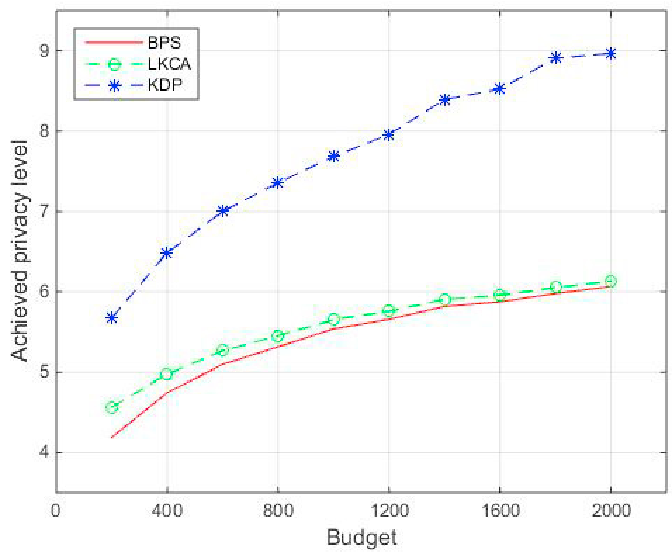
The study utilized entropy theory to measure "unpredictability." As the budget (representing system resources or density) increased, KDP consistently outperformed the baseline LKAC (Clique-based) and BPS protocols in terms of privacy protection levels.
Scalability with Participants
A crucial finding was that as the number of participants increased from 50 to 150, the privacy level grew. This indicates good adaptation and flexibility; the system becomes more secure as the crowd becomes denser, which is ideal for urban crowdsourcing environments.
Critical Analysis & Conclusion
Takeaway
The core achievement here is the hybridization of geometric blurring and statistical perturbation. By using the Gaussian distribution, the authors provide a tunable parameter that allows system administrators to balance the "truthfulness" of coordinates (Service Quality) against the "security" of the workers.
Limitations & Future Work
While the paper proves the effectiveness of the privacy layer, it does not deeply address the incentive mechanism—specifically, how the added noise affects the fairness of payments to workers. The authors acknowledge this, noting that future work will focus on integrating these privacy protections into auction algorithms and trust-degree computations to ensure malicious workers don't hide behind the noise.
This work marks a significant step toward making MCS viable for privacy-conscious users in the growing Internet of Things (IoT) landscape.