
Efficient Node Privacy: Protecting Social Relationships in the RDF Era
A Differentially Private Approach for Querying RDF Data of Social Networks
This paper introduces a differentially private framework specifically designed for querying Social Network data in RDF format. It proposes a novel approach utilizing Node Privacy and Global Sensitivity, alongside an index-like data structure to enable high-performance statistical counting queries while maintaining strict privacy guarantees.
TL;DR
As social networks increasingly adopt RDF (Resource Description Framework) to represent complex relationships, protecting individual privacy has become a significant challenge. This paper presents a robust framework for -differential privacy that centers on Node Privacy. By introducing a specialized index structure, the authors enable the calculation of Global Sensitivity for statistical queries in milliseconds, allowing for a real-time, privacy-preserving analytical environment without sacrificing the utility of the social data.
The Challenge: Why Tabular DP Fails for Graphs
In a standard database, records are independent. Removing "Alice" only changes the count by one. However, in an RDF social graph, "Alice" is connected to "Bob" and "Charlie" through "follows" or "friends" predicates.
If a query asks for "the number of users followed by at least two people," removing Alice doesn't just remove a row; it removes all her outgoing and incoming edges. This might cause Bob to fall below the "two followers" threshold, effectively removing him from the query results as well. This interdependency means that the Sensitivity (the maximum change caused by one individual) can be much higher than 1, making traditional DP mechanisms either inaccurate or computationally impossible to calculate if one tries to simulate every "neighbor" graph.
Methodology: The Power of Relational Indexing
The core innovation of this research is the transformation of raw RDF triples into a directed property graph, followed by the creation of an index-like data structure.
1. The Strategy: Node Privacy
Unlike "Edge Privacy," which only hides whether a specific link exists, Node Privacy hides the entire existence of an individual. This is the "gold standard" for social network privacy but is notoriously difficult to implement efficiently due to the graph's structural complexity.
2. The Index Structure
The authors define a structure where for every node :
- Origin Nodes (): Nodes that point to .
- Destination Nodes (): Nodes that points to.
This index allows Algorithm 3 (getSensitivity) to pinpoint exactly how many other nodes will be affected if a specific node is removed, without actually re-executing the SPARQL query on a modified database.
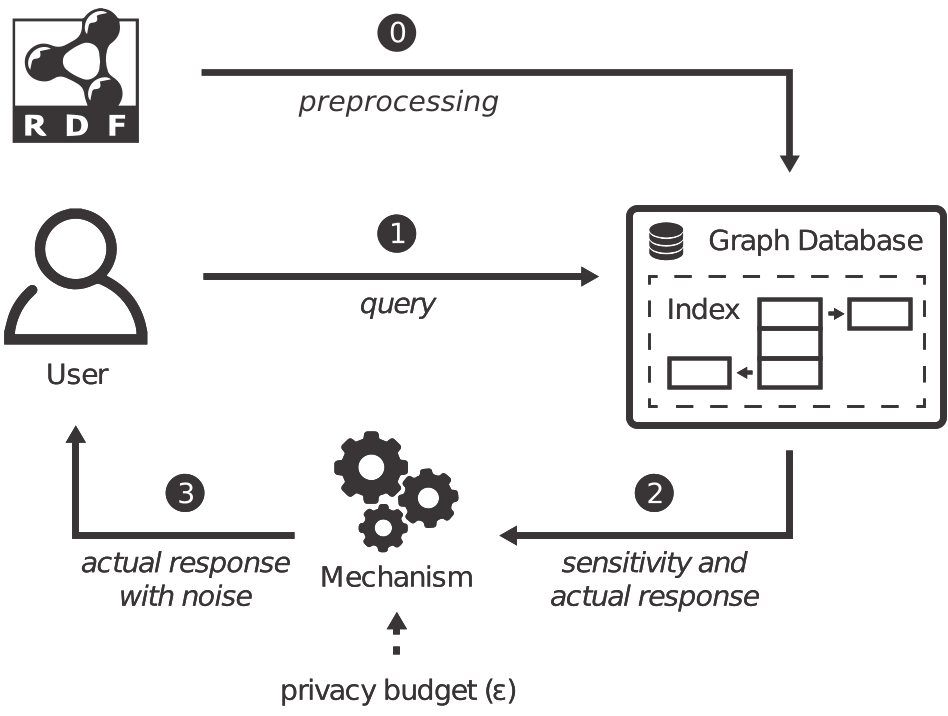 Figure: The four-step workflow from RDF extraction to the delivery of the privatized result.
Experimental Validation: Performance Meets Utility
The researchers tested their approach on three real-world datasets: Facebook, Twitter, and Google+.
Breaking the Computational Bottleneck
A "naive" approach to finding sensitivity would involve running queries (where is the number of users). For the Google+ dataset (), this is impossible in a production environment.
- Our Approach: Sensitivity calculation took only 0.3446 seconds for the massive Google+ dataset.
- Scalability: While building the index is an "offline" cost (taking about 2.4 hours for 13 million edges), the "online" response time is near-instant.
The Trade-off: Accuracy vs. Privacy
The paper utilizes the Laplace Mechanism, adding noise proportional to .
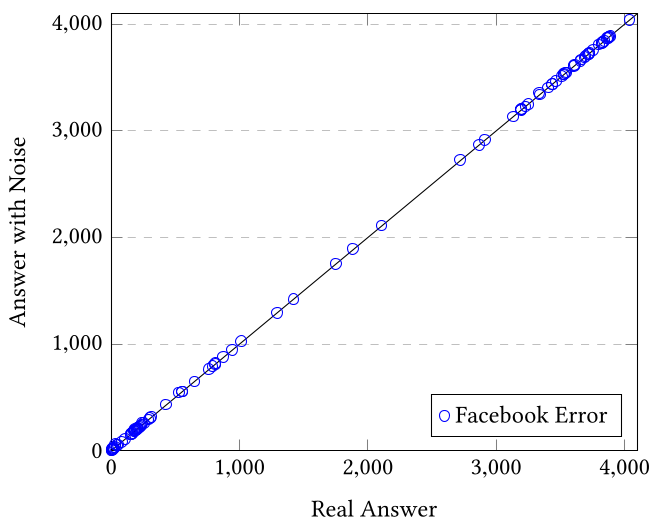 Figure: Utility results for . Points close to the diagonal line indicate high accuracy despite the added noise.
Even with a strict privacy budget (), the Relative Error remained low enough for the data to be useful for sociologists and data scientists. For large datasets like Twitter, the percentage error was a mere 0.86%.
Critical Insight & Conclusion
This paper addresses a critical gap in the Linked Data ecosystem. Most DP research assumes a flat, relational structure. By treating the RDF graph as a set of interdependent entities and pre-calculating those dependencies into an index, the authors have made Global Sensitivity—once considered a theoretical luxury—a practical reality for social network analysis.
Limitations: The current work is optimized for counting queries. Future iterations will need to handle more complex aggregations like AVG or MAX, where sensitivity calculation becomes even more volatile.
Final Takeaway: For organizations handling sensitive social graphs, the move from ad-hoc anonymization to formal Differential Privacy is now a performance-viable option.