
Differentially Private Geo-Social Ranking: Balancing Influence and Anonymity
Differentially Private Geo-Social Ranking
This paper introduces a differentially private framework for Geo-Social Ranking (GSR). It proposes a ranking algorithm that leverages the Laplace mechanism to protect both social relationships (edges) and user locations while identifying the most influential users relative to a query point.
TL;DR
As Location-Based Social Networks (LBSNs) grow, finding "influential users" near specific locations—known as Geo-Social Ranking (GSR)—is vital for targeted advertising. However, this process risks exposing sensitive friendships and exact movements. This paper presents a novel approach to GSR that satisfies -Differential Privacy, ensuring that the presence or absence of a single user's data does not significantly alter the ranking results.
The Privacy Paradox in Geo-Social Networks
Traditional ranking systems are a privacy nightmare. In a Geo-Social network, your data isn't just a row in a table; it is a node in a graph connected to others. Revealing a "top-k" list of influential users could inadvertently leak:
- Social Privacy: The existence of sensitive relationships (e.g., medical or political affiliations).
- Spatial Privacy: Precise location coordinates that reveal home addresses or health status.
Existing methods like -anonymity often fail against adversaries with background knowledge. The authors argue that Differential Privacy (DP) is the only robust solution, but applying it to GSR requires a fundamental rethink of "neighboring datasets" in a graph context.
Methodology: The Anatomy of Private Ranking
The researchers break down the ranking task into two measurable scores that are then combined into a single "Utility Function."
1. Redefining Neighbors
They define Neighboring Geo-Social Graphs as two graphs that differ by exactly one edge (friendship) or one node's location coordinate. This is a critical step because it sets the boundary for how much "noise" needs to be added to the system.
2. The Hybrid Scoring Function
The Geo-Social score for a user is a weighted sum:
- Social Score (): The count of "relevant friends" within a range of query .
- Spatial Score (): An inverse proportion to the sum of distances between the user/friends and the query point .
3. Sensitivity and the Laplace Mechanism
The core technical contribution is the derivation of Global Sensitivity (). By calculating the maximum possible change any single user can make to the score, the authors determine precisely how much Laplace noise () to inject.
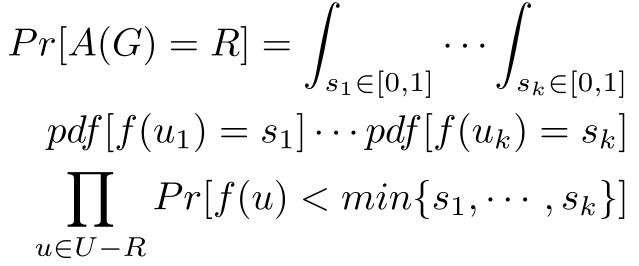 Algorithm 1: The noisy ranking process ensures the output set remains private.
Experimental Insights
Testing on the Gowalla dataset (New York City subset), the study focuses on two metrics:
- F-Score: Measuring how many of the "true" top-k users remain in the private top-k list.
- Mallows Distance: Measuring the deviation between noisy and ground-truth rankings.
The Price of Privacy
As expected, there is a "Privacy Tax."
- Larger = Lower Accuracy: When you ask for more top users, you must add more noise to protect the identity of every individual in that larger set.
- Smaller = More Privacy/Less Utility: A tighter privacy budget () results in significantly more noise than a relaxed one ().
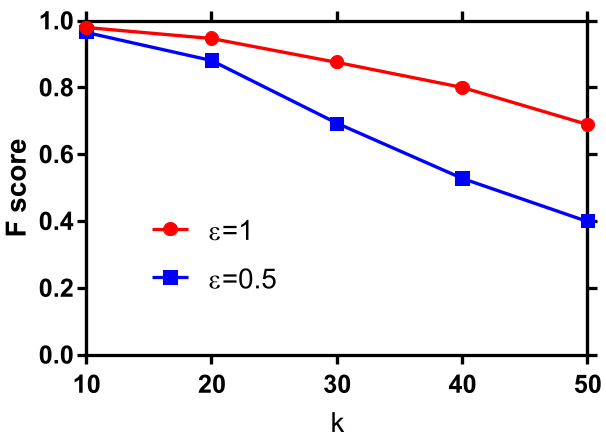 Figure 1: F-score performance across varying and values.
Critical Analysis & Conclusion
Takeaway
This work provides a rigorous foundation for spatial-social privacy. By decomposing the ranking into social and spatial sensitivities, the authors successfully map the abstract concept of Differential Privacy onto the concrete, high-dimensional reality of Geo-Social networks.
Limitations & Future Work
While effective, the algorithm's accuracy drops sharply as increases. This is a common limitation of the Laplace mechanism for top-k queries. Future research could explore Exponential Mechanisms or Local Differential Privacy (LDP) to empower users to perturb their own data before it ever reaches the server, further reducing the trust required in a central authority.
For practitioners, this paper serves as a blueprint: if you are building an LBSN, you can no longer afford to ignore the sensitivity of the "friend recommendation" or "influencer search" features.