
Debunking the DP-Recommendation Impossibility: High-Accuracy Graph-Link Analysis
Differentially private graph-link analysis based social recommendation
This paper introduces a high-accuracy differentially private (DP) mechanism for graph-link social recommendations, challenging the long-held "negative conclusion" that DP inevitably ruins recommendation utility. By redefining global sensitivity and proving the monotonicity of the utility function, the authors employ a One-Sided Noisy Arg-Max mechanism to achieve a superior privacy-utility trade-off compared to the baseline Laplace and Exponential mechanisms.
TL;DR
For years, the academic consensus was that you couldn't have your cake and eat it too: differentially private social recommendations were thought to be either "not private" or "not useful." This paper from Southeast University disrupts that notion. By correcting an over-estimation in function sensitivity and leveraging the Report One-Sided Noisy Arg-Max mechanism, the authors achieve a 35x improvement in recommendation accuracy under the same privacy budget.
The "Negative Conclusion" Trap
In differential privacy (DP), the amount of noise we add is proportional to Sensitivity (): the maximum change a single data point (in this case, a social link) can cause to the output.
Machanavajjhala et al. (2011) famously argued that because one link (A-B) could potentially affect the recommendations for every other node in the network, the sensitivity was astronomical. Their conclusion? DP in social networks is practically unfeasible.
However, this paper identifies two critical flaws in that logic:
- Output Mismatch: Prior sensitivity definitions considered the entire "utility vector" (scores for all potential friends) as the output, rather than the final selected "top-1" recommendation.
- Context Blindness: They ignored the fact that the receiver of a recommendation already knows their own links.
Methodology: Precision Sensitivity & Monotonicity
The authors propose a refined sensitivity definition () that focuses on the utility of an individual node recommendation. By assuming the target node knows their own immediate connections, they can relax the privacy requirements for incident edges, drastically lowering the noise threshold.
The Monotonicity Breakthrough
The most elegant part of the paper is the proof that utility functions like Common Neighbors (CN) and Katz Distance are monotonically increasing.
- Intuition: Adding an edge can only increase or keep constant the "closeness" between other nodes; it never makes nodes more distant.
This property allows the authors to move from the standard Exponential Mechanism to the Report One-Sided Noisy Arg-Max.
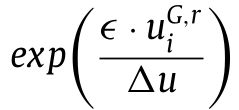
This change effectively doubles the privacy budget efficiency. Why? Because we only care about the change in one direction (adding an edge), we can use a tighter noise distribution.
Experiments: Performance Leap
The team tested their mechanism (MR) against the classic Laplace (ML) and Exponential (ME) baselines using the Facebook Ego-network and Wiki-Vote datasets.
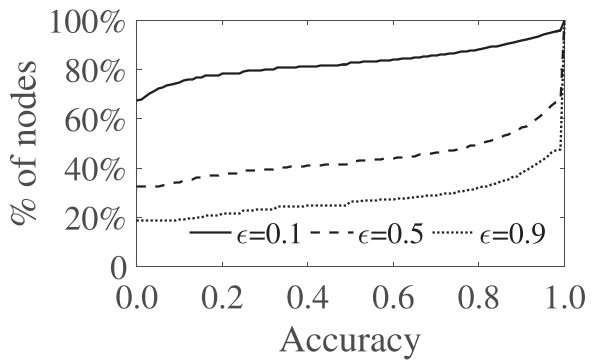 (Note: Refer to Figure 2 in the paper for the CDF of accuracy across different metrics)
Key Findings:
- Accuracy at ε=0.5: While the prior "State-of-the-Art" yielded almost 0% perfect recommendations (δ=1.0), the proposed MR mechanism hit nearly 35%.
- Budget Utilization: The "Privacy Loss" of previous methods was nearly zero even when the budget was high, meaning they were adding way more noise than legally required. The MR mechanism's privacy loss closely tracks the budget, ensuring maximum utility for every unit of privacy "spent."
Critical Insight: Why it Works
The "magic" here isn't just a better algorithm—it's a better mathematical model of the attack. By acknowledging that "privacy" doesn't mean hiding everything from everyone (e.g., hiding a user's own friends from themselves), the authors reclaimed the utility that was previously lost to unnecessary noise.
Conclusion & Limitations
This paper is a vital "course correction" for privacy-preserving graph analysis. It proves that social recommendation can be private and accurate.
Weakness: However, the study focuses on traditional graph metrics (CN, Katz). In the modern era of Graph Neural Networks (GNNs) and Latent Factor models, the sensitivity of a weight update is much harder to bound than a simple neighbor count. The next frontier will be applying these refined sensitivity insights to the gradients of deep recommendation models.