
GPMF: Balancing Privacy and Utility in Social Network Similarity Release
Differentially Private Node Similarity Matrix Release for Large-Scale Social Networks
This paper introduces GPMF, a Generic Differentially Private Matrix Factorization method for releasing node similarity matrices in large-scale social networks. It achieves (ε, δ)-differential privacy while maintaining high structural utility by combining a provable gradient estimation technique with a private Langevin Monte Carlo (LMC) optimizer.
TL;DR
Releasing node similarity matrices is vital for social network analysis but risks exposing sensitive structural data. GPMF (Generic Private Matrix Factorization) solves this by using gradient estimation for scalability and Private Langevin Monte Carlo to ensure that privacy-preserving noise actually helps the model converge rather than just "drowning" the data.
Academic Positioning: This work is a "Methodological Optimization" that improves the robustness and scalability of Differentially Private (DP) Matrix Factorization, moving beyond the limitations of standard DP-SGD.
Problem & Motivation: The "Noise Swamping" Effect
In social networks, node similarity matrices (like Katz Index) are high-dimensional and sparse. When applying Differential Privacy to Matrix Factorization (MF), researchers typically use DP-gradient descent. However, two barriers exist:
- Complexity: Adding individual attributes to the objective function makes manual gradient derivation a nightmare.
- The Utility Gap: To satisfy DP, standard methods inject massive noise into every gradient step. This noise often dominates the signal, leading to poor model accuracy—a phenomenon the authors call "swamping the signal."
The authors' insight is profound: What if the noise required for privacy could be reconciled with the noise used in stochastic optimization?
Methodology: Gradient Estimation and Private LMC
GPMF stands on two technical pillars:
1. Provable Gradient Estimation
Instead of calculating the analytical gradient for every new objective function, GPMF uses Gaussian Smoothing. By sampling random directions () from a Gaussian distribution, the method estimates the gradient. The authors prove that the error between this estimate and the true gradient can be preset and optimized, making the method "Generic" for any differentiable function.
2. Private Langevin Monte Carlo (LMC)
LMC is a known optimizer that naturally includes a noise term to help it escape local minima. GPMF cleverly replaces the standard LMC noise with DP-compliant Gaussian noise.
- The Physics Intuition: In standard LMC, noise is "interference." In GPMF, the "Privacy Noise" pulls double duty—it provides the mathematical differential privacy guarantee AND acts as the thermal noise needed for the LMC algorithm to explore the non-convex landscape of matrix factorization.
(Note: Refer to Algorithm 1 in the paper for the detailed iterative update rule involving the Cauchy distribution derived learning rate η.)
Experiments & Results
The authors tested GPMF across multiple network types, from the small Karate club network to the large-scale "Bit" network (3,600+ nodes).
Key Findings:
- Stability: Unlike baseline methods (priv-GD), GPMF's Mean Average Precision (MAP) remains remarkably stable even as the privacy budget () becomes more restrictive (smaller).
- Network Reconstruction: GPMF achieved higher MAP than the non-private Laplacian Eigenmaps (LE) on several datasets, proving that the low-dimensional embedding captured by GPMF effectively preserves the essential "DNA" of the network.
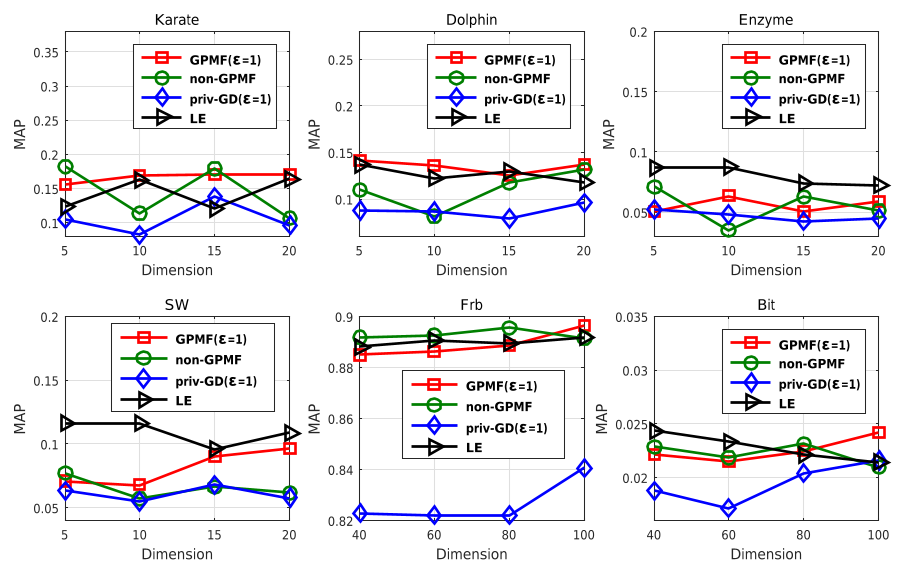 Figure 1: Performance across different embedding dimensions. GPMF shows a steady upward trend in utility compared to the erratic behavior of the non-private GPMF and the lower performance of priv-GD.
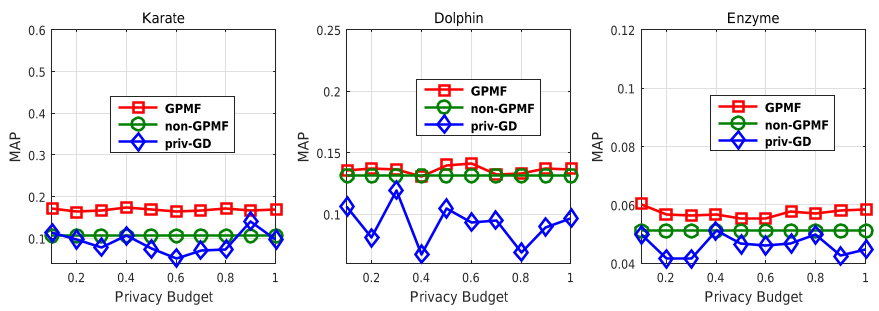 Figure 2: Impact of . GPMF maintains high utility even at high privacy (low ), whereas traditional priv-GD fails to provide meaningful results as more noise is required.
Critical Analysis & Conclusion
Takeaway
GPMF is a significant step forward because it treats privacy noise as a functional component of the optimization process rather than a destructive byproduct. By utilizing the inherent properties of Langevin Monte Carlo, the authors find a "sweet spot" where privacy and utility coexist.
Limitations
- Computational Overhead: While it solves the analytic complexity, the sampling-based gradient estimation ( samples per iteration) may increase the computational cost compared to direct GD on simple functions.
- Hyperparameter Tuning: The performance relies on the correct setting of the smoothing parameter and temperature (), which may vary across different network topologies.
Future Outlook
This approach could be extended to Dynamic Networks or Heterogeneous Social Networks, where the objective functions are even more complex and the demand for generic, scalable DP solutions is even higher.