
Balancing Personalization and Privacy: A Geometric DP Approach to Video Recommendation
Differentially Private Online Learning for Cloud-Based Video Recommendation With Multimedia Big Data in Social Networks
This paper proposes a cloud-assisted Video Recommendation system that utilizes distributed online learning combined with Differential Privacy. It introduces the P-DAP (Private Distributed learning with Adaptive context space Partition) algorithm and a novel Geometric Differentially Private model to achieve state-of-the-art accuracy while protecting both user context and vendor repository privacy.
TL;DR
Personalized video recommendation is a double-edged sword: the more data providers have (age, hobbies, status), the better the recommendation, but the higher the risk of identity leakage. This paper introduces a Cloud-assisted Differentially Private Video Recommendation System that uses Distributed Online Learning. By adaptively partitioning the user context space and applying a novel Geometric Differential Privacy model, the system achieves over 88% accuracy while providing rigorous privacy guarantees for both users and service vendors.
Contextual Motivation: The Big Data Privacy Paradox
In the era of Online Social Networks (OSNs), we generate vast amounts of multimedia data. While this enables hyper-personalized recommendations, it creates two major friction points:
- Computational Complexity: Stand-alone systems cannot process high-dimensional "Big Data" context vectors in real-time.
- Privacy Leakage: Recommending a luxury car video might reveal a user's income; meanwhile, the performance of specific videos is a commercial secret for vendors.
The authors argue that existing solutions like simple Anonymization or heavy Cryptography are either insecure against-side channel attacks or too computationally expensive for cloud-scale streaming.
Methodology: Adaptive Partitioning and Dual-Mechanism DP
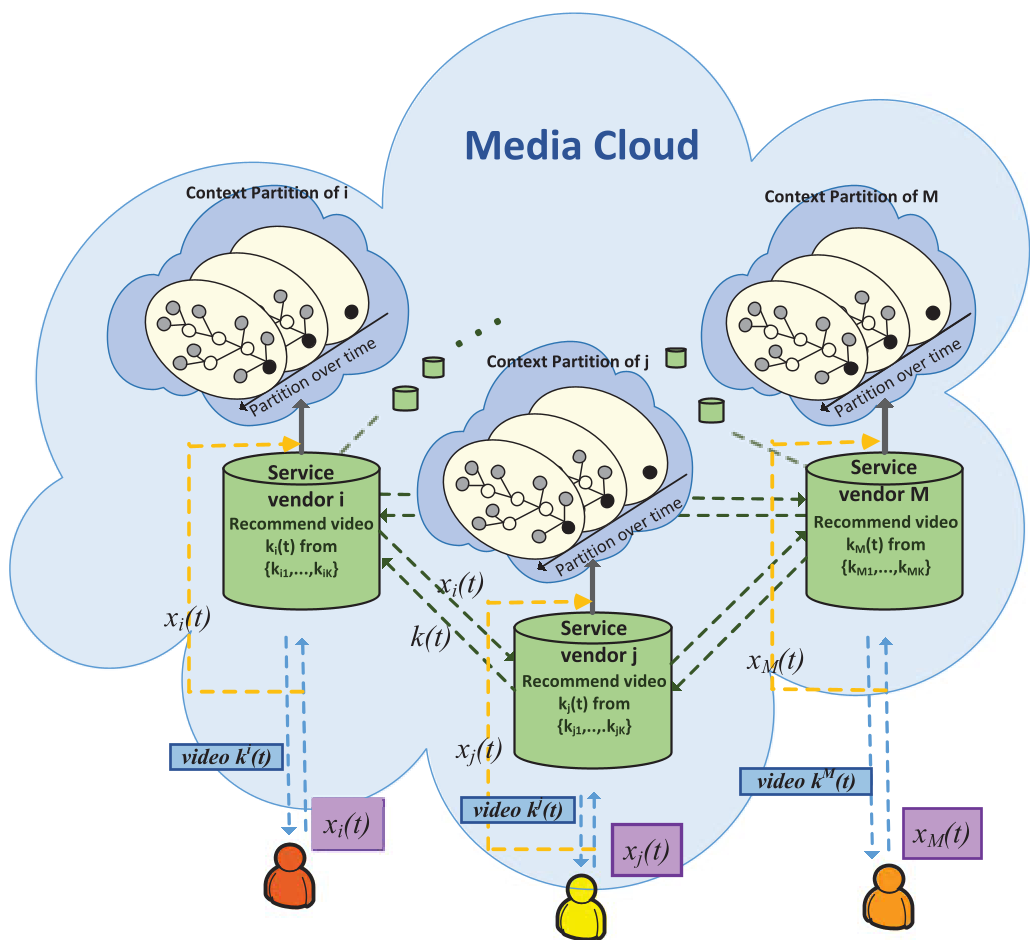
The core innovation lies in treating recommendation as a Distributed Contextual Bandit problem.
1. Adaptive Space Partitioning
To handle the "curse of dimensionality," the system doesn't use a static lookup table. Instead, it dynamically splits the -dimensional hypercube (context space) into smaller subspaces based on user traffic. If a subspace receives enough data, it is partitioned further ( sub-hypercubes), allowing the model to "zoom in" on user interests.
2. The Dual-Privacy Framework
The system protects two distinct parties:
- User Privacy (Exponential Mechanism): Instead of deterministically picking the best video, the server selects a video with a probability proportional to . This prevents an adversary from reverse-engineering a user's features from the recommendation output.
- Vendor Privacy (Laplace Mechanism + Tree Aggregation): Vendors share rewards to cooperate but add Laplace noise to their revenue gains. A tree-based aggregation method is used to keep the added noise low even under continual observation over time.
3. Geometric Differential Privacy (The "Secret Sauce")
The "Geometric" insight is that not all context subspaces are equal. In dense areas of the context space, the system can afford to be more private (add more noise) because the large sample size masks the noise. In sparse areas, it adjusts the privacy level () to protect utility. Specifically, is increased as the partition level increases, minimizing the "Regret" (performance loss).
Experimental Validation
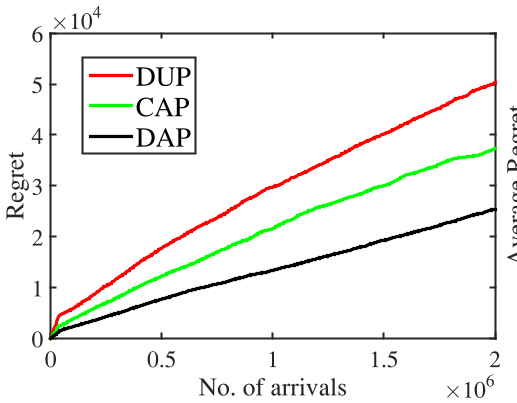
Using 578,000 real-world user context vectors (13,900-dimensional) from Sina Microblog, the researchers compared their approach (DAP) against Centralized (CAP) and Uniform Partitioning (DUP) models.
- Convergence: The "Regret" (the gap between the algorithm and an omniscient optimal strategy) is sublinear, meaning the system learns the optimal strategy quickly.
- Privacy-Utility Tradeoff: Even with a high privacy level (), the system maintains an accuracy of roughly 80%. When using the Geometric model (GP-DAP), this accuracy jumps to 88.17%.
Critical Insight & Conclusion
The true value of this paper is the Geometric DP model. In most academic DP papers, is a static global constant. Here, by making a function of the data's geometric distribution (density), the authors bridged the gap between theoretical privacy and industrial-grade accuracy.
Limitations: The model assumes a fixed network of service vendors; in highly dynamic cloud environments where vendors constantly join or leave, a more flexible ad-hoc distributed consensus might be required.
Future Impact: This framework is not limited to video. It can be applied to any high-dimensional "Big Data" recommendation task, such as location-based services or healthcare product suggestions, where user attributes are inherently sensitive.